
Inquiry · Philosophy of inquiry
Dialectical Inquiry: Generating Knowledge Through the Synthesis of Opposites
Dialectical inquiry generates knowledge by setting opposing positions against each other and building something better from the conflict. This article traces the idea from Socrates and Hegel to strategic planning, reviews the experimental evidence and explains how to use it.
Most organisations try to reach decisions by building agreement. Dialectical inquiry deliberately does the opposite. It takes a proposal, constructs the strongest possible opposing proposal, and sets the two against each other in the expectation that the conflict will expose hidden assumptions and produce a better understanding than either side started with. The idea has a long philosophical history, from the question-and-answer method of Socrates to the grand system of Hegel, and in the late twentieth century it was turned into a practical technique for strategic planning and tested in dozens of experiments. This article explains the idea, the evidence and how to use it well.
Ancient roots: dialectic as reasoned dialogue
The Greek word dialektikē referred to the art of conversation, specifically of reasoning by question and answer. In Plato's dialogues, Socrates examines a claim by drawing out its consequences until they conflict with other things the speaker believes (Plato, 1997). Dialectic in this sense is a way of testing ideas through structured disagreement. Aristotle (1984) gave it a more formal treatment in the Topics, describing it as reasoning from opinions that are generally accepted, and recommending it as a way of exploring both sides of a question and so detecting where truth and error lie. For both philosophers, dialectic was a method of inquiry: a way of moving from opinion towards knowledge by exposing contradictions.
Hegel and the dialectic of history
The modern meaning of "dialectical" comes mainly from the German philosopher G. W. F. Hegel. In the Phenomenology of Spirit, Hegel (1807/1977) described how forms of consciousness and of social life develop through internal conflict: each position, pursued consistently, generates tensions that it cannot resolve on its own terms, and these are overcome in a richer position that preserves what was true in the earlier ones. Hegel's term for this overcoming, Aufhebung, means at once to cancel, to preserve and to lift up. Frederick Beiser (2005) emphasises that, for Hegel, contradiction was not a sign of failure but the engine by which understanding grows.
A famous illustration is Hegel's account of lordship and bondage. Two self-conscious beings each seek recognition from the other; one wins and becomes master, the other becomes servant. But the master's victory proves hollow, since recognition from someone he regards as a mere instrument is worthless, while the servant, through working on the world, develops a self-understanding the master lacks (Hegel, 1807/1977). Neither position is stable, and the tension pushes towards a form of mutual recognition that neither side started with. Whatever one makes of the argument, it shows the dialectical pattern clearly: a position is not refuted from outside but undone by the consequences of its own success.
Hegel is often credited with the formula "thesis, antithesis, synthesis". He did not use it. Gustav Mueller (1958) showed that the formula comes from Fichte and was attached to Hegel by later commentators, a "legend" that oversimplifies a much more complex view. Hegel's dialectic was later adapted by Karl Marx into a theory of historical change driven by economic conflict. Karl Popper (1940) criticised dialectical philosophy for treating contradictions as acceptable and so making theories impossible to refute. He argued that the useful core of dialectic is simpler: the method of trial and error, in which criticism of a theory leads to a better one.
Popper's point is the one that matters for practical inquiry. Stripped of its metaphysics, the dialectical idea is that opposing views, taken seriously, can reveal what each one misses, and that a better position can be built from the conflict.
From philosophy to inquiring systems
In 1971 the systems scientist C. West Churchman published The Design of Inquiring Systems, which described several ideal types of inquiry, each named after a philosopher (Churchman, 1971). One was the "Hegelian inquiring system". In it, the same body of data is interpreted by two opposing world views, each of which makes the data appear to support its own conclusion. A "grand observer" watches the debate and forms a new view that accounts for what each side gets right. Churchman's insight was that data rarely speak for themselves; they are interpreted through assumptions, and the best way to bring those assumptions into view is to watch a rival set of assumptions interpret the same data.
Dialectical inquiry in strategic planning
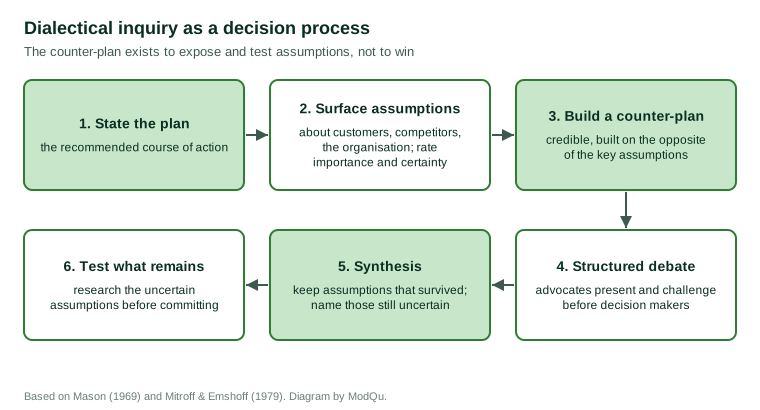
Churchman's student Richard Mason turned the Hegelian system into a planning method. Working with a company that faced a major decision about its future, Mason (1969) compared two approaches. In the "expert" approach, planners developed a recommended plan and presented it. In the "dialectical" approach, planners identified the assumptions underlying the recommended plan, constructed a credible counter-plan based on opposite assumptions, and had advocates debate the two plans before managers. Mason reported that the dialectical approach brought hidden assumptions into the open and led managers to a richer understanding of the decision.
Ian Mitroff and colleagues developed the method into Strategic Assumption Surfacing and Testing (Mitroff & Emshoff, 1979; Mitroff et al., 1979). Groups identify the stakeholders whose behaviour a plan depends on, list the assumptions the plan makes about each, rate those assumptions for importance and certainty, and then focus debate on assumptions that are both important and uncertain. Figure 1 shows the core of the process.
What the experiments show
Because dialectical inquiry makes specific claims about improving decisions, researchers tested it in laboratory and field experiments, usually comparing it with two alternatives: devil's advocacy, in which a critic attacks a plan's assumptions without offering a counter-plan, and consensus, in which a group simply discusses until it agrees.
Early experiments were promising for structured conflict in general. Cosier (1978) found that participants exposed to criticism of a plan made more accurate predictions than those given only supporting arguments. Schweiger et al. (1986) compared the three approaches in groups of managers working on a business case. Both dialectical inquiry and devil's advocacy produced higher-quality recommendations and assumptions than consensus, although members of the consensus groups were more satisfied with the process and more willing to continue working together. A follow-up study found that these differences persisted when groups worked on several cases over time (Schweiger et al., 1989).
Charles Schwenk (1990) combined the available studies in a meta-analysis. Both dialectical inquiry and devil's advocacy improved decisions compared with expert approaches that presented a single recommended plan. Devil's advocacy appeared, if anything, slightly more effective than dialectical inquiry, and Schwenk suggested that its advantage might lie in its simplicity: building a full counter-plan is laborious, and a poor counter-plan may be dismissed too easily.
The broader research on team conflict adds an important qualification. In a meta-analysis of team studies, De Dreu and Weingart (2003) found that both relationship conflict and task conflict were, on average, associated with lower team performance and satisfaction. The benefits of structured debate appear to depend on keeping conflict focused on ideas and on a shared goal, rather than on people. Dialectical inquiry works by institutionalising disagreement in a way that is clearly about the plan, which may be why it succeeds where unstructured conflict does not.
Why opposition improves inquiry
Psychology offers several explanations for why structured opposition helps. Irving Janis (1972) documented how cohesive policy groups, such as the planners of the Bay of Pigs invasion, suppressed doubts and converged on flawed decisions, a pattern he called groupthink. Dialectical methods are designed to make dissent a role rather than a risk.
Mercier and Sperber (2011) proposed that human reasoning evolved primarily for argument: to produce reasons that persuade others and to evaluate others' reasons. People are poor at finding flaws in their own arguments but good at finding flaws in other people's. If this is right, inquiry works best when people with different views examine each other's reasoning, which is exactly what dialectical methods arrange.
A striking test of this idea comes from the Wason selection task, a logic puzzle that most individuals get wrong. Moshman and Geil (1998) found that only about one in ten students solved it working alone, but around three-quarters of small groups solved it after discussion. Groups did not simply adopt the majority's first answer; members argued, and correct reasoning tended to win when it was challenged and defended. The result illustrates the core claim of dialectical inquiry in miniature: exchange between people who initially disagree can reach answers that no individual reached alone.
There is, however, a difference between assigned and genuine disagreement. Nemeth et al. (2001) found that authentic dissent, from someone who actually holds the opposing view, stimulated more original thinking than a devil's advocate playing a role, even when the arguments were the same. Role-played opposition is better than none, but it should be designed to feel real, for example by having advocates prepare their positions in earnest.
Dialectic in analysis: competing hypotheses
Intelligence analysts face a version of the same problem. Evidence is usually ambiguous, and an analyst who settles early on one explanation tends to read later evidence as support for it. Richards Heuer, a veteran of the US Central Intelligence Agency, proposed the Analysis of Competing Hypotheses as a remedy (Heuer, 1999). The analyst lists every plausible explanation, sets out the evidence in a matrix against all of them at once, and looks above all for evidence that is inconsistent with each hypothesis, since evidence consistent with several hypotheses cannot distinguish between them. The hypothesis with the least evidence against it, rather than the one with the most evidence for it, is tentatively preferred.
The method is dialectical in spirit even though one person can apply it: each hypothesis is made to confront the others over the same body of evidence, exactly as Churchman's opposing world views confront the same data. It also shows how dialectical inquiry can be made routine rather than reserved for major strategic decisions. Any research team interpreting an unexpected result can ask what the strongest rival explanation would be and what evidence would separate the two.
Adversarial collaboration
A recent descendant of dialectical inquiry is adversarial collaboration, in which researchers who disagree about a finding design a study together, agreeing in advance what result would favour each side. Mellers et al. (2001) used the method to resolve a dispute about whether presenting probabilities as frequencies eliminates a well-known reasoning error. Kahneman and Klein (2009), who had come from opposing traditions in the study of expert intuition, wrote a joint paper identifying the conditions under which intuitive expertise can be trusted, and found that they agreed more than either had expected. The method keeps the core of dialectic, two committed positions confronting the same evidence, while building in an agreed test.
Synthesis without compromise
The aim of dialectical inquiry is not a compromise that splits the difference, but a synthesis that keeps what is right in each position. Organisational researchers have developed this idea in theories of paradox. Smith and Lewis (2011) argue that many organisational tensions, such as between exploiting current strengths and exploring new opportunities, cannot be resolved once and for all and must be managed by holding both demands in view. Roger Martin (2007) studied successful leaders and described "integrative thinking": the ability to hold two opposing models in mind and create a new model that contains elements of both but is superior to each.
In education, David and Roger Johnson developed a related method called constructive controversy, in which students research and argue one side of an issue, then switch sides, and finally work together to reach a joint position. Their review of the research found that this approach produced higher achievement, better reasoning and more positive relationships than either debate, in which one side wins, or concurrence-seeking discussion (Johnson & Johnson, 2009).
Philip Tetlock's work on integrative complexity gives this quality a measurable form. Suedfeld and Tetlock (1977) coded the communications of national leaders during international crises and found that crises ending in war were preceded by a fall in the complexity of leaders' statements: less recognition of other perspectives and less integration of competing considerations. The capacity for synthesis seems to matter most precisely when stakes are high.
A worked example
Consider a retailer whose leadership team favours opening a chain of large out-of-town stores. The plan rests on several assumptions: that customers will drive to the stores, that the range advantage of large stores will outweigh convenience, that rents will remain affordable, and that online competitors will not undercut the chain on the same products.
In a dialectical exercise, a second team is asked to build the best possible case for the opposite strategy: a network of small urban stores combined with fast home delivery. To make that case, they must assume the reverse: that customers value convenience over range, that city-centre traffic will continue to fall, and that online competitors will dominate wide-range retail. Presented side by side, the two plans make visible what the original planners had taken for granted. Debate quickly shows that the assumption about customers' willingness to drive is both critical and uncertain, while the rent assumption is critical but well supported by existing leases.
The synthesis need not adopt either plan. It might recommend a smaller number of large stores in locations with demonstrated drive-in demand, combined with a delivery service, and it would identify the key uncertainty for research: how far customers in each catchment area are actually prepared to travel. The dialectic has not answered the strategic question on its own, but it has converted a confident plan into a sharper question that evidence can settle.
Limits and risks
Dialectical inquiry has costs. It takes time and effort, and a poorly constructed counter-plan can make the original plan look stronger than it is. It can also harden positions if advocates come to identify with their sides, which is why the method requires a clear separation between the debate and the decision. Popper's (1940) warning also applies: the aim is to find out which assumptions are false, not to celebrate contradiction. A synthesis that simply accommodates everything has not learned anything.
Using dialectical inquiry in practice
A practical version of the method can be run in a few hours:
- State the proposal clearly and list the assumptions it depends on, especially about customers, competitors and the organisation itself.
- Rate the assumptions by how important they are to the plan and how certain they are. Focus on those that are important and uncertain.
- Build a credible alternative based on the opposite of the key assumptions, and assign people to develop it seriously.
- Debate before decision makers, with each side presenting its case and challenging the other's assumptions.
- Construct a synthesis that keeps the assumptions that survived and identifies those that remain uncertain.
- Test what remains uncertain with research before committing, so the conflict leads to new evidence rather than just new opinions.
Three practical points improve the results. Choose advocates who can make the counter-plan credible, ideally people who partly believe it. Keep the decision makers separate from the advocates, so that the debate informs a judgement rather than becoming a contest. And record the assumptions that were challenged, so that they can be revisited when circumstances change.
Conclusion
From Socratic dialogue to strategic planning, dialectical inquiry rests on one durable insight: we see the assumptions behind a position most clearly when a serious alternative is set beside it. The experimental evidence shows that structured opposition, whether a full counter-plan or a determined critic, produces better decisions than seeking agreement too early, provided the conflict stays focused on ideas. The lesson for research teams is straightforward. When a conclusion seems obvious, it is worth asking who would argue against it and on what assumptions, and then giving that argument a fair hearing before the conclusion is reported. Used that way, disagreement becomes one of the most productive resources an inquiry has.
References
Aristotle. (1984). The complete works of Aristotle: The revised Oxford translation (J. Barnes, Ed.; Vols. 1–2). Princeton University Press.
Beiser, F. C. (2005). Hegel. Routledge.
Churchman, C. W. (1971). The design of inquiring systems: Basic concepts of systems and organization. Basic Books.
Cosier, R. A. (1978). The effects of three potential aids for making strategic decisions on prediction accuracy. Organizational Behavior and Human Performance, 22(2), 295–306. https://doi.org/10.1016/0030-5073(78)90018-1
De Dreu, C. K. W., & Weingart, L. R. (2003). Task versus relationship conflict, team performance, and team member satisfaction: A meta-analysis. Journal of Applied Psychology, 88(4), 741–749. https://doi.org/10.1037/0021-9010.88.4.741
Hegel, G. W. F. (1977). Phenomenology of spirit (A. V. Miller, Trans.). Oxford University Press. (Original work published 1807)
Heuer, R. J., Jr. (1999). Psychology of intelligence analysis. Center for the Study of Intelligence, Central Intelligence Agency.
Janis, I. L. (1972). Victims of groupthink: A psychological study of foreign-policy decisions and fiascoes. Houghton Mifflin.
Johnson, D. W., & Johnson, R. T. (2009). Energizing learning: The instructional power of conflict. Educational Researcher, 38(1), 37–51. https://doi.org/10.3102/0013189X08330540
Kahneman, D., & Klein, G. (2009). Conditions for intuitive expertise: A failure to disagree. American Psychologist, 64(6), 515–526. https://doi.org/10.1037/a0016755
Martin, R. L. (2007). The opposable mind: How successful leaders win through integrative thinking. Harvard Business School Press.
Mason, R. O. (1969). A dialectical approach to strategic planning. Management Science, 15(8), B403–B414. https://doi.org/10.1287/mnsc.15.8.B403
Mellers, B., Hertwig, R., & Kahneman, D. (2001). Do frequency representations eliminate conjunction effects? An exercise in adversarial collaboration. Psychological Science, 12(4), 269–275. https://doi.org/10.1111/1467-9280.00350
Mercier, H., & Sperber, D. (2011). Why do humans reason? Arguments for an argumentative theory. Behavioral and Brain Sciences, 34(2), 57–74. https://doi.org/10.1017/S0140525X10000968
Mitroff, I. I., & Emshoff, J. R. (1979). On strategic assumption-making: A dialectical approach to policy and planning. Academy of Management Review, 4(1), 1–12. https://doi.org/10.5465/amr.1979.4289166
Mitroff, I. I., Emshoff, J. R., & Kilmann, R. H. (1979). Assumptional analysis: A methodology for strategic problem solving. Management Science, 25(6), 583–593. https://doi.org/10.1287/mnsc.25.6.583
Moshman, D., & Geil, M. (1998). Collaborative reasoning: Evidence for collective rationality. Thinking & Reasoning, 4(3), 231–248. https://doi.org/10.1080/135467898394148
Mueller, G. E. (1958). The Hegel legend of "thesis-antithesis-synthesis." Journal of the History of Ideas, 19(3), 411–414. https://doi.org/10.2307/2708045
Nemeth, C., Brown, K., & Rogers, J. (2001). Devil's advocate versus authentic dissent: Stimulating quantity and quality. European Journal of Social Psychology, 31(6), 707–720. https://doi.org/10.1002/ejsp.58
Plato. (1997). Complete works (J. M. Cooper, Ed.). Hackett.
Popper, K. R. (1940). What is dialectic? Mind, 49(196), 403–426. https://doi.org/10.1093/mind/XLIX.196.403
Schweiger, D. M., Sandberg, W. R., & Ragan, J. W. (1986). Group approaches for improving strategic decision making: A comparative analysis of dialectical inquiry, devil's advocacy, and consensus. Academy of Management Journal, 29(1), 51–71. https://doi.org/10.5465/255859
Schweiger, D. M., Sandberg, W. R., & Rechner, P. L. (1989). Experiential effects of dialectical inquiry, devil's advocacy, and consensus approaches to strategic decision making. Academy of Management Journal, 32(4), 745–772. https://doi.org/10.5465/256567
Schwenk, C. R. (1990). Effects of devil's advocacy and dialectical inquiry on decision making: A meta-analysis. Organizational Behavior and Human Decision Processes, 47(1), 161–176. https://doi.org/10.1016/0749-5978(90)90051-A
Smith, W. K., & Lewis, M. W. (2011). Toward a theory of paradox: A dynamic equilibrium model of organizing. Academy of Management Review, 36(2), 381–403. https://doi.org/10.5465/amr.2011.59330958
Suedfeld, P., & Tetlock, P. (1977). Integrative complexity of communications in international crises. Journal of Conflict Resolution, 21(1), 169–184. https://doi.org/10.1177/002200277702100108