
Share how you play
Tell us how often you play board games, card games or puzzles, which ones you own and what you spend. Your answers are combined with other people's and reported only as totals.
Start the board games and puzzles surveyAbout 5 minutes. No account needed. You can stop at any time.
What board games and puzzles cover
This topic covers games and puzzles played with physical pieces, usually at a table:
- Board games, played on a board with pieces, from chess and backgammon to modern strategy games.
- Card games, with standard decks or special cards, from traditional games to collectible card games.
- Tile and dice games, such as dominoes, mahjong and many dice games.
- Party games, such as word, drawing and guessing games for groups.
- Role-playing games, in which players take on characters in a story led by a game master.
- Jigsaw puzzles, from small children's puzzles to puzzles with thousands of pieces.
- Logic and paper puzzles, such as crosswords, sudoku and word searches.
- Mechanical puzzles, such as twisting cubes and interlocking wooden puzzles.
Traditional games around the world
Many games have long histories and are linked with particular regions:
- Chess, which developed from earlier games in India and Persia and is now played worldwide.
- Go, from China, also popular in Japan and Korea.
- Mahjong, a tile game from China, played widely across Asia and beyond.
- Mancala games, a family of games played with seeds or stones in pits, found across Africa, the Middle East and South Asia.
- Backgammon, one of the oldest known board games, popular in the Middle East and the Mediterranean.
- Carrom, a tabletop game popular in South Asia.
- Card games that differ by country, with local decks and rules.
These games are often played in public places, such as parks, cafés and clubs, as well as at home.
Example
Two retired neighbours meet every afternoon in a local park to play chess. Other people stop to watch, and over the summer a small group forms, bringing extra boards and taking turns.
Modern board games
Since the 1990s, a large market for new board games has grown, often called hobby or modern board games. Common features include:
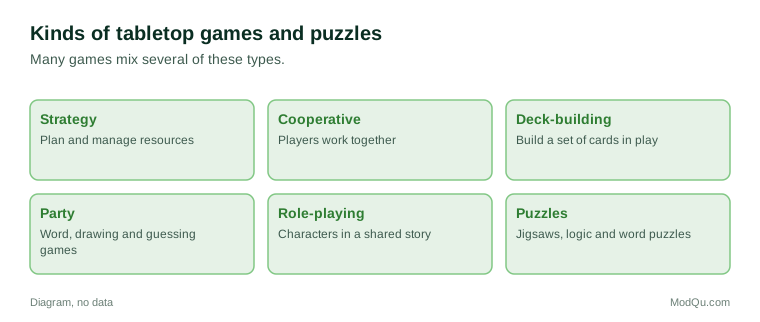
- Strategy games, where players plan and manage resources.
- Cooperative games, where players work together against the game rather than each other.
- Deck-building games, where players build a set of cards as they play.
- Legacy games, which change permanently as they are played over many sessions.
- Short family games, quick to learn and play.
- Solo modes, for people who play alone.
New games are often funded through crowdfunding campaigns, where buyers pay in advance. Large conventions bring together players, designers and publishers.
Who plays and where
People play board games and puzzles with family, friends, partners, children and strangers. Places to play include:
- At home, the most common place.
- Board game cafés, which charge a fee to play from a library of games.
- Clubs and meet-up groups.
- Libraries, some of which lend games.
- Schools and community centres.
- Tournaments, for games such as chess, bridge and some card games.
- Online versions of physical games.
Example
A group of colleagues visit a board game café after work. They pay a cover charge each, and staff recommend a cooperative game they can learn in ten minutes. Two of them later buy their own copy to play at home.
Jigsaws and paper puzzles
Jigsaw puzzles appeal to people of all ages. Some people complete them alone as a quiet activity; others work on them with family over several days. Puzzles range from 100 to more than 1,000 pieces, and some people glue and frame finished puzzles. Puzzle swaps and second-hand sales are common, because a finished puzzle may not be done again.
Crosswords, sudoku and word puzzles are published in newspapers, magazines, books and apps. Many people complete them daily as a routine.
Buying games and what they cost
People buy games from toy shops, specialist game shops, bookshops, supermarkets, online retailers and second-hand sellers. Prices range from very cheap card games to large strategy games with many pieces. Points people weigh include:
- Number of players and play time.
- How hard the rules are to learn.
- Age range.
- Reviews, videos and recommendations.
- Replay value, whether the game stays interesting.
- Price and component quality.
- Storage space, as collections can grow large.
Example (hypothetical figures)
A family buys four games in a year: two at 25 each in their local currency, one at 40 and one at 60, a total of 150. They play the cheaper games about 20 times each and the others about 5 times each, so 50 plays in all. That works out at 3 per play for the year.
Benefits people mention
Players often mention benefits such as:
- Time together away from screens.
- Social contact and conversation.
- Mental challenge and problem-solving.
- Learning skills such as counting, reading and taking turns for children.
- Relaxation, especially with puzzles.
Researchers have studied games and puzzles in relation to thinking skills and wellbeing, with mixed findings, so claims that particular games improve memory or prevent decline are often debated.
Trends and debates
Current trends include:
- Growth of board game cafés and game nights.
- Crowdfunded games with many add-ons and high prices.
- Apps and hybrid games, which mix physical pieces with digital tools.
- Revival of traditional games, including chess after popular online and screen interest.
- Second-hand markets and game libraries.
- More diverse game themes and designers.
People debate the cost of some modern games, the space they take up, and whether online play replaces or adds to playing in person.
What people and businesses want to know
Questions businesses want answered include how often people play board games, cards and puzzles, who they play with, which games they own, where they buy them, what they spent last year, and what makes them try a new game.
Key terms
- Board gameA game played on a board with pieces, following set rules.
- Cooperative gameA game in which players work together against the game.
- Deck-building gameA game in which players add cards to their deck as they play.
- Legacy gameA game that changes permanently over many sessions.
- Game masterThe person who leads the story in a role-playing game.
- MancalaA family of games played by moving seeds or stones between pits.
- CrowdfundingRaising money from many buyers in advance to produce a product.
- Replay valueHow interesting a game stays after many plays.
Full glossary: game development terms on EditingTests.com.
Board games and puzzles vocabulary test
How well do you know the language of this topic? Try 8 quick questions. Your score is shown straight away and is not saved.
What the board games and puzzles survey asks
This survey is part of ModQu's Leisure and Lifestyle survey. The board games and puzzles part takes about five minutes and covers:
- How often you play board games, card games or puzzles, and which kinds.
- Who you play with and where, such as at home, in cafés or clubs.
- Which games you own, and how many you play regularly.
- How much you spent on games and puzzles in the last year, and where you bought them.
- What makes you choose or try a new game.
- Whether you play online versions of board or card games.
After that you can choose to continue with other short parts of the Leisure and Lifestyle survey, such as gambling and lotteries or cannabis, or stop.
Ready to take part?
Your answers help show what people really think and do. Results are only ever reported as totals; no one can see your individual answers.
Start the surveyQuestions about this survey
Who can take part?
Adults.
Do I have to give my name?
No. You may be asked for your age group, region and similar details so results can be broken down, but not your name. ModQu never asks for passwords, card numbers or account numbers.
How are the results used?
Answers are combined into totals and percentages and published in ModQu reports. Individual answers are never shown.
Is the vocabulary test part of the survey?
No. It is optional and separate, and your score is not stored.
What is a good first modern board game for a family?
Many families start with short games that take under an hour, have simple rules and suit a wide age range. Shops and game cafés often recommend titles for beginners.