
Share your experience of extreme weather
Tell us whether extreme weather has affected you, how prepared you are and whether you are insured. Your answers are combined with other people's and reported only as totals.
Start the weather and extreme events surveyAbout 5 minutes. No account needed. You can stop at any time.
What extreme weather covers
Extreme weather means weather that is much more severe than usual for a place and time of year, or severe enough to cause damage, disruption or harm. In Canada, the main types are:
- Floods, from rivers rising in spring, heavy rain overwhelming storm drains, coastal storm surges or ice jams.
- Severe storms, including thunderstorms, hail, tornadoes, ice storms, blizzards and, on the east coast, the remains of hurricanes.
- Extreme heat, especially long heat waves with warm nights.
- Extreme cold and wind chill.
- Wildfires, which can force evacuations and spread smoke far away.
- Drought, which affects farms, water supplies and fire risk.
Other countries face similar events, along with hazards such as tropical cyclones and monsoon floods. Scientific assessments report that climate change is making some kinds of extreme weather, such as heat waves and heavy rainfall, more frequent or intense in many regions.
How warnings work
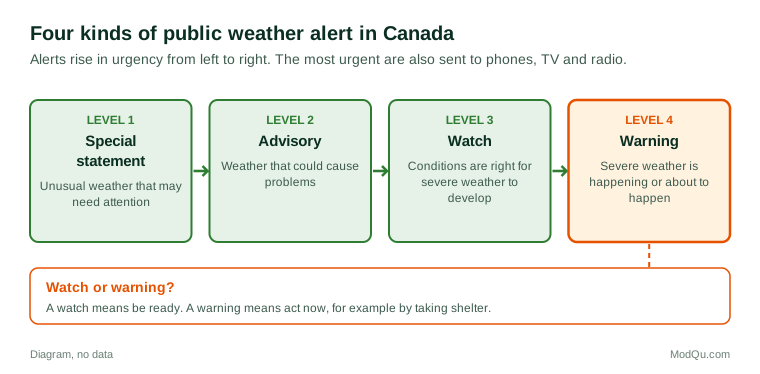
In Canada, Environment and Climate Change Canada issues public weather alerts. The main kinds are:
- Special weather statements, for unusual weather that may need attention.
- Advisories, for weather that is less severe but could still cause problems.
- Watches, when conditions are favourable for severe weather to develop.
- Warnings, when severe weather is happening or about to happen.
The national public alerting system, Alert Ready, sends the most urgent alerts, such as tornado warnings and evacuation orders, to televisions, radios and compatible mobile phones. In the United States, the National Weather Service issues watches and warnings, and Wireless Emergency Alerts send urgent messages to phones.
Example
A family camping in a provincial park receives a phone alert for a tornado warning in their area. They had thought a watch and a warning were the same thing. They take shelter in the park's concrete washroom building, as the alert advises. Later they look up the difference: a watch means conditions could produce a tornado; a warning means one is happening or about to.
Being prepared at home
Public safety agencies such as Public Safety Canada and the Canadian Red Cross encourage households to be ready to look after themselves for at least 72 hours in an emergency. Common steps include:
- An emergency kit with water, food that does not spoil, a flashlight, a battery or crank radio, spare batteries, a first aid kit, medications, copies of important documents and some cash.
- A household plan that says where to meet, who to call and how to leave.
- Knowing local risks, such as whether the home is in a flood zone or a wildfire interface area.
- Signing up for local alerts from the municipality.
- Planning for people and pets who need extra help, such as older relatives, people with disabilities and animals.
Many people intend to make a kit but have not done it, or have one that is out of date.
Example (hypothetical figures)
A household of three plans water for 72 hours using the common guide of 2 litres of drinking water per person per day, plus extra for cooking and washing. Drinking water alone comes to 2 × 3 × 3 = 18 litres. They buy four 5-litre jugs, giving 20 litres, and add a reminder in their calendar to replace the water once a year.
Protecting the home
Households also take steps to reduce damage to the home itself:
- Floods: installing a sump pump and backup battery, a backwater valve to stop sewer water flowing in, sloping ground away from the house, extending downspouts and keeping valuables out of the basement.
- Wildfire: clearing dry brush and debris near the house, using fire-resistant roofing and keeping gutters clear, following programs such as FireSmart in Canada.
- Storms: trimming trees near the house, securing outdoor furniture and having a backup power plan.
- Heat: shades and blinds, fans, air conditioning or a heat pump, and knowing where nearby cooling centres are.
Insurance
Home insurance is a large part of how households recover from extreme weather, and many people are not sure what their policy covers. Points that often cause confusion include:
- Overland flooding, when water enters from the surface such as an overflowing river, is often an optional add-on in Canada and may not be available in high-risk areas.
- Sewer backup coverage is also often a separate option.
- Wind, hail and fire damage is usually covered in standard home policies.
- Deductibles may be higher for some kinds of weather damage.
- Additional living expenses, such as hotel costs during repairs or an evacuation, may be covered up to a limit.
Governments in Canada have discussed a national flood insurance program for high-risk homes, and provinces offer disaster financial assistance after major events for some losses that cannot be insured.
Example
After heavy rain, water comes up through a basement floor drain in a family's home. They assume their insurance will cover it. Their policy covers sewer backup but not overland flooding. The adjuster finds that the water came from the sewer, so most of the claim is covered, minus a deductible. A neighbour without sewer backup coverage is not covered at all.
Living through an event and recovering
People who have lived through an extreme weather event often describe the same stages: warnings, the event itself, possible evacuation, cleaning up, dealing with insurance and government programs, repairs and a long period of stress. Common difficulties include:
- not knowing when it is safe to return home;
- losing power for days, which affects heating, cooling, food and medical equipment;
- finding contractors after a disaster, and avoiding unlicensed or fraudulent ones;
- the cost of repairs that are not covered;
- the emotional toll on adults and children, which can last long after the repairs.
Example
A couple evacuated from a wildfire spend ten days in a hotel two hours away. Their home survives, but smoke damage means every room must be cleaned. They keep receipts for all costs, which their insurer later reimburses under additional living expenses. They say the hardest part was not knowing for several days whether the house was still standing.
What people disagree about
People disagree about how much extreme weather is linked to climate change, whether people should be allowed to rebuild in high-risk areas, who should pay for flood protection and disaster recovery, and how much governments should spend on preparing for future events. Questions that businesses and governments want answered include whether people have been affected by extreme weather recently, whether they have an emergency kit, and whether they have flood insurance.
Key terms
- Weather watchA notice that conditions are favourable for severe weather to develop.
- Weather warningA notice that severe weather is happening or about to happen.
- Overland floodingFlooding from surface water, such as an overflowing river or lake, entering a home.
- Sewer backupWater from the sewer system flowing back into a building through drains.
- Backwater valveA device that stops sewer water from flowing back into a home.
- Emergency kitA supply of water, food and essentials to last at least 72 hours.
- DeductibleThe amount a policyholder pays before insurance covers the rest of a claim.
- Evacuation orderAn official instruction to leave an area because of danger.
Full glossary: climate risk analytics terms on EditingTests.com.
Weather and extreme events vocabulary test
How well do you know the language of this topic? Try 8 quick questions. Your score is shown straight away and is not saved.
What the weather and extreme events survey asks
This survey is part of ModQu's Energy and Environment survey. The weather and extreme events part takes about five minutes and covers:
- Whether you have been affected by extreme weather in the last two years, and how.
- Which kinds of extreme weather worry you most where you live.
- Whether you have an emergency kit and a household plan.
- What you have done to protect your home from floods, fire, storms or heat.
- Whether you have flood or sewer backup insurance, and how sure you are about your coverage.
- How you receive weather alerts and how much you trust them.
After that you can choose to continue with other short parts of the Energy and Environment survey, such as home energy use and bills or solar power at home, or stop.
Ready to take part?
Your answers help show what people really think and do. Results are only ever reported as totals; no one can see your individual answers.
Start the surveyQuestions about this survey
Who can take part?
Adults.
Do I have to give my name?
No. You may be asked for your age group, region and similar details so results can be broken down, but not your name. ModQu never asks for passwords, card numbers or account numbers.
How are the results used?
Answers are combined into totals and percentages and published in ModQu reports. Individual answers are never shown.
Is the vocabulary test part of the survey?
No. It is optional and separate, and your score is not stored.