
Share your experience of video games
Tell us where you play, what you spend and what you think about game subscriptions and in-game purchases. Your answers are combined with other people's and reported only as totals.
Start the video games surveyAbout 5 minutes. No account needed. You can stop at any time.
What this topic covers
This topic covers playing video games for fun, on any device:
- Consoles connected to a television, and handheld consoles.
- Computers, including gaming PCs and laptops.
- Phones and tablets, where many people play short casual games.
- Cloud gaming, where a game runs on a remote server and streams to the player's screen.
- Virtual reality, using a headset.
It also covers how games are bought and paid for, playing online with others, and how families manage gaming. Watching other people play and competitive esports are covered on the esports and game streaming page.
Who plays
Gaming is no longer mainly a pastime for teenage boys. Adults of all ages play, and a large share of players are women. What differs is how and what people play:
- Casual players play puzzle, word and card games on phones in short sessions.
- Regular players have a console or computer and play a few times a week.
- Dedicated players spend many hours a week, follow new releases and may own several devices.
- Social players mainly play with friends or family, online or in the same room.
- Lapsed players played a lot when younger and now play rarely.
Many people who play phone games every day do not call themselves "gamers", which matters when a survey asks about gaming. Asking about specific activities, such as playing a puzzle game on a phone, gives a fuller picture than asking whether someone is a gamer.
Example
A grandmother plays a word game on her tablet every morning with her coffee and a match-three puzzle game in the evening. When her grandson asks whether she plays video games, she says no. When he points to the tablet, she laughs and says she plays "about an hour a day".
How games are paid for
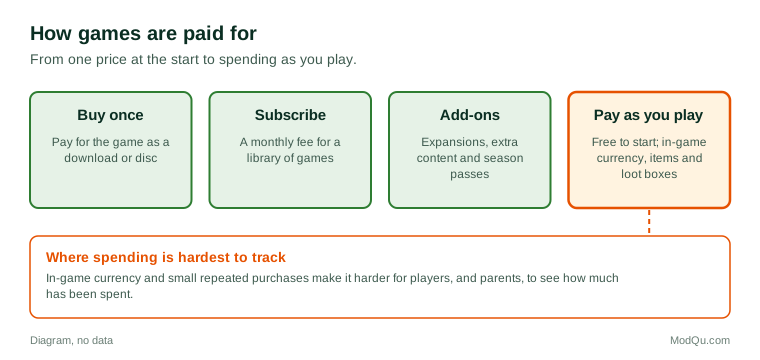
Games are sold and funded in several ways:
- Buying a game outright, as a download or on a disc.
- Free-to-play games, which cost nothing to download and earn money from in-game purchases or ads.
- Subscriptions that give access to a library of games for a monthly fee, and often online play.
- Expansions and downloadable content (DLC) that add new levels, characters or stories.
- Season or battle passes that unlock rewards over a few months of play.
- In-game currency, bought with real money and spent on items.
Players often weigh the price of a new game against how many hours they expect to play it. A long game played for months can feel like better value than a short one at the same price.
Example (hypothetical figures)
A player pays $90 for a new game and plays it for 120 hours over a year, about 75 cents an hour. They also pay $15 a month for a game subscription and play 60 hours of games from its library over the year. The subscription costs $180, or $3 an hour, so they decide to cancel it and buy games one at a time.
In-game purchases and loot boxes
In-game purchases range from cosmetic items, such as outfits for a character, to items that make a player stronger. Some games sell loot boxes: random packs of items bought with real or in-game money, where the player does not know what they will get.
Loot boxes are controversial because they work in a way that resembles gambling. Some countries have restricted or regulated them, and some game stores and rating bodies now require games to warn buyers that they include paid random items. Parents often worry about children spending money without understanding it, especially when in-game currency hides the real price.
Example
A nine-year-old spends $70 on in-game currency over a weekend using a parent's saved card on a console. The parent asks the platform for a refund, which is partly granted, and then turns on a setting that requires a password for every purchase.
Questions businesses and regulators want answered include how much players spend in a month, on what, whether they regret purchases, and how many parents use spending controls.
Playing with others
Many games are played online with friends or strangers. Online play allows people to stay in touch across distances and is a regular social activity for many adults. It also brings problems: harassment, cheating, toxic behaviour in voice and text chat, and contact from strangers. Platforms offer tools to mute, block and report other players, and to limit who can send messages.
Playing together in the same room, sometimes called couch co-op, remains popular for families and friends, especially with party games and sports games.
Families and gaming
Parents face common questions about gaming:
- which games suit a child's age, often guided by ratings from the Entertainment Software Rating Board (ESRB) in North America;
- how much time is reasonable on school nights and weekends;
- whether to allow online chat;
- how to manage spending;
- whether gaming affects sleep, schoolwork or mood.
Consoles, computers and phones include parental controls for play time, purchases, content ratings and communication. Many families also play together, which some parents say helps them understand what their children enjoy.
Example
A family sets a rule of one hour of gaming on school nights and longer on weekends. The children argue that some games cannot be saved partway through. The family agrees that a game started before the hour is up can be finished, as long as homework is done first.
Accessibility and benefits
Games can be adjusted for players with disabilities through options such as subtitles, colour-blind modes, remappable controls, difficulty settings and adaptive controllers. Some people credit games with improving problem-solving, hand-eye coordination or keeping in touch with friends. Others worry about too much screen time and the effect of some content. The World Health Organization includes "gaming disorder", a pattern of gaming that seriously harms daily life, in its classification of diseases, though it applies to a small share of players.
What people disagree about
Opinion is divided on whether loot boxes are gambling, whether game prices are fair, whether subscriptions are good value, how much screen time is too much, whether violent games affect behaviour, and whether games should be treated as art. These views often differ between people who play and people who do not.
Key terms
- ConsoleA device built mainly for playing video games on a TV or as a handheld.
- Free-to-playA game that costs nothing to download and earns money in other ways.
- In-game purchaseSomething bought inside a game with real or game money.
- Loot boxA random pack of game items bought without knowing the contents.
- DLCDownloadable content that adds to a game after release.
- Battle passA paid track of rewards unlocked by playing over a season.
- Cloud gamingPlaying a game that runs on a remote server and streams to your screen.
- ESRB ratingAn age and content rating for games in North America.
Full glossary: gaming terms on EditingTests.com.
Video games vocabulary test
How well do you know the language of this topic? Try 8 quick questions. Your score is shown straight away and is not saved.
What the video games survey asks
This survey is part of ModQu's Media and Entertainment survey. The video games part takes about five minutes and covers:
- On which devices you play games, and how often.
- Which kinds of games you play most.
- How much you spend on games, subscriptions and in-game purchases each month.
- What you think about loot boxes and other paid random items.
- Whether you play online with others, and your experience of it.
- If you are a parent, how you manage your children's gaming.
After that you can choose to continue with other short parts of the Media and Entertainment survey, such as streaming tv and video or music and podcasts, or stop.
Ready to take part?
Your answers help show what people really think and do. Results are only ever reported as totals; no one can see your individual answers.
Start the surveyQuestions about this survey
Who can take part?
People aged 16 and over who play games.
Do I have to give my name?
No. You may be asked for your age group, region and similar details so results can be broken down, but not your name. ModQu never asks for passwords, card numbers or account numbers.
How are the results used?
Answers are combined into totals and percentages and published in ModQu reports. Individual answers are never shown.
Is the vocabulary test part of the survey?
No. It is optional and separate, and your score is not stored.
Do phone games count?
Yes. Any game played on a phone, tablet, computer, console or headset counts.