
Share how much you trust science
Tell us how much you trust scientists, where you get science news and which topics you feel unsure about. Your answers are combined with other people's and reported only as totals.
Start the trust in science surveyAbout 5 minutes. No account needed. You can stop at any time.
What trust in science means
Trust in science is not a single thing. When people say they trust or distrust science, they may mean different things:
- Trust in the method: confidence that careful observation, testing and peer review produce reliable knowledge.
- Trust in scientists: belief that scientists are competent, honest and work in the public interest.
- Trust in institutions: confidence in universities, research bodies, health agencies and journals.
- Trust in particular findings: acceptance of specific results, such as on vaccines, climate or nutrition.
- Trust in advice: willingness to follow recommendations based on science.
A person can trust the scientific method but doubt a particular agency, or trust scientists in one field more than in another. Surveys therefore ask several questions rather than a single one.
Why people trust scientists
People who trust scientists often point to:
- Competence: scientists are trained and expert in their field.
- Track record: medicines, technologies and forecasts that work.
- Self-correction: science changes its views when new evidence arrives.
- Openness: methods and data are published so others can check them.
- Independence: research that is free from political or commercial pressure.
Why people doubt them
Reasons people give for distrust include:
- Conflicts of interest, when research is funded by companies or groups with a stake in the result.
- Changing advice, such as shifting guidance on diet or health, which some read as unreliability rather than self-correction.
- Scandals, such as fraud, faked data or hidden results.
- Values, when findings seem to clash with religious, political or cultural views.
- Distance, when scientists seem out of touch with ordinary lives.
- Misinformation, false claims shared online that look like science.
Example
A parent trusts doctors and follows medical advice but is sceptical of nutrition studies after reading conflicting headlines about eggs, coffee and fat. They say they now wait for advice to "settle" before changing what the family eats.
How trust differs between people and places
Trust in science varies between countries and within them. Research has linked it to education, age, political views, religious belief, experience with health systems and trust in government more generally. People who distrust institutions in general often also distrust scientific institutions. Trust also differs by topic: many people trust science on space or medicine more than on topics that are politically contested.
Where people get science information
Common sources include:
- doctors, pharmacists and other health workers;
- television and radio news;
- newspapers and news websites;
- social media, videos and podcasts;
- friends and family;
- government and health agency websites;
- museums, science centres and public lectures;
- school and university courses.
Health workers are often among the most trusted sources, while social media is often seen as less reliable even by people who use it often.
Example
A retired mechanic gets most science news from short online videos. When a video makes a claim about a new treatment, he checks the national health agency's website before believing it, a habit he picked up after sharing a false post that his grandson corrected.
Topics that divide opinion
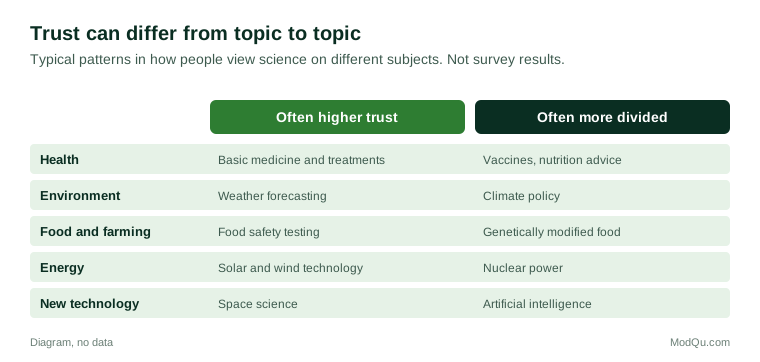
The figure below shows that trust can vary from topic to topic for the same person. Topics where opinion is often divided include vaccines, climate change, genetically modified food, nuclear power, evolution in some communities and new technologies such as artificial intelligence. Topics where trust is usually higher include space science, basic medicine and weather forecasting.
Trust after a crisis
Public health emergencies, disasters and scandals can change trust quickly. Clear, honest communication, including admitting uncertainty, tends to be linked to steadier trust. Advice that changes without explanation, or that seems driven by politics, can weaken it.
Example (hypothetical figures)
A local survey asks 500 people to rate their trust in scientists on a scale of 1 to 10, before and after a public health campaign. The average rises from 6.1 to 6.6. Among people who had seen the campaign's question-and-answer sessions, the average rises to 7.0. The organizers note that people who chose to attend may have trusted scientists more to begin with.
How surveys measure trust
Measuring trust is harder than it looks. Researchers ask about different kinds of trust, different groups of scientists and different topics. They avoid leading wording such as "Do you agree that science can be trusted?" Repeating the same questions over the years lets researchers see trends. Results depend on who answers, so good surveys report how respondents were reached and weight results to match the population.
What people disagree about
- Whether scientists should give advice on policy or only present evidence.
- How much uncertainty should be shown in public advice.
- Whether doubt is healthy scepticism or harmful distrust.
- How to deal with misinformation without censoring debate.
- How funding sources should be disclosed.
Why surveys ask about trust in science
Questions that research bodies, universities, science communicators and public agencies want answered include how much people trust scientists, which sources they use, which topics they are unsure about and what would increase their trust. Answers are grouped and every question can be skipped.
How scientists can earn trust
Research on science communication points to several practices that people say make them more willing to trust scientific advice. These include explaining how a finding was reached, not only what it is; being open about uncertainty and about what is still unknown; disclosing who paid for research; correcting mistakes publicly; listening to people's concerns instead of dismissing them; and working with trusted local messengers, such as doctors, teachers and community leaders. People also say they value scientists who speak in plain language and who are willing to say "we do not know yet".
Key terms
- Peer reviewChecking of research by other experts before it is published.
- Scientific consensusThe shared view of most experts in a field, based on the evidence.
- Conflict of interestA situation where a researcher's interests could bias their work.
- ReplicationRepeating a study to see if the same results appear.
- RetractionWithdrawal of a published paper because of serious errors or misconduct.
- ScepticismQuestioning claims until there is good evidence.
- MisinformationFalse or misleading information, shared with or without intent to deceive.
- UncertaintyThe range within which a result may lie, given the limits of the evidence.
Full glossary: science communication terms on EditingTests.com.
Trust in science vocabulary test
How well do you know the language of this topic? Try 8 quick questions. Your score is shown straight away and is not saved.
What the trust in science survey asks
This survey is part of ModQu's Science and Technology Attitudes survey. The trust in science part takes about five minutes and covers:
- How much you trust scientists, and in which fields.
- Where you get science news and information.
- Which sources you trust most and least.
- Which science topics you feel unsure or divided about.
- Whether your trust has changed in recent years, and why.
- What would make you trust scientific advice more.
After that you can choose to continue with other short parts of the Science and Technology Attitudes survey, such as space exploration or genetic testing, or stop.
Ready to take part?
Your answers help show what people really think and do. Results are only ever reported as totals; no one can see your individual answers.
Start the surveyQuestions about this survey
Who can take part?
Adults.
Do I have to give my name?
No. You may be asked for your age group, region and similar details so results can be broken down, but not your name. ModQu never asks for passwords, card numbers or account numbers.
How are the results used?
Answers are combined into totals and percentages and published in ModQu reports. Individual answers are never shown.
Is the vocabulary test part of the survey?
No. It is optional and separate, and your score is not stored.
Is there a right answer to the trust questions?
No. The survey records what people think. Trust, doubt and uncertainty are all valid answers.
Do I need to know a lot about science to take part?
No. The survey is for everyone, whatever their science background.