
Share your experience of social media
Tell us which apps you use, how your use is changing and what you think of ads and influencers. Your answers are combined with other people's and reported only as totals.
Start the social media surveyAbout 5 minutes. No account needed. You can stop at any time.
What this topic covers
Social media means apps and websites where people create, share and react to posts, photos, videos and messages. This topic covers:
- Social networks for keeping up with friends and family.
- Short-video apps built around a feed of videos chosen by the app.
- Photo-sharing platforms.
- Professional networks for careers and business contacts.
- Discussion forums and community sites organized by topic.
- Messaging apps and group chats, which many people now use more than public posting.
- Video platforms where creators post longer videos.
It also covers advertising, influencers, shopping, wellbeing and the debates about how these platforms should be run.
How people use social media
People use social media for many reasons, and often for several at once:
- keeping in touch with family and friends;
- following news and local information;
- entertainment, especially short videos;
- learning: recipes, home repairs, fitness routines and study tips;
- following creators, celebrities, sports teams and brands;
- joining communities around a hobby, a health condition or a neighbourhood;
- buying and selling items in marketplace features;
- promoting a business or their own work.
Over time, many people have moved from posting publicly to watching and to sharing in private group chats. Some people check social media dozens of times a day without posting anything.
Example
A woman in her fifties joined a social network years ago to see photos of her nieces and nephews. Now she rarely posts, but uses the platform daily for a local buy-and-sell group, a gardening group and updates from her town's fire department. Her nieces and nephews have moved to other apps and share photos with her by text instead.
Feeds and algorithms
Most platforms now decide what appears in a feed using an algorithm, a set of rules that predicts what each person is likely to watch, like or share. Feeds that once showed posts from people a user followed, in order, now mix in recommended posts from accounts they have never seen.
People react to this in different ways. Some enjoy discovering new content. Others feel they see too little from friends, too many ads, or content that makes them angry or anxious. Some platforms let users switch to a chronological feed or adjust what they see, though many people do not know these settings exist.
Time spent and how people feel about it
Social media use can take up a lot of time without people noticing. Common concerns include:
- scrolling longer than planned;
- checking first thing in the morning and late at night;
- comparing oneself with others;
- feeling left out;
- exposure to arguments, harassment or upsetting content.
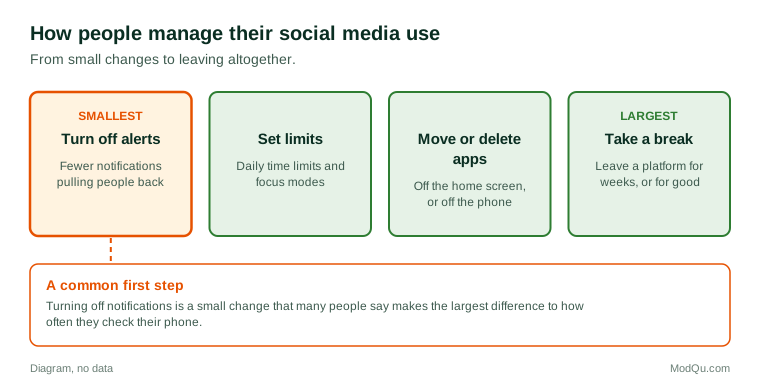
Many people take steps to manage their use: deleting an app from the phone, setting time limits, turning off notifications, unfollowing accounts, or taking breaks. Some leave a platform entirely; others return after a few weeks because friends, groups or work depend on it.
Example
A university student notices they spend about three hours a day on a short-video app, mostly late at night. They move the app into a folder on the last screen of their phone and set a one-hour limit. After a month their screen time report shows about an hour and a half a day, and they say they are sleeping better.
Ads, influencers and shopping
Social media is paid for mainly by advertising, often targeted using information about what people watch, like and search for. Many people have seen an ad and wondered how the app knew they were interested.
Influencers are people with large followings who are paid by brands to promote products, or who earn money from the platform itself. In Canada, the Competition Bureau expects paid endorsements to be clearly disclosed, for example with a label such as "ad" or "sponsored". Ad Standards, the industry's self-regulatory body, also publishes disclosure guidelines for influencers.
People's views of influencers vary. Some trust creators more than ads because they seem more personal; others distrust anyone who is paid to recommend something.
Example (hypothetical figures)
A shopper buys a $45 skin-care product after seeing a creator they follow use it. A week later they buy two more products from the same brand for $60 after seeing ads for them. Asked whether social media affects what they buy, they say "not really", but their purchases from that brand over the month total $105.
Questions businesses want answered here include how often people buy after seeing something on social media, which kinds of creators they trust, and whether they notice when a post is paid.
Young people and social media
Social media use by children and teenagers is one of the most debated topics in this area. Most major platforms set a minimum age of 13 in their terms, but many younger children use them. Parents, teachers and health organizations raise concerns about sleep, body image, bullying, contact from strangers and time taken from other activities. Other people point to benefits, such as friendship, creativity and support for young people who feel isolated.
Governments in several countries, including Australia, have passed or proposed laws setting minimum ages or requiring age checks. In Canada, provinces have restricted phone use in schools and some school boards have taken legal action against large platforms.
Privacy and safety
Social media platforms hold a lot of personal information: photos, messages, contacts, location and interests. Concerns include who can see a person's posts, how data is used for ads, fake accounts and scams, impersonation, and the permanence of old posts. Many people review their privacy settings only after something goes wrong, such as a stranger contacting their child, an old post resurfacing, or a friend's account being taken over and used to send scam messages.
What people disagree about
Opinion is divided on whether social media does more good than harm, whether platforms should be responsible for harmful content, how much moderation is censorship, whether there should be age limits, and whether algorithm-driven feeds should be optional. These views often vary by age and by which platforms people use.
Key terms
- FeedThe stream of posts an app shows a user.
- AlgorithmRules an app uses to decide what each user sees.
- InfluencerA person with a large following who promotes products or ideas.
- Sponsored postA post a brand has paid for, which should be labelled.
- EngagementLikes, comments, shares and other reactions to a post.
- Targeted adAn ad shown to people based on their data or behaviour.
- Content moderationReviewing and removing posts that break a platform's rules.
- Chronological feedA feed that shows posts in order of time.
Full glossary: social media platforms terms on EditingTests.com.
Social media vocabulary test
How well do you know the language of this topic? Try 8 quick questions. Your score is shown straight away and is not saved.
What the social media survey asks
This survey is part of ModQu's Media and Entertainment survey. The social media part takes about five minutes and covers:
- Which social media apps you use daily, weekly or rarely.
- How much time you spend on them, and whether that has gone up or down this year.
- What you use social media for most.
- How you feel about the ads you see.
- Whether you have bought something after seeing it from an influencer or creator.
- How you manage your time or privacy on social media.
After that you can choose to continue with other short parts of the Media and Entertainment survey, such as streaming tv and video or music and podcasts, or stop.
Ready to take part?
Your answers help show what people really think and do. Results are only ever reported as totals; no one can see your individual answers.
Start the surveyQuestions about this survey
Who can take part?
Social media users.
Do I have to give my name?
No. You may be asked for your age group, region and similar details so results can be broken down, but not your name. ModQu never asks for passwords, card numbers or account numbers.
How are the results used?
Answers are combined into totals and percentages and published in ModQu reports. Individual answers are never shown.
Is the vocabulary test part of the survey?
No. It is optional and separate, and your score is not stored.
Will the survey ask for my social media accounts?
No. ModQu does not ask for your usernames or ask you to connect any account.