
Share how you groom your pet
Tell us who grooms your pet, how often and how much you pay. Your answers are combined with other people's and reported only as totals.
Start the pet grooming surveyAbout 5 minutes. No account needed. You can stop at any time.
What pet grooming covers
Grooming is more than making a pet look tidy. It includes:
- Brushing and combing to remove loose hair, dirt and tangles.
- Bathing with products made for animals.
- Clipping or trimming the coat, especially for breeds whose hair keeps growing.
- Hand-stripping, removing dead hair by hand from some wire-coated breeds.
- Nail trimming, which prevents overgrown nails that can cause pain.
- Ear cleaning and checks for infection.
- Teeth brushing to reduce dental disease.
- Checking the skin for lumps, parasites, cuts and sore spots.
Regular grooming also gives owners a chance to notice health problems early. Many vets say that lumps, skin infections and fleas are often first found during grooming.
How grooming needs differ
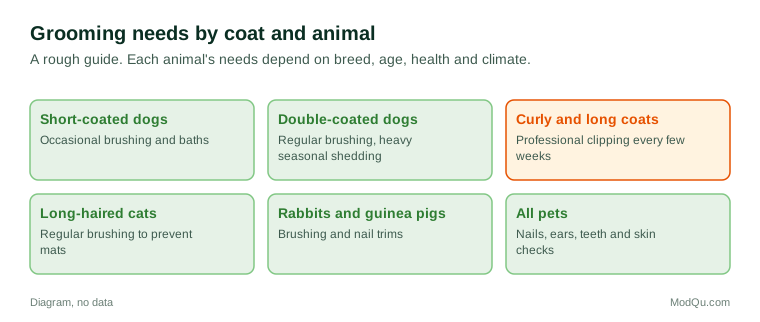
Grooming needs depend on the kind of animal and its coat:
- Short-coated dogs usually need occasional brushing and baths.
- Double-coated breeds, with a dense undercoat, shed heavily, especially at certain times of year, and need regular brushing. Shaving them is often discouraged.
- Curly and long-coated breeds, whose hair keeps growing, usually need professional clipping every four to eight weeks.
- Cats mostly groom themselves, but long-haired cats need regular brushing to prevent mats, and older cats may need help.
- Rabbits and guinea pigs need brushing, especially long-haired breeds, and nail trims.
- Horses need daily grooming and hoof care.
Climate matters too. In hot countries owners may clip coats shorter, while in cold places some keep coats long for warmth.
Grooming at home or with a professional
Owners choose between doing it themselves, paying a groomer, or both. Common reasons for home grooming are cost, convenience and the pet's dislike of strangers. Common reasons for using a professional are a difficult coat, lack of time or skill, the need for clippers and a grooming table, and a pet that will not sit still for its owner.
Many owners do routine brushing and nail checks at home and book a professional for full grooms.
Example
A family with a curly-coated dog tries clipping it at home to save money. The result is uneven, and the dog becomes nervous of the clippers. They switch to a groomer every six weeks and brush the dog at home twice a week, which stops the coat matting between visits.
Types of grooming services
Professional grooming comes in several forms:
- Grooming salons in shops or standalone premises.
- Mobile groomers who work from a fitted van outside the owner's home.
- Home-visit groomers who groom in the owner's home.
- Grooming at vets and pet shops.
- Self-service wash stations, where owners use a tub, dryer and products for a fee.
- Cat-only groomers, since some cats find dog salons stressful.
How often and how much
Frequency depends on coat, lifestyle and owner preference. A short-coated dog may never visit a groomer, while some breeds go every month.
Example (hypothetical figures)
An owner of a medium curly-coated dog pays 70 dollars for a full groom every six weeks, or about nine visits a year, which is 630 dollars. They also buy a brush and comb for 30 dollars and shampoo for 20 dollars. Their grooming cost for the year is 680 dollars. A neighbour with a short-coated dog spends about 40 dollars a year on a brush, shampoo and nail clippers.
Prices vary by country, city, size of the pet, coat condition and extra services such as de-matting, teeth cleaning or nail grinding. Many groomers charge more for matted or difficult coats.
Choosing a groomer
Owners often choose a groomer through recommendations, reviews and trial visits. Things they look for include:
- experience with the breed or species;
- training or qualifications, which are voluntary in many countries;
- a calm, clean space and safe handling;
- how long the pet will be kept and whether it will be caged;
- how dryers are used, since some heated cage dryers carry risks;
- willingness to stop if a pet is distressed;
- clear prices and photos of past work.
In many countries, grooming is not licensed, so standards vary. Some regions have introduced licensing or are considering it.
Example
A cat owner books a cat-only groomer for their long-haired cat, which has developed mats it cannot reach. The groomer works in a quiet room, takes breaks when the cat becomes tense and advises a short body clip. The owner starts brushing the cat for a few minutes each evening to prevent new mats.
Grooming products owners buy
Owners who groom at home build up a kit over time. Common items include brushes and combs suited to the coat, shampoos and conditioners made for animals, nail clippers or grinders, ear cleaner, pet toothbrushes and toothpaste, de-shedding tools, grooming wipes and, for some, clippers and a grooming table. Many owners say they bought the wrong brush at first and learned from a groomer or vet which tool works for their pet's coat. Human shampoos are usually not recommended because animal skin differs from human skin.
Welfare and stress
Some pets find grooming stressful. Causes include noise from clippers and dryers, being handled by strangers, long waits and past bad experiences. Owners and groomers reduce stress by:
- starting gentle handling and brushing when pets are young;
- short, positive sessions with treats;
- booking quieter times;
- using low-stress or fear-free handling methods;
- asking a vet about sedation for pets that cannot be groomed safely awake.
Vets sometimes see grooming injuries, such as cuts or overheating. Most groomers work safely, but owners are encouraged to ask questions and check their pet afterwards.
Grooming trends
Grooming has grown into a larger business in many countries. Trends include creative grooming with dyes and styled cuts, spa treatments, natural or fragrance-free products, and subscription plans with regular appointments. Some people enjoy these; others question whether they serve the pet or the owner.
What people disagree about
Grooming raises some debates:
- whether groomers should be licensed and trained to a set standard;
- whether double-coated breeds should ever be shaved;
- whether coloured dyes and fashion cuts are acceptable;
- whether cats should be bathed or clipped at all except for health reasons.
Questions pet product brands, groomers and retailers want answered include who grooms pets, how often, at what cost and what owners value in a groomer.
Key terms
- GroomerA person who cleans, brushes and trims animals' coats.
- MatA tight knot of tangled fur that can pull on the skin.
- Double coatA coat with a dense undercoat beneath longer guard hairs.
- Hand-strippingRemoving dead hair by hand from some wire-coated breeds.
- De-sheddingRemoving loose undercoat to reduce shedding.
- Mobile groomerA groomer who works from a fitted van at the owner's home.
- Nail grindingFiling nails with a rotary tool instead of clipping them.
- Fear-free handlingMethods that aim to reduce an animal's fear and stress during care.
Full glossary: animal health terms on EditingTests.com.
Pet grooming vocabulary test
How well do you know the language of this topic? Try 8 quick questions. Your score is shown straight away and is not saved.
What the pet grooming survey asks
This survey is part of ModQu's Pets and Animals survey. The pet grooming part takes about five minutes and covers:
- Who grooms your pet: you, a professional or both.
- How often your pet is groomed, and what is done.
- How much you pay for grooming, as a range.
- How you chose your groomer and what matters most.
- Whether your pet finds grooming stressful.
- Which grooming products and tools you buy.
After that you can choose to continue with other short parts of the Pets and Animals survey, such as pet ownership or veterinary care, or stop.
Ready to take part?
Your answers help show what people really think and do. Results are only ever reported as totals; no one can see your individual answers.
Start the surveyQuestions about this survey
Who can take part?
Pet owners.
Do I have to give my name?
No. You may be asked for your age group, region and similar details so results can be broken down, but not your name. ModQu never asks for passwords, card numbers or account numbers.
How are the results used?
Answers are combined into totals and percentages and published in ModQu reports. Individual answers are never shown.
Is the vocabulary test part of the survey?
No. It is optional and separate, and your score is not stored.