
Share your experience of online legal help
Tell us whether you have used an online legal service, what for, and how much you trusted it. Your answers are combined with other people's and reported only as totals.
Start the online legal services surveyAbout 5 minutes. No account needed. You can stop at any time.
What online legal services are
Online legal services are ways of getting legal information, documents or advice through a website or app rather than, or as well as, visiting a lawyer's office. They range from free public guides to paid services run by law firms.
The main kinds include:
- Legal information websites, run by governments, courts, charities and consumer bodies, which explain rights and procedures.
- Document services, which offer templates or guided questionnaires that produce a will, a tenancy agreement, a letter, a contract or a business document.
- Online advice from lawyers, by video call, phone, chat or email, often for a fixed fee.
- Online courts and tribunals, where people can file claims, upload evidence and sometimes have hearings online.
- Online dispute resolution, where a platform helps two sides negotiate or mediate.
- Lawyer directories and comparison sites, which help people find and compare providers.
- Automated tools, such as chatbots and question-and-answer systems that explain options or draft documents.
Why people use them
People give a range of reasons for looking online first:
- Cost: fixed prices or free information can be cheaper than an office appointment.
- Convenience: services are available at any time and from home.
- Speed: simple documents can be produced in minutes.
- Privacy: some people prefer to research a sensitive matter alone first.
- Distance: people in rural areas, or abroad, may have no lawyer nearby.
- Understanding: some want to learn the basics before paying for advice.
Example
A couple who are buying a home want to make wills. They use a guided online service that asks questions about their family and property. Because one of them has children from an earlier relationship, the service suggests they speak to a lawyer, and they book a video appointment.
What people use them for
Common uses include:
- Wills and powers of attorney.
- Tenancy agreements and letters to landlords.
- Consumer complaints and letters before action.
- Business start-up documents, such as terms and conditions or shareholder agreements.
- Employment questions, such as checking a contract or a dismissal.
- Separation and divorce, especially where both sides agree.
- Immigration applications and visa questions.
- Traffic tickets and parking appeals.
- Small claims, using online court systems.
Limits and risks
Online services work well for some needs but not others. Points people commonly weigh include:
- Information is not advice. A general guide explains the law; advice applies it to a person's own situation. Many sites state that they provide information only.
- Templates may not fit. A standard document may miss something important about a family, property or business, or may not meet formal requirements in a particular country or region.
- Jurisdiction matters. Laws differ between countries and often between regions within a country. A document made for one place may not work in another.
- Who is behind the service. Some services are run by regulated law firms; others are technology companies that are not regulated in the same way.
- Complaints and insurance. Clients of regulated lawyers often have access to complaint schemes and professional insurance; this may not apply to other services.
- Accuracy of automated tools. Automated systems can produce answers that sound confident but are wrong or out of date.
- Data security. Legal matters involve sensitive personal details.
Example
A small business owner downloads a free contract template for a client project. Months later, when the client refuses to pay, a lawyer points out that the template does not say when payment is due or what happens if work is changed. The owner starts using a lawyer-reviewed version for future projects.
Regulation in different countries
Who may give legal advice, and how online providers are treated, varies widely. In many countries only qualified lawyers may carry out certain reserved activities, such as representing people in court. Some countries, such as England and Wales, allow a wider range of businesses to provide legal services, including firms owned partly by non-lawyers, under a licensing system. In other places, such as many United States states, there are strict rules against the unauthorized practice of law, and courts and regulators have debated whether document services fall within those rules. Several countries and regions have been testing new rules, sometimes called regulatory sandboxes, to allow new kinds of providers under supervision.
Because of this, the same kind of service may be regulated, lightly regulated or not allowed, depending on where the user lives.
Price and value
Online services often use fixed or subscription prices instead of hourly rates. People compare price with what they get, such as whether a lawyer checks the document, whether there is a follow-up call, and what happens if something goes wrong.
Example (hypothetical figures)
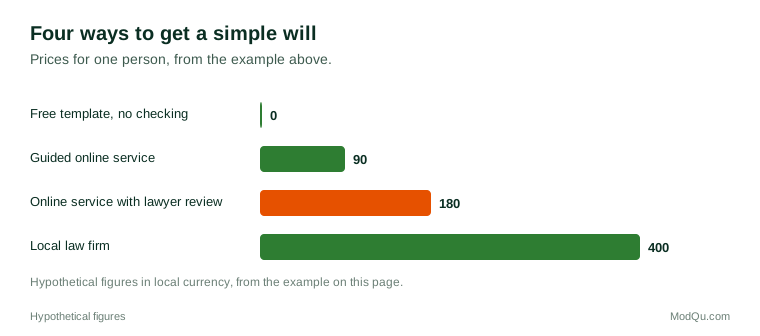
A person needs a simple will. A free template costs 0 but includes no checking. A guided online service costs 90 in their local currency. The same service with a lawyer review costs 180. A local law firm quotes 400 for a meeting and a will. The person chooses the reviewed online option, paying 220 less than the firm's quote.
Trust in online legal advice
Trust is one of the main questions for online legal help. People tend to weigh:
- Whether a named, qualified lawyer is involved.
- Whether the provider is regulated and how to complain.
- Reviews and recommendations, though these can be unreliable.
- Whether the website is run by a public body, a charity or a business.
- Whether the information is dated and specific to their country.
- How they would feel if the advice turned out to be wrong.
People often trust official court and government information sites more than commercial sites, and many trust a human lawyer more than an automated tool for a serious matter. Views can differ by age, experience and the type of problem.
What people and businesses want to know
Questions law firms, legal technology companies and consumer bodies want answered include how many people have used an online legal service, what for, how much they paid, whether the problem was solved, how they would rate the help, and how much they trust online and automated legal help compared with an in-person lawyer.
Key terms
- Legal informationGeneral explanation of the law and procedures, not tailored to one person.
- Legal adviceApplying the law to a person's own situation and recommending what to do.
- Document templateA standard form that a person fills in with their own details.
- JurisdictionThe country or region whose laws and courts apply.
- Reserved activityLegal work that only authorized people may carry out.
- Unauthorized practice of lawGiving legal services without the required qualification or licence.
- Online dispute resolutionUsing an online platform to negotiate or mediate a dispute.
- Regulatory sandboxA supervised trial that lets new kinds of providers operate under special rules.
Full glossary: legal ai terms on EditingTests.com.
Online legal services vocabulary test
How well do you know the language of this topic? Try 8 quick questions. Your score is shown straight away and is not saved.
What the online legal services survey asks
This survey is part of ModQu's Law and Rights survey. The online legal services part takes about five minutes and covers:
- Whether you have used an online legal service, and which kind.
- What you used it for, and how much you paid.
- Whether it solved your problem, or whether you also needed a lawyer.
- How much you trust online legal information, online lawyers and automated tools.
- What would make you more or less likely to use online legal help.
- How you would look for legal help if you needed it tomorrow.
After that you can choose to continue with other short parts of the Law and Rights survey, such as using a lawyer or consumer rights and complaints, or stop.
Ready to take part?
Your answers help show what people really think and do. Results are only ever reported as totals; no one can see your individual answers.
Start the surveyQuestions about this survey
Who can take part?
Adults.
Do I have to give my name?
No. You may be asked for your age group, region and similar details so results can be broken down, but not your name. ModQu never asks for passwords, card numbers or account numbers.
How are the results used?
Answers are combined into totals and percentages and published in ModQu reports. Individual answers are never shown.
Is the vocabulary test part of the survey?
No. It is optional and separate, and your score is not stored.