
Share your experience of online harassment
Tell us whether you have been harassed online, where it happened and whether you reported it. Your answers are combined with other people's and reported only as totals.
Start the online harassment surveyAbout 5 minutes. No account needed. You can stop at any time.
What online harassment includes
Online harassment, sometimes called online abuse or cyberharassment, is behaviour using digital technology that targets a person or group to intimidate, upset, threaten or humiliate them. It includes:
- Insults and name-calling in comments or messages.
- Threats of violence, including against family members.
- Hate speech targeting people for their race, religion, gender, sexuality, disability or other characteristics.
- Sexual harassment, including unwanted sexual messages and images.
- Image-based abuse: sharing or threatening to share intimate images without consent.
- Doxxing: publishing someone's private information, such as their home address.
- Cyberstalking: repeated monitoring, contact or tracking that causes fear.
- Impersonation: creating fake accounts in someone's name.
- Pile-ons: many people targeting one person at once.
- Cyberbullying, the term often used when children and young people are involved.
Some forms are crimes in many countries; others are against platform rules but not illegal. The line between harsh criticism and harassment is debated, especially for public figures.
Where it happens
Online harassment can happen anywhere people interact online:
- social media comments, replies and direct messages;
- online games and voice chat;
- messaging apps and group chats;
- email;
- dating apps;
- forums and community sites;
- video and live-streaming platforms;
- workplace and school chat tools.
Example
A gamer who uses a voice chat feature in an online game receives repeated insults about their accent from players on the opposing team. They mute the players, report them through the game, and later switch voice chat to friends only.
Who is targeted
Anyone can be harassed online, but surveys in many countries have found that some groups report it more often or in more severe forms. These include young people, women (particularly for sexual harassment and image-based abuse), people from ethnic and religious minorities, LGBTQ+ people, people with disabilities, journalists, politicians, activists and content creators. Experiences differ between countries and platforms, which is one reason surveys on this topic are useful.
Effects on people
People who are harassed online describe effects such as:
- fear, anxiety, stress and low mood;
- difficulty sleeping or concentrating;
- withdrawing from social media or public discussion;
- changing what they post or self-censoring;
- worries about physical safety, especially after threats or doxxing;
- effects on work, study or reputation;
- in some cases, needing to move home or change phone numbers.
Some people say they shrug it off; for others, the effects are serious and long-lasting.
Responding: block, mute, report
Platforms offer tools such as:
- Blocking, which stops a person contacting you or seeing your content.
- Muting, which hides someone's posts without them knowing.
- Restricting who can comment, message or tag you.
- Filtering words or phrases from comments.
- Reporting content or accounts that break the platform's rules.
- Privacy settings limiting who can see your posts and personal details.
Many people also keep evidence, such as screenshots with dates, usernames and links, before blocking or deleting, in case they decide to report to the platform, an employer, a school or the police.
Example (hypothetical figures)
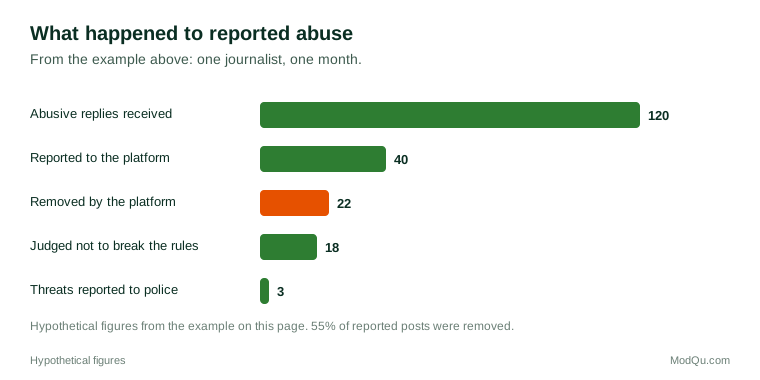
A journalist tracks abusive replies over one month: 120 in total. They report 40 of them to the platform. The platform removes 22 and says 18 did not break its rules, so 55% of reported posts were removed (22 ÷ 40). The journalist also reports 3 threats to the police.
Reporting and getting help
Many people who are harassed online do not report it. Reasons include believing nothing will happen, not knowing how, fearing it will make things worse, or thinking it is not serious enough. Those who report may go to:
- the platform or service;
- an employer or school, if colleagues or classmates are involved;
- the police, especially for threats, stalking, image-based abuse or hate crimes;
- specialist helplines and charities, which exist in many countries for online abuse, image-based abuse and cyberbullying;
- national online safety regulators or commissioners in countries that have them.
Example
A student finds a fake social media account using their name and photos to post insulting messages to classmates. They take screenshots, report the account to the platform using its impersonation form, and tell a teacher. The account is removed within two days and the school speaks to the students involved.
Harassment at work and school
Online harassment often involves people who know each other offline. Colleagues may harass each other through work chat tools, email or social media, and employers in many countries have duties to deal with harassment that affects the workplace, whether it happens online or in person. In schools, cyberbullying between pupils often continues outside school hours through messaging apps and social media, and many schools have policies that cover online behaviour. Parents, teachers and employers are often unsure where their responsibility begins and ends when harassment happens outside working or school hours.
Laws and regulation
Laws differ widely. Many countries have laws against threats, stalking, harassment, hate speech and sharing intimate images without consent that apply online as well as offline. Some have introduced specific online safety laws that require platforms to assess and reduce risks, act on reports, and protect children. Others rely more on platforms' own rules. Debates continue about balancing protection from abuse with freedom of expression and privacy, and about anonymity online.
What people disagree about
- Anonymity. Some argue that requiring real names would reduce abuse; others say anonymity protects vulnerable people and that much abuse comes from named accounts.
- Platform responsibility. People disagree about how much platforms should do and how fast.
- Free speech. Where to draw the line between offensive speech and harassment is contested.
- Public figures. Some say strong criticism comes with public life; others say abuse drives people out of public roles.
Key terms
- Online harassmentBehaviour using digital technology to intimidate, upset, threaten or humiliate someone.
- CyberbullyingOnline harassment, often used when children or young people are involved.
- DoxxingPublishing someone's private information, such as their address, without consent.
- CyberstalkingRepeated online monitoring or contact that causes fear.
- Image-based abuseSharing or threatening to share intimate images without consent.
- Pile-onMany people targeting one person online at the same time.
- BlockingA tool that stops a person contacting you or seeing your content.
- MutingA tool that hides someone's posts without them knowing.
Full glossary: trust safety platforms terms on EditingTests.com.
Online harassment vocabulary test
How well do you know the language of this topic? Try 8 quick questions. Your score is shown straight away and is not saved.
What the online harassment survey asks
This survey is part of ModQu's Digital Life and the Internet survey. The online harassment part takes about five minutes and covers:
- Whether you have been harassed or abused online, and what form it took.
- Where it happened: social media, games, messaging, email, dating apps or elsewhere.
- Whether you blocked, muted or reported the person, and what happened.
- Whether you reported it to anyone outside the platform.
- How it affected you and how you use the internet.
- What you think platforms and governments should do.
After that you can choose to continue with other short parts of the Digital Life and the Internet survey, such as internet use habits or search engines, or stop.
Ready to take part?
Your answers help show what people really think and do. Results are only ever reported as totals; no one can see your individual answers.
Start the surveyQuestions about this survey
Who can take part?
Adults who use the internet.
Do I have to give my name?
No. You may be asked for your age group, region and similar details so results can be broken down, but not your name. ModQu never asks for passwords, card numbers or account numbers.
How are the results used?
Answers are combined into totals and percentages and published in ModQu reports. Individual answers are never shown.
Is the vocabulary test part of the survey?
No. It is optional and separate, and your score is not stored.
Is online harassment a crime?
Some forms, such as threats, stalking and sharing intimate images without consent, are crimes in many countries. Others may break platform rules without being illegal. Laws differ by country.
Where can I get support?
Many countries have helplines and charities for online abuse, cyberbullying and image-based abuse. In an emergency or if you feel in danger, contact local emergency services.