
Share your experience of online communities
Tell us whether you belong to an online community, what it is about and how often you post. Your answers are combined with other people's and reported only as totals.
Start the online communities surveyAbout 5 minutes. No account needed. You can stop at any time.
What an online community is
An online community is a group of people who interact regularly online around a shared interest or purpose. Unlike a general social media feed, a community has some sense of membership, shared norms and repeated contact between the same people. Communities can be public or private, large or small, and can last for decades or a few months.
The main kinds
Online communities take many forms:
- Forums and message boards, organised by topic and thread, among the oldest forms.
- Groups inside social media platforms, often linked to a place, a hobby or a life stage.
- Discussion sites built around many topic-based sub-communities with voting on posts.
- Chat servers and channels for real-time conversation, popular with gamers and hobbyists.
- Group chats in messaging apps, often for smaller or private communities.
- Question-and-answer sites where people ask and answer questions.
- Fan communities around books, music, films, sports teams and games.
- Support communities for health conditions, caring, grief, addiction recovery or parenting.
- Professional and learning communities for people in the same job or field of study.
- Local communities, such as neighbourhood groups that share news, lost pets and recommendations.
- Creator communities around a particular video creator, writer or podcaster.
Why people join
People give many reasons:
- Information and advice, especially on specialised topics.
- Shared interests that friends and family do not share.
- Support and understanding from others in the same situation.
- Belonging and identity, especially for people who feel isolated where they live.
- Entertainment and humour.
- Local connection, such as knowing what is happening nearby.
- Learning and career: networking, feedback and job leads.
- Buying, selling and swapping within a trusted group.
Example
A person diagnosed with a rare health condition finds that no one they know has heard of it. They join an online support community where members share their experiences of treatments, appointments and daily life. They mostly read for the first few months, then start answering questions from newly diagnosed members.
Lurking, posting and taking part
In most communities a small share of members post most of the content, while many more read without posting. Readers who rarely or never post are often called lurkers. Researchers have long observed this pattern, sometimes described as the "90-9-1" rule of thumb, although the exact proportions vary widely between communities.
People give different reasons for not posting: they get what they need by reading, they are shy, they worry about being judged, or they lack time. Lurkers still benefit and may contribute in other ways, such as voting or sharing.
Example (hypothetical figures)
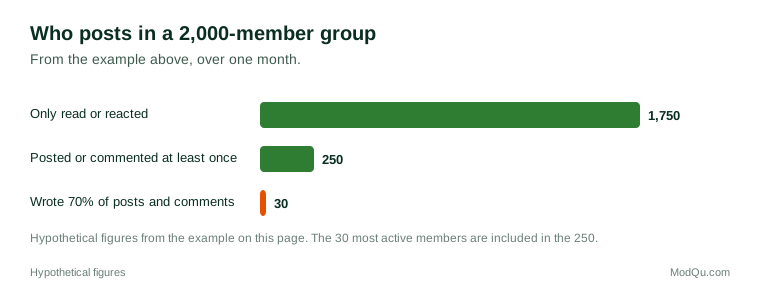
A local gardening group has 2,000 members. In one month, 30 members write 70% of the posts and comments, 250 members post or comment at least once, and the rest only read or react. So 1,750 of the 2,000 members (87.5%) did not post or comment that month, but the group's statistics show that most of them viewed posts.
How people find and leave communities
People find online communities through searches, recommendations from friends, links from other sites, and suggestions from platforms. Many join during a particular life stage, such as pregnancy, starting university, moving to a new city or after a diagnosis, and leave when that stage ends. Others stay for years and become long-term members or moderators. Common reasons for leaving include losing interest, conflict, changes in moderation or platform rules, and the community becoming too large or too busy to follow.
Communities that meet offline
Many online communities lead to offline contact. Hobby groups arrange meet-ups, events and trips; local groups organise clean-ups and help for neighbours; support communities sometimes hold in-person gatherings; and fan communities meet at conventions and matches. Members often describe these meetings as turning online contacts into real friendships.
How communities are run
Communities need rules and someone to apply them. Moderators, often unpaid volunteers, approve members, remove spam and abusive posts, settle disputes and keep discussions on topic. Platforms also have their own rules and enforcement. Common community rules cover respectful behaviour, no spam or self-promotion, staying on topic, privacy of members and, for support communities, not giving medical or legal advice as fact.
Moderation is demanding work. Volunteer moderators report stress, abuse and burnout, and disagreements about moderation decisions are common.
Benefits and problems
Members describe many benefits: practical help, friendships that move offline, emotional support, learning and fun. People who are isolated by illness, disability, caring duties, location or identity often say online communities are especially important to them.
Problems include:
- Misinformation spreading within a trusted group.
- Conflict, arguments and "drama".
- Harassment and abuse, sometimes organised by people outside the community.
- Echo chambers, where only one view is welcome.
- Scams targeting trusting members.
- Privacy risks when members share personal details.
- Platform dependence: if a platform changes its rules or closes, a community can lose its home and history.
Example
A neighbourhood group starts sharing warnings about a supposed crime wave that turns out to be based on one misread post. A moderator posts a correction with a link to the local police's statement and adds a rule asking members to share sources for safety warnings.
How online communities are changing
Many communities have moved from open forums to closed groups and private chats, which offer more privacy but are harder to find. Platform changes, such as new rules for third-party apps or shifts in what algorithms show, have pushed some communities to move or split. Some communities now use AI tools for moderation and summaries, while others ban AI-generated posts. Questions that platforms, organisations and researchers want answered include how many people belong to online communities, what they are about, how actively people take part and what makes them stay or leave.
Key terms
- Online communityA group of people who interact regularly online around a shared interest or purpose.
- ForumA website for discussions organised into topics and threads.
- ThreadA series of posts replying to one original post.
- LurkerA member who reads but rarely or never posts.
- ModeratorA person who enforces a community's rules.
- Community guidelinesThe rules members are expected to follow.
- Echo chamberA setting where people mostly hear views that match their own.
- NetiquetteInformal rules of polite behaviour online.
Full glossary: social media platforms terms on EditingTests.com.
Online communities vocabulary test
How well do you know the language of this topic? Try 8 quick questions. Your score is shown straight away and is not saved.
What the online communities survey asks
This survey is part of ModQu's Digital Life and the Internet survey. The online communities part takes about five minutes and covers:
- Whether you belong to an online community, and how many.
- What your main community is about: a hobby, place, health, work, identity or other.
- How often you read, react, post or comment.
- Why you joined and why you stay.
- Whether you have experienced conflict, harassment or misinformation in a community.
- Whether you help run or moderate a community.
After that you can choose to continue with other short parts of the Digital Life and the Internet survey, such as internet use habits or search engines, or stop.
Ready to take part?
Your answers help show what people really think and do. Results are only ever reported as totals; no one can see your individual answers.
Start the surveyQuestions about this survey
Who can take part?
Adults who use the internet.
Do I have to give my name?
No. You may be asked for your age group, region and similar details so results can be broken down, but not your name. ModQu never asks for passwords, card numbers or account numbers.
How are the results used?
Answers are combined into totals and percentages and published in ModQu reports. Individual answers are never shown.
Is the vocabulary test part of the survey?
No. It is optional and separate, and your score is not stored.
Who runs online communities?
Most are run by volunteer moderators and founders, within the rules of the platform that hosts them. Some are run by organisations, charities or companies.
Do I need to post to be part of an online community?
No. Many members only read, and communities still count them as members.
Are private groups safer than public ones?
They can offer more privacy, but members can still copy and share posts, so many groups advise against sharing sensitive personal details.