
Share your experience of misinformation
Tell us whether you have seen false information online recently, how you check if something is true and whether you have shared something later found false. Your answers are combined with other people's and reported only as totals.
Start the misinformation online surveyAbout 5 minutes. No account needed. You can stop at any time.
Misinformation, disinformation and malinformation
Researchers and fact-checkers often separate three kinds of problem information:
- Misinformation: false or misleading information shared without intent to deceive, for example a person forwarding a health myth they believe is true.
- Disinformation: false information created or spread deliberately to deceive, for profit, politics or to cause harm.
- Malinformation: true information shared to cause harm, such as leaking private details or presenting facts out of context.
In everyday speech, "misinformation" is often used for all three. The term "fake news" is also common but is used in so many ways, including to dismiss accurate reporting, that many researchers avoid it.
Common forms
False or misleading content takes many forms:
- Invented stories made to look like news.
- Misleading headlines that do not match the article.
- Out-of-context images or video, such as an old photo presented as showing a current event.
- Edited or manipulated media, including AI-generated images, audio and video, sometimes called deepfakes.
- Fake quotes attributed to well-known people.
- Health and science myths, such as false cures.
- Scams disguised as news or official announcements.
- Satire that people mistake for real news.
- Impostor accounts pretending to be organisations or public figures.
Example
A photo of a flooded street is shared widely during a storm with the caption that it shows a city centre that morning. A reverse image search shows the same photo was published five years earlier from a different country. The person who shared it deletes their post and shares the correction.
Why false information spreads
Several factors help false information spread:
- Emotion: content that causes surprise, fear or anger is more likely to be shared.
- Speed: people share quickly, often without reading beyond the headline.
- Trust in the sender: information from friends and family feels reliable.
- Confirmation bias: people are more likely to believe claims that fit what they already think.
- Algorithms that promote engaging content, which can include false content.
- Closed groups and messaging apps, where content is hard for outsiders to see or correct.
- Breaking news, when facts are uncertain and demand for information is high.
- Organised campaigns using fake accounts or paid promotion.
How people check information
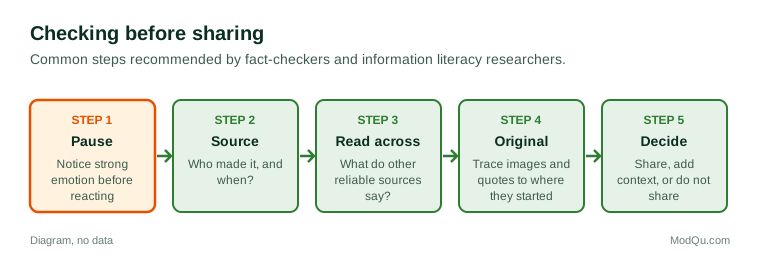
When asked how they check whether something is true, people mention:
- looking for the same story from established news organisations;
- checking the original source, author and date;
- using fact-checking websites, many of which follow the International Fact-Checking Network's code of principles;
- doing a reverse image search for photos;
- reading beyond the headline;
- checking official sources such as health authorities or statistics offices;
- asking someone they trust;
- noticing warning signs such as emotional language, spelling errors, no sources or claims that "the media won't tell you".
Researchers who study information literacy recommend lateral reading (checking what other sources say about a claim or website) and a habit of pausing before sharing.
Example (hypothetical figures)
A person decides to check every news-like post they want to share for one week. They planned to share 20 posts. After checking, 14 were accurate, 4 were misleading or out of context, and 2 were false. They shared only the 14 accurate posts, so checking stopped 6 of the 20 (30%) from being shared.
Sharing something that turns out to be false
Many people have shared something they later learned was false. Common reactions include deleting the post, sharing a correction, telling the person who sent it, or doing nothing because it seems too late or embarrassing. Researchers have found that corrections can reduce belief in false claims, though the original claim can still linger in memory.
Example
A grandparent forwards a message to a family group warning that a new law will close all bank accounts of people over seventy. A grandchild checks the national bank regulator's website, finds no such law and replies with the link. The grandparent posts a message thanking them and asks the group not to forward the warning.
Misinformation during crises and elections
False information tends to rise during crises such as pandemics, natural disasters, conflicts and terror attacks, when people urgently want information and facts are still emerging. Rumours about causes, cures, rescue efforts or who is to blame can spread within minutes. Elections are another peak, with false claims about candidates, voting dates, polling places and results. Election authorities and health agencies in many countries now publish rapid corrections and encourage people to check official channels, and some platforms add labels or information panels during these periods.
Who is responsible and what can be done
Responses to misinformation come from several directions:
- Platforms: removing or labelling false content, reducing its reach, adding fact-check notes, community notes and warnings before sharing.
- Fact-checkers and journalists: checking viral claims and publishing corrections.
- Governments: laws on platform responsibilities, election rules and media literacy programs. Approaches vary widely, and some laws have been criticised for threatening free speech.
- Schools and libraries: teaching media and information literacy.
- Individuals: checking before sharing and correcting mistakes.
UNESCO and other international organisations promote media and information literacy as a long-term response.
What people disagree about
- Free speech and moderation. People disagree about how far platforms and governments should go in removing or limiting content, and who should decide what is false.
- Who to trust. Trust in news media, governments, scientists and fact-checkers differs widely between countries and groups.
- Scale of the problem. Researchers debate how much misinformation changes people's beliefs and behaviour, compared with how much it reflects existing views.
- AI-generated content. Some fear that realistic AI images, audio and video will make it harder to tell real from fake; others think new detection tools and labelling will help.
Key terms
- MisinformationFalse or misleading information shared without intent to deceive.
- DisinformationFalse information spread deliberately to deceive.
- MalinformationTrue information shared to cause harm.
- DeepfakeRealistic fake video, audio or images made using AI.
- Fact-checkingChecking whether claims are accurate and publishing the findings.
- Reverse image searchSearching with an image to find where else it has appeared.
- Confirmation biasThe tendency to favour information that supports existing beliefs.
- Media literacyThe ability to access, judge and create media critically.
Full glossary: journalism terms on EditingTests.com.
Misinformation online vocabulary test
How well do you know the language of this topic? Try 8 quick questions. Your score is shown straight away and is not saved.
What the misinformation online survey asks
This survey is part of ModQu's Digital Life and the Internet survey. The misinformation online part takes about five minutes and covers:
- How often you see information online that you think is false or misleading.
- Where you see it most: social media, messaging apps, video sites, websites or elsewhere.
- How you check whether something is true.
- Whether you have shared something that later turned out to be false, and what you did.
- Which sources you trust most for checking facts.
- Who you think should do most to reduce misinformation.
After that you can choose to continue with other short parts of the Digital Life and the Internet survey, such as internet use habits or search engines, or stop.
Ready to take part?
Your answers help show what people really think and do. Results are only ever reported as totals; no one can see your individual answers.
Start the surveyQuestions about this survey
Who can take part?
Adults who use the internet.
Do I have to give my name?
No. You may be asked for your age group, region and similar details so results can be broken down, but not your name. ModQu never asks for passwords, card numbers or account numbers.
How are the results used?
Answers are combined into totals and percentages and published in ModQu reports. Individual answers are never shown.
Is the vocabulary test part of the survey?
No. It is optional and separate, and your score is not stored.
What should I do if I shared something false?
Many fact-checkers suggest deleting or correcting the post and telling the people you shared it with, so the correction reaches the same audience.
How can I tell if a photo is real?
A reverse image search can show where a photo first appeared. Checking whether established news organisations show the same image also helps.
Is satire misinformation?
Satire is meant as humour, but it can become misinformation when people share it believing it is true.