
Share your nail care habits
Tell us how often you have your nails done, where, and how much you spend. Your answers are combined with other people's and reported only as totals.
Start the nail care surveyAbout 5 minutes. No account needed. You can stop at any time.
What nail care covers
Nail care is looking after the nails on the hands and feet. For some people this means trimming and filing at home. For others it includes painted nails, nail art and regular salon treatments. Nail care is done for hygiene, comfort, appearance and self-expression, and in many cultures painted or decorated nails are linked with celebrations and special events.
The main areas are:
- Basic care: trimming, filing, cleaning and moisturizing the nails and cuticles.
- Manicures: treatment for the hands and fingernails, often with polish.
- Pedicures: treatment for the feet and toenails.
- Nail enhancements: products that add length or strength, such as gel, acrylic or press-on nails.
- Nail art: designs, patterns, gems and decorations.
The main types of treatment
People choose between several kinds of treatment, each with its own look, cost and upkeep:
- Regular polish: painted on and air-dried. It is cheap and easy to remove, but chips within days for many people.
- Gel polish: painted on and hardened, or cured, under an ultraviolet or LED lamp. It usually lasts two to three weeks without chipping, but needs soaking or filing to remove.
- Acrylic nails: a powder and liquid mixed into a paste, shaped over the nail or an extension, which hardens in the air. They are strong and can add length, and need regular infills as the natural nail grows.
- Builder gel and hard gel: thicker gels used to strengthen or extend nails.
- Dip powder: nails are dipped into coloured powder and sealed.
- Press-on nails: ready-made nails glued or stuck on at home, often reusable.
Example
A nurse who must keep nails short and unpainted at work saves nail art for holidays. Before a family wedding she buys a set of press-on nails, wears them for the weekend, and removes them on Sunday night before her next shift.
Salon or at home
Many people do both, depending on time, money and the occasion. Reasons people give for using a salon include:
- A more professional finish and longer-lasting results.
- Access to treatments that are hard to do alone, such as acrylics.
- Relaxation and time for themselves.
- Advice from a nail technician.
Reasons for doing nails at home include:
- Lower cost.
- Flexible timing.
- Enjoying the creative side.
- Avoiding travel and waiting times.
- Concerns about hygiene at some salons.
Home kits, including gel lamps, have become widely available, and many people learn techniques from online videos.
Example (hypothetical figures)
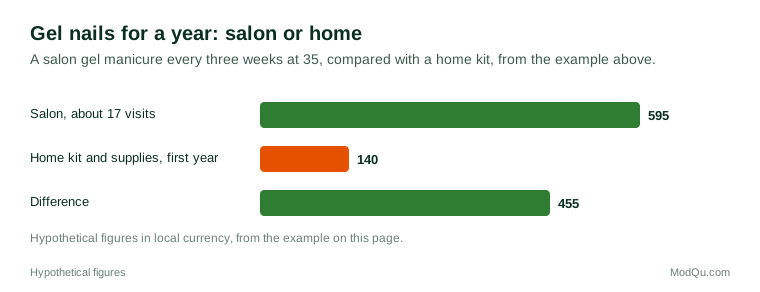
A person has a gel manicure at a salon every three weeks for 35 in their local currency, or about 17 times a year, costing 595. They buy a home gel kit for 60 and polishes and supplies for about 80 a year. Doing it at home costs about 140 in the first year, 455 less than the salon, though they still visit the salon for special events.
Pedicures and foot care
Pedicures usually include soaking the feet, trimming and shaping toenails, removing hard skin, massaging and, if wanted, applying polish. People have pedicures for appearance, comfort and, especially in warm weather, open shoes.
A pedicure is different from medical foot care. People with diabetes, circulation problems or painful nail conditions often see a podiatrist or chiropodist, a health professional who treats feet. Salons in many countries are not allowed to treat medical foot problems.
Nail health
Healthy nails are usually smooth and evenly coloured. Changes in nails, such as discolouration, thickening, ridges, pain or separation from the nail bed, can have many causes, including injury, fungal infection or other health conditions. People with such changes often consult a pharmacist, doctor or podiatrist rather than covering them with polish.
Common concerns linked to nail treatments include:
- Thin or weak nails after removing gel or acrylics too roughly.
- Damaged cuticles from cutting or pushing too hard.
- Infections if tools are not cleaned properly or the skin is cut.
- Allergic reactions to some ingredients in gels and acrylics, especially when they touch the skin before curing.
- Exposure to ultraviolet light from curing lamps, which has prompted some people to use sunscreen or fingerless gloves.
Salon safety and regulation
Rules for nail salons vary widely. In some countries and regions nail technicians must have a licence and salons are inspected; in others there are few formal requirements. Customers often look at:
- Whether tools are cleaned and sterilized between clients, or are single-use.
- Whether foot spas are cleaned properly.
- Whether the salon is well ventilated, as nail products can give off strong fumes.
- Whether technicians wear masks and gloves.
- Reviews and recommendations.
There have also been concerns in several countries about working conditions in some nail salons, including low pay and, in some cases, exploitation of workers.
Example
A customer notices that a new salon takes metal tools from a sealed pouch for each client and wipes down the table between appointments. At another salon nearby she saw tools reused from a cup. She chooses the first salon even though it costs a little more.
Trends and debates
Recent changes in nail care include:
- Nail art and social media, which spread new designs quickly.
- Press-on and reusable nails, which offer salon-style looks at home.
- Men's nail care and polish, which has become more visible.
- "Clean" and less harsh products, such as polishes labelled free of certain chemicals.
- Sustainability, including concern over single-use tools and products.
- Prices and tipping, and what a fair price is for skilled work.
What people and businesses want to know
Questions businesses want answered include how often people have their nails done, whether at a salon or at home, which treatments they choose, what they spend per visit and per year, how they choose a salon, and what concerns they have about safety and nail health.
Key terms
- ManicureA treatment for the hands and fingernails, often with polish.
- PedicureA treatment for the feet and toenails.
- CuticleThe thin layer of skin at the base of the nail.
- Gel polishPolish hardened under an ultraviolet or LED lamp.
- CuringHardening gel products under a lamp.
- Acrylic nailsNail enhancements made from a powder and liquid that harden in air.
- InfillFilling the gap that appears at the base of enhancements as nails grow.
- PodiatristA health professional who treats problems of the feet.
Full glossary: cosmetology terms on EditingTests.com.
Nail care vocabulary test
How well do you know the language of this topic? Try 8 quick questions. Your score is shown straight away and is not saved.
What the nail care survey asks
This survey is part of ModQu's Beauty and Personal Care survey. The nail care part takes about five minutes and covers:
- How often you have your nails done, and whether at a salon or at home.
- Which treatments you use, such as regular polish, gel, acrylics or press-ons.
- How much you spend per visit and in a typical year.
- How you choose a salon, and what matters most to you.
- Any problems you have had, such as damaged nails or reactions.
- Whether your nail care habits have changed recently, and why.
After that you can choose to continue with other short parts of the Beauty and Personal Care survey, such as skin care or hair care and salons, or stop.
Ready to take part?
Your answers help show what people really think and do. Results are only ever reported as totals; no one can see your individual answers.
Start the surveyQuestions about this survey
Who can take part?
Adults.
Do I have to give my name?
No. You may be asked for your age group, region and similar details so results can be broken down, but not your name. ModQu never asks for passwords, card numbers or account numbers.
How are the results used?
Answers are combined into totals and percentages and published in ModQu reports. Individual answers are never shown.
Is the vocabulary test part of the survey?
No. It is optional and separate, and your score is not stored.
How long does a salon manicure take?
A basic manicure often takes 30 to 45 minutes. Gel, acrylic sets and detailed nail art can take one to two hours.
Is it safe to remove gel polish at home?
Many people do, usually by soaking the nails in remover rather than peeling the gel off, which can take layers of the natural nail with it.