
Share your experience of going to the movies
Tell us how often you go to the cinema, what you spend and what makes you choose a theatre over streaming. Your answers are combined with other people's and reported only as totals.
Start the movies and cinemas surveyAbout 5 minutes. No account needed. You can stop at any time.
What this topic covers
This topic covers watching films, in a cinema and elsewhere:
- Multiplex cinemas with many screens, usually in malls and shopping areas.
- Independent and repertory cinemas that show older, foreign-language and art-house films.
- Premium formats, such as large-format screens, 3D, reclining seats and immersive sound.
- Drive-ins, still operating in some parts of Canada, mostly in summer.
- Film festivals, such as those held in Toronto, Montreal and Vancouver and in many smaller cities.
- Watching films at home through streaming, digital rental and purchase, and discs.
Streaming services in general are covered on the streaming TV and video page; this page focuses on films and on the choice between going out and staying in.
Why people go to the cinema
People who go to theatres give a range of reasons:
- The big screen and sound, especially for action, science fiction and animated films.
- Seeing a film when it comes out, before spoilers spread online.
- A night out or a date, often combined with dinner.
- A shared experience: laughing, jumping or cheering with a crowd.
- Getting the children out of the house, especially during school holidays.
- Fewer distractions than at home, with phones put away.
- Special events: opening nights, fan screenings, anniversaries of classic films, and live broadcasts of opera or theatre.
Example
A group of friends who usually stream films at home buy tickets for the opening night of the final film in a series they have followed since high school. They dress up, go out for dinner first, and stay for the scene after the credits. Asked why they did not wait to stream it, one says the night out was "half the point".
Why people stay home
People who go less often, or not at all, often mention:
- cost, especially for families;
- convenience: no travel, parking or set showtimes;
- comfort, with pausing, eating their own food and better control of noise;
- films arriving on streaming soon after release;
- large televisions and sound systems at home;
- behaviour of other audience members, such as talking and phone use;
- accessibility needs, although many cinemas now offer captioning devices and described video.
Example
A single parent of a toddler has not been to a cinema in three years. Paying for a babysitter on top of tickets makes a night out expensive. When the local cinema starts a monthly parents' screening with the lights partly up and the sound lower, they bring the toddler along and go most months.
What a cinema visit costs
The cost of a cinema visit is more than the ticket. People also pay for snacks, drinks, parking, and sometimes online booking fees or premium seats. Many cinemas offer discounts on certain days of the week, for children and seniors, or through loyalty and membership programs.
Example (hypothetical figures)
A family of four goes to a weekend afternoon showing. Two adult tickets cost $15 each and two child tickets $11 each, for $52. Two large popcorns and four drinks add $38, and online booking fees add $6. The total is $96. They rent a newly released film at home the next month for $25 and make their own popcorn.
The example shows why survey questions about spending look at the whole visit, not just tickets. Concession sales are an important source of cinema revenue, and food prices are a common complaint.
How films reach audiences
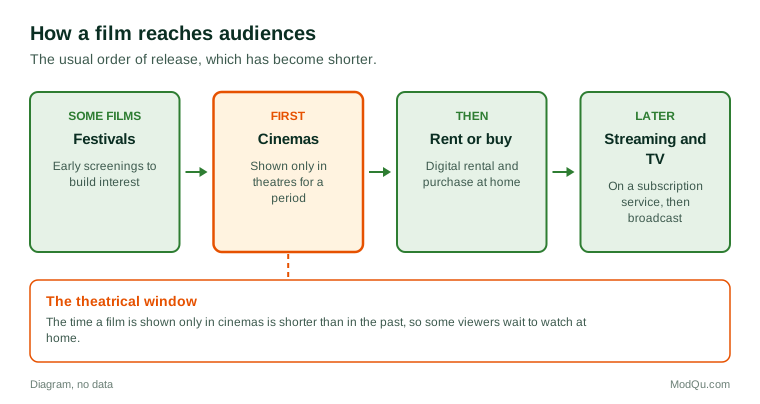
Films usually move through stages after they are finished:
- Festival screenings, for some films, to build interest and find distributors.
- Theatrical release, when the film is shown only in cinemas for a period, often called the theatrical window.
- Digital rental and purchase, where viewers can rent or buy the film online.
- Streaming, on a subscription service.
- Television broadcast, sometimes much later.
The time between cinema release and home viewing has become shorter than in the past, and some films go straight to streaming without a cinema release. People who know a film will be at home in a few weeks may decide to wait.
Example
A couple who love horror films notice that most of the ones they want to see now arrive on digital rental within weeks of their release. They now go to the cinema only for films they think will look and sound much better on a big screen, and rent the rest at home.
The cinema experience is changing
Cinemas have made changes to attract audiences:
- reclining seats and reserved seating;
- premium large screens and better sound;
- food and drink menus, including licensed areas;
- subscriptions that allow a number of films per month for a set fee;
- events, such as screenings of classic films, anime, concerts and sports;
- private rentals for birthday parties and companies.
Some of these changes raise prices, so cinemas try to balance comfort with value. Independent cinemas often focus on community: film clubs, talks with directors, local festivals and programs for students.
Canadian films
Canada has an active film industry in English, French and Indigenous languages, supported in part by public funding from Telefilm Canada, provincial agencies and tax credits. French-language Quebec films often do well in Quebec cinemas, while English-language Canadian films usually compete for screens with large American releases. Many Canadian films reach audiences through festivals, public broadcasters and streaming. Canada is also a major location for filming American productions, especially in Vancouver, Toronto and Montreal.
What people disagree about
Opinion is divided on whether cinemas will remain popular, whether films should reach streaming sooner, whether ticket and snack prices are fair, whether premium formats are worth paying for, how much public money should support Canadian film, and whether watching at home is "as good" as seeing a film in a theatre. These views often differ by age, family situation and how close people live to a cinema.
Key terms
- MultiplexA cinema with many screens.
- Theatrical windowThe period when a film is shown only in cinemas.
- Premium formatA screening with a larger screen, better sound or special seats.
- ConcessionsFood and drink sold at a cinema.
- Repertory cinemaA cinema that shows older and classic films.
- Box officeTicket sales for a film, or the place tickets are sold.
- Described videoNarration describing on-screen action for viewers who are blind or have low vision.
- DistributorThe company that brings a film to cinemas and other outlets.
Full glossary: cinema exhibition terms on EditingTests.com.
Movies and cinemas vocabulary test
How well do you know the language of this topic? Try 8 quick questions. Your score is shown straight away and is not saved.
What the movies and cinemas survey asks
This survey is part of ModQu's Media and Entertainment survey. The movies and cinemas part takes about five minutes and covers:
- How many times you went to a cinema in the past year.
- What makes you choose a cinema over watching at home, and the reverse.
- What you spend on a typical visit, including food and drink.
- Which formats and kinds of cinemas you go to.
- How you usually watch new films at home, and how long you are willing to wait.
- What would make you go to the cinema more often.
After that you can choose to continue with other short parts of the Media and Entertainment survey, such as streaming tv and video or music and podcasts, or stop.
Ready to take part?
Your answers help show what people really think and do. Results are only ever reported as totals; no one can see your individual answers.
Start the surveyQuestions about this survey
Who can take part?
Adults.
Do I have to give my name?
No. You may be asked for your age group, region and similar details so results can be broken down, but not your name. ModQu never asks for passwords, card numbers or account numbers.
How are the results used?
Answers are combined into totals and percentages and published in ModQu reports. Individual answers are never shown.
Is the vocabulary test part of the survey?
No. It is optional and separate, and your score is not stored.
Do film festivals count as going to the cinema?
Yes. The survey asks about any film screening you went to, including festivals, drive-ins and community screenings.