
Tell us about loyalty programs and deals
Tell us which programs you belong to, which you value and where you look for deals before you shop. Your answers are combined with other people's and reported only as totals.
Start the loyalty programs and deals surveyAbout 5 minutes. No account needed. You can stop at any time.
What loyalty programs are
A loyalty program rewards customers for buying from a company again and again. Members usually sign up with an email address or phone number and identify themselves at checkout with a card, an app or a linked payment card. In return they receive points, discounts, free items or special offers.
Common types include:
- points programs, where spending earns points that can be redeemed for discounts or products;
- coalition programs, where points are earned and redeemed at many partner businesses;
- tiered programs, where members reach levels such as silver or gold that bring extra benefits;
- paid memberships, where members pay a fee for free shipping, discounts or other perks;
- punch-card style programs, such as a free coffee after a set number of purchases;
- credit card rewards, which give points, miles or cash back on spending.
Many large programs are linked to grocery stores, pharmacies, gas stations, airlines, hotels and coffee chains.
How points work
Points programs set an earn rate, the number of points earned per dollar spent, and a redemption value, what the points are worth when spent. Comparing programs is hard because each uses its own currency. A program that gives 10 points per dollar is not necessarily better than one that gives 1 point per dollar; what matters is the value of the reward.
Example (hypothetical figures)
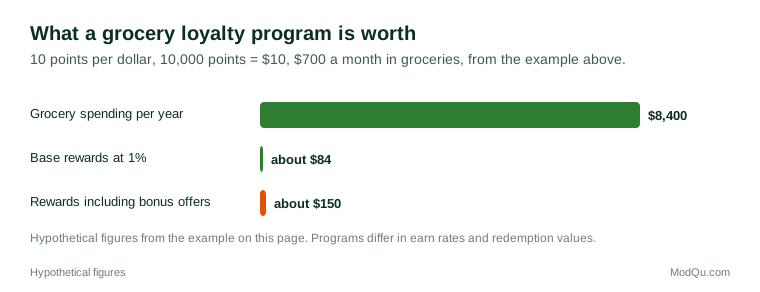
A shopper earns 10 points per dollar at a grocery store, and 10,000 points can be redeemed for $10 off. That is a return of 1%. She spends $700 a month on groceries, so she earns about $84 a year in rewards. Personalized bonus offers on items she already buys raise her total to about $150.
What members value
Shoppers value loyalty programs that are:
- easy to use, with automatic recognition at checkout;
- generous enough that rewards feel worthwhile;
- simple to understand and redeem;
- linked to stores they already use;
- free, or worth the fee for paid memberships.
Common frustrations include points that expire, changes that reduce the value of points, rewards that are hard to redeem, too many separate apps and cards, and offers on products they do not want.
Example
A man belongs to 14 loyalty programs but actively uses three: his grocery store, his pharmacy and a coffee app. He forgets the others at checkout. When a hardware store program changes its rules and his points lose value, he stops scanning his card there and shops wherever is closest.
Do programs change behaviour?
Retailers hope loyalty programs bring customers back more often and raise spending. Some shoppers do change where they shop to collect points or reach a reward. Others simply join the programs of stores they already use. Personalized offers, such as bonus points on a product a shopper buys regularly, are designed to increase visits and basket size.
Data and privacy
Loyalty programs collect detailed records of what members buy, when and where. Companies use this data to personalize offers, plan stock and prices, and sometimes to sell advertising to brands. Many members are comfortable with this exchange as long as they get value; others are uneasy about how much is known about them. Privacy laws require companies to explain how they use personal information and to obtain consent.
How people find deals
Beyond loyalty programs, shoppers use many tools to save money:
- weekly flyers, in print or in apps;
- flyer and price-comparison apps that gather offers from many stores;
- digital coupons loaded to a loyalty account;
- cash-back apps and websites, which pay back a share of purchases;
- price matching, where a store matches a competitor's advertised price;
- sale events such as Black Friday and Boxing Day;
- email and text offers from retailers;
- browser extensions that apply coupon codes at online checkouts.
Some shoppers spend a lot of time planning trips around deals; others take whatever offers appear at checkout.
Example
A retired couple review the flyers every Thursday on an app, make a list of the best grocery prices across three stores, and ask one store to price match. They say they save about $25 a week and enjoy the routine. Their daughter, who works full time, prefers to shop at one store and rely on her loyalty offers.
Paid memberships
Paid memberships charge a yearly or monthly fee in exchange for benefits such as free shipping, member prices or streaming services. Shoppers who use them often may save more than the fee; others pay for benefits they rarely use. Paid memberships can also make shoppers less likely to compare prices elsewhere.
Credit card rewards
Credit card rewards are a large part of how many people collect points. Shoppers choose cards based on the rewards they want, such as travel, cash back or store points. Card rewards are worth less than they appear if a balance is carried and interest is paid.
Fairness of sales and discounts
Shoppers sometimes doubt whether a sale price is a real saving. Advertising rules in Canada prohibit misleading claims about regular prices, but many shoppers still compare prices across stores before trusting a discount.
Small businesses and loyalty
Independent cafés, restaurants and shops often run simple programs through point-of-sale systems or apps. Shoppers say these feel more personal, but they add to the number of programs people must keep track of.
What retailers and marketers want to know
Retailers, program operators and brands want to understand how many programs people belong to, which they actually use, what rewards they value, how programs affect where people shop and how comfortable members are with the data collected.
Key terms
- Loyalty programA program that rewards customers for repeat purchases.
- Earn rateThe number of points earned per dollar spent.
- Redemption valueWhat points are worth when they are spent.
- Coalition programA program where points are earned and used at many partner businesses.
- Tiered programA program with levels that bring extra benefits as members spend more.
- Cash backA reward paid as a share of the purchase price.
- Price matchingA store matching a competitor's lower advertised price.
- BreakagePoints or rewards that are earned but never redeemed.
Full glossary: retail analytics terms on EditingTests.com.
Loyalty programs and deals vocabulary test
How well do you know the language of this topic? Try 8 quick questions. Your score is shown straight away and is not saved.
What the loyalty programs and deals survey asks
This survey is part of ModQu's Shopping and Retail survey. The loyalty programs and deals part takes about five minutes and covers:
- How many loyalty programs you belong to, and how many you use regularly.
- Which program you value most, and why.
- Whether you have changed where you shop to earn or use points.
- Where you look for deals before shopping: flyers, apps, coupons or cash-back sites.
- Whether you pay for any memberships, and whether they are worth it.
- How comfortable you are with the information programs collect about you.
After that you can choose to continue with other short parts of the Shopping and Retail survey, such as online shopping or groceries and food shopping, or stop.
Ready to take part?
Your answers help show what people really think and do. Results are only ever reported as totals; no one can see your individual answers.
Start the surveyQuestions about this survey
Who can take part?
Adults.
Do I have to give my name?
No. You may be asked for your age group, region and similar details so results can be broken down, but not your name. ModQu never asks for passwords, card numbers or account numbers.
How are the results used?
Answers are combined into totals and percentages and published in ModQu reports. Individual answers are never shown.
Is the vocabulary test part of the survey?
No. It is optional and separate, and your score is not stored.