
Share how you use laundry services
Tell us whether you use a laundry or dry cleaner, how often and how much you spend each month. Your answers are combined with other people's and reported only as totals.
Start the laundry services and dry cleaning surveyAbout 5 minutes. No account needed. You can stop at any time.
What laundry services cover
Laundry services are businesses that wash, dry, press or clean clothes and household textiles for customers. The main kinds are:
- Self-service laundromats, also called launderettes or coin laundries, where customers use machines themselves.
- Wash-and-fold or service washes, where staff wash, dry and fold laundry, usually charged by weight or by bag.
- Dry cleaners, which clean garments with solvents instead of water.
- Pressing and ironing services.
- Pickup and delivery services, often booked by app.
- Specialist cleaning, for wedding dresses, leather, suede, curtains, rugs and duvets.
- Alterations and repairs, often offered by dry cleaners.
- Commercial laundries, serving hotels, hospitals and restaurants.
In many countries, informal laundry work, such as washing clothes for neighbours, is also common.
Why people use laundry services
Reasons vary by household:
- No washing machine or dryer at home, common in some apartments, shared housing and student accommodation, and in many countries where home machines are less common.
- Lack of space for a dryer or for drying clothes indoors.
- Large or bulky items, such as duvets and curtains, that do not fit home machines.
- Delicate or tailored clothes, such as suits and wool coats.
- Saving time.
- Work uniforms and shirts needing a pressed finish.
- A broken machine or a move to a new home.
Example
A student in shared housing has no dryer, and the shared washer is often busy. Every Sunday they take two bags to a laundromat, where large dryers finish the load in under an hour. They use the time to study.
Laundromats
Laundromats offer washers and dryers that customers pay to use, by coin, card, token or app. Many have larger machines than homes, which are useful for bedding. Some also sell detergent, offer service washes, or include cafés and seating. In some countries laundromats are a normal part of daily life for millions of people in apartments without machines; in others they are mainly used for large items or during emergencies.
Dry cleaning
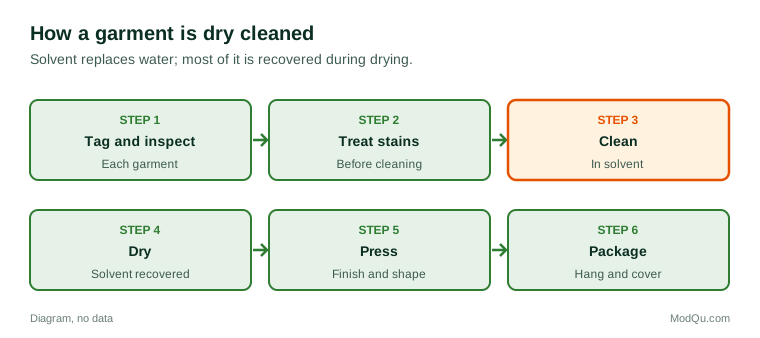
Dry cleaning is not actually dry. Garments are cleaned in a liquid solvent instead of water, which can be gentler on some fabrics and helps remove oil-based stains. The steps usually include:
- Tagging and inspecting each garment.
- Treating stains before cleaning.
- Cleaning in a machine with solvent.
- Drying inside the machine, which recovers much of the solvent.
- Pressing and finishing.
- Packaging, often on hangers in plastic covers.
The most widely used traditional solvent has been perchloroethylene, often called perc. Because of health and environmental concerns, several countries and regions have restricted or are phasing out its use. Alternatives include hydrocarbon solvents, silicone-based solvents and professional wet cleaning, which uses water with special machines and detergents.
Care labels
Most clothes carry care labels with symbols showing how they should be washed, dried, ironed and cleaned. An international system of symbols, based on a standard from the International Organization for Standardization (ISO 3758), is used in many countries, though some use their own. Common symbols include:
- A washtub, for washing, with a temperature or dots.
- A triangle, for bleaching.
- A square, for drying.
- An iron, for ironing, with dots for heat.
- A circle, for professional cleaning, with letters showing which process is suitable.
Many people do not understand all the symbols, and some ignore "dry clean only" labels and wash items at home.
Example
A person washes a wool jacket labelled "dry clean only" in their washing machine on a cool cycle. It shrinks by a size and the lining puckers. They take their next wool coat to a dry cleaner, which costs more but keeps its shape.
Costs
Prices depend on the country, city and type of service. Laundromats usually charge per wash and per drying cycle. Wash-and-fold services charge per kilogram or per bag. Dry cleaners usually charge per item, with higher prices for suits, coats and specialist garments. Pickup and delivery may add a fee or require a minimum order.
Example (hypothetical figures)
An office worker has five shirts laundered and pressed every week at 3 each in their local currency, or 15 a week. Over a month of four weeks, that is 60. They also dry clean one suit a month for 18. Their monthly spending on laundry services is 78.
Pickup apps and new services
App-based laundry services let people book collection and delivery, track orders and pay online. Some offer subscriptions for a set amount of laundry each month. They appeal to people with busy schedules, but may cost more than local laundromats and depend on reliable delivery. Lockers in apartment buildings and workplaces, where customers drop off and collect laundry, have also spread in some cities.
The environment
Laundry has several environmental effects:
- Energy and water use, which commercial machines may use more efficiently per load than home machines.
- Solvents used in dry cleaning.
- Microfibres released from synthetic fabrics during washing, which enter waterways.
- Plastic covers and hangers used by dry cleaners.
- Transport for pickup and delivery services.
Some dry cleaners now offer wet cleaning, reusable garment bags and hanger recycling. Some customers ask about these options before choosing a service.
Trends and debates
Current trends include:
- App-based laundry and subscriptions.
- Fewer formal clothes, with more casual work dress in some places reducing demand for dry cleaning.
- Greener dry cleaning methods.
- Laundromats as community spaces, sometimes with cafés or study areas.
- Hygiene concerns, especially after the COVID-19 pandemic.
What people and businesses want to know
Questions businesses want answered include how many people use laundromats, wash-and-fold services or dry cleaners, how often, what for, how much they spend each month, how they choose a service, and whether they would use pickup and delivery.
Key terms
- LaundromatA self-service laundry with washers and dryers for public use.
- Wash-and-foldA service where staff wash, dry and fold laundry for customers.
- Dry cleaningCleaning clothes with a liquid solvent instead of water.
- PerchloroethyleneA traditional dry cleaning solvent, often called perc.
- Wet cleaningProfessional cleaning with water, special machines and detergents.
- Care labelA label with symbols showing how to wash and care for a garment.
- PressingUsing heat and steam to remove creases and shape garments.
- MicrofibresTiny fibres released from synthetic fabrics during washing.
Full glossary: household cleaning supplies terms on EditingTests.com.
Laundry services and dry cleaning vocabulary test
How well do you know the language of this topic? Try 8 quick questions. Your score is shown straight away and is not saved.
What the laundry services and dry cleaning survey asks
This survey is part of ModQu's Household Life survey. The laundry services and dry cleaning part takes about five minutes and covers:
- Whether you use a laundromat, wash-and-fold service or dry cleaner, and which ones.
- How often you use them, and what items you take.
- How much you spend on laundry services in a typical month.
- Why you use these services instead of washing at home.
- Whether you have used, or would use, an app with pickup and delivery.
- What matters most to you when choosing a laundry service.
After that you can choose to continue with other short parts of the Household Life survey, such as cleaning and laundry or household chores and time use, or stop.
Ready to take part?
Your answers help show what people really think and do. Results are only ever reported as totals; no one can see your individual answers.
Start the surveyQuestions about this survey
Who can take part?
Adults.
Do I have to give my name?
No. You may be asked for your age group, region and similar details so results can be broken down, but not your name. ModQu never asks for passwords, card numbers or account numbers.
How are the results used?
Answers are combined into totals and percentages and published in ModQu reports. Individual answers are never shown.
Is the vocabulary test part of the survey?
No. It is optional and separate, and your score is not stored.
Can I wash dry clean only clothes at home?
Some people do with care, but the label reflects the maker's advice, and washing may shrink or damage some fabrics.
How long does dry cleaning take?
Many cleaners return items in one to three days, and some offer same-day service for an extra charge.