
Share your experience of decorating
Tell us whether you have redecorated recently, where you get ideas and whether you have hired a designer. Your answers are combined with other people's and reported only as totals.
Start the interior design and decorating surveyAbout 5 minutes. No account needed. You can stop at any time.
What this topic covers
This topic covers how people choose the look and feel of the inside of their homes:
- Decorating: paint, wallpaper, lighting, curtains, rugs, art and accessories.
- Furnishing: choosing and arranging furniture.
- Interior design: planning the layout, colours, materials and lighting of a space, sometimes with a professional.
- Styling and staging: arranging a home to look its best, often before selling.
- Organizing: storage and decluttering.
Larger building work such as moving walls is covered on the home renovation and repairs page, and buying furniture on the furniture and home furnishings page.
Why people decorate
Common reasons for redecorating include:
- moving into a new home, often the biggest time for decorating;
- making a space feel fresh after years in the same home;
- a change in household, such as a new baby, a partner moving in or a child leaving;
- working from home, which has led many people to create a home office;
- preparing to sell;
- wear and tear, when furniture, paint or floors look tired;
- personal expression: making the home feel like one's own.
Example
After working from a kitchen table for two years, a project manager turns a small spare room into an office. They paint the walls a soft green, add a desk lamp and a bookcase, and hang curtains to reduce glare on the screen. The project takes three weekends and they say it has made working from home feel more separate from family life.
Where people get ideas
People find decorating ideas in many places:
- social media and image-sharing platforms, where people save photos of rooms they like;
- home decorating shows on television and streaming;
- magazines and websites;
- store displays and showrooms;
- friends' and family members' homes;
- hotels, restaurants and cafés;
- designers and online design services.
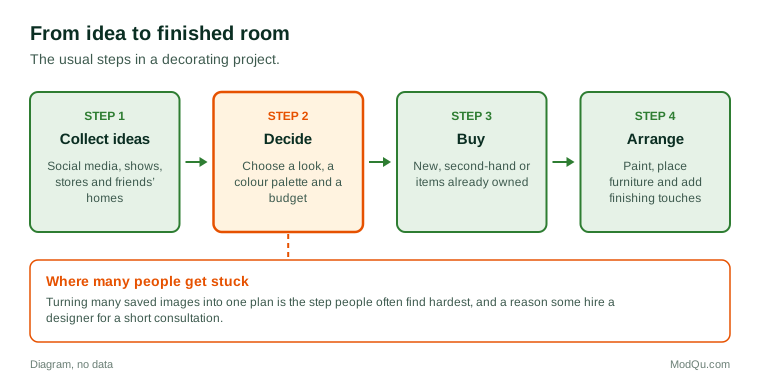
Many people say they find it hard to turn ideas into a plan. Saving hundreds of images can make it harder to decide, and rooms shown online are often styled and lit for photos. A colour that looks warm on a screen can look quite different on a wall in a north-facing room, which is why many people test paint samples before buying.
Questions businesses want answered here include which sources people use most, how they move from an idea to a purchase, and whether they buy online or in stores.
Budgets and priorities
Decorating budgets range from a few hundred dollars for paint and accessories to many thousands for a new room. People often have to decide where to spend and where to save:
- spending more on items used every day, such as a sofa, a mattress or a dining table;
- saving on accessories and trends that may change;
- buying second-hand or vintage for character and lower cost;
- doing it in stages, one room or one item at a time, as money allows.
Example (hypothetical figures)
A couple sets a $3,000 budget to redecorate their living room. They spend $1,600 on a sofa, $300 on paint and supplies, $450 on a rug, $250 on two lamps and $200 on curtains, a total of $2,800. They find a second-hand coffee table for $80 and frame prints they already own, finishing $120 under budget.
Doing it yourself or hiring help
Many people decorate on their own, painting, assembling furniture and arranging rooms themselves. Others hire help:
- Interior designers plan spaces, choose finishes and furnishings, and may manage contractors. Some provinces regulate the title "interior designer" for professionals with specific training.
- Decorators and stylists focus on colours, furnishings and accessories.
- Online design services offer room plans and shopping lists for a fixed fee.
- Store design services, sometimes free with a purchase.
- Painters, wallpaper installers and other trades for specific jobs.
People who hire a designer often say they did so to avoid costly mistakes, save time or get help with a large or complex project. Those who do not often mention cost or a wish to make their own choices.
Example
A family buying their first house hires a designer for a two-hour consultation rather than a full project. The designer suggests paint colours that work together across the open main floor and a furniture layout for the living room. The family does the rest themselves over the next year.
Styles and trends
Styles change over time. In recent years trends have included:
- warmer colours and natural materials, after years of grey and white;
- natural wood, stone and textured fabrics;
- plants throughout the home;
- vintage and second-hand pieces, valued for character and sustainability;
- multipurpose rooms that work as an office, guest room and gym;
- personal and eclectic rooms rather than matching sets.
Many people say they prefer a timeless look to following trends, while others enjoy changing their decor often. Concern about waste has led some people to buy less and keep furniture longer.
Renters and small spaces
Renters face limits on what they can change. Many leases restrict painting, nail holes or changes to fixtures. Renters often use removable wallpaper, rugs, lamps, curtains, plants and furniture to make a space their own, and ask landlords for permission to paint. People in small apartments and condos look for furniture that folds, stacks or stores items.
Example
A renter in a studio apartment cannot paint or change the overhead light. They use a large rug to mark out a living area, a bookshelf as a room divider, plug-in wall lamps and peel-off wallpaper behind the bed. When they move out, everything comes down without leaving marks.
What people disagree about
Opinion is divided on whether hiring a designer is worth the cost, whether to follow trends, whether fast-changing decor is wasteful, how much to spend on furniture, and whether open-concept layouts work for family life. Survey questions help show how decorating habits differ by age, budget and whether people rent or own.
Key terms
- Interior designPlanning the layout, colours, materials and lighting of a space.
- DecorThe furnishings and decoration of a room.
- Accent wallOne wall painted or covered differently from the others.
- Colour paletteA set of colours chosen to work together.
- StagingArranging a home to look its best, often before selling.
- Mood boardA collection of images and samples used to plan a look.
- Focal pointThe feature that draws the eye in a room.
- Open conceptA layout where kitchen, dining and living areas share one space.
Full glossary: interior design terms on EditingTests.com.
Interior design and decorating vocabulary test
How well do you know the language of this topic? Try 8 quick questions. Your score is shown straight away and is not saved.
What the interior design and decorating survey asks
This survey is part of ModQu's Home and Property survey. The interior design and decorating part takes about five minutes and covers:
- Whether you have redecorated a room in the last year, and which one.
- Where you get decorating ideas.
- How much you spent, and what you spent most on.
- Whether you have hired an interior designer, decorator or online design service.
- Which styles you like, and how often you change your decor.
- What stops you from decorating more.
After that you can choose to continue with other short parts of the Home and Property survey, such as buying a home or renting, or stop.
Ready to take part?
Your answers help show what people really think and do. Results are only ever reported as totals; no one can see your individual answers.
Start the surveyQuestions about this survey
Who can take part?
Adults.
Do I have to give my name?
No. You may be asked for your age group, region and similar details so results can be broken down, but not your name. ModQu never asks for passwords, card numbers or account numbers.
How are the results used?
Answers are combined into totals and percentages and published in ModQu reports. Individual answers are never shown.
Is the vocabulary test part of the survey?
No. It is optional and separate, and your score is not stored.
Can renters take part?
Yes. Renters are asked about the changes they can make and the limits they face.