
Share your experience of inheritance
Tell us whether you have been involved in a disagreement over a will or an estate, and how it ended. Your answers are combined with other people's and reported only as totals.
Start the inheritance disputes surveyAbout 5 minutes. No account needed. You can stop at any time.
What an inheritance dispute is
An inheritance dispute is a disagreement about how the property of a person who has died should be shared. The property, called the estate, can include a home, savings, investments, a car, personal belongings, a business and debts. The person who died is often called the deceased, and the people who receive something are called beneficiaries or heirs.
Disputes can be about many different things:
- Whether a will is valid, for example because it was not signed properly or the person may not have understood what they were signing.
- What a will means, when its wording is unclear or describes property that no longer exists.
- Whether the shares are fair, when a close relative is left out or receives much less than expected.
- How the estate is being managed, when beneficiaries think the person in charge is too slow, is not sharing information, or is favouring someone.
- Who owns a particular item, such as a family home, a piece of land or an heirloom with sentimental value.
- Debts and gifts made before death, when some family members received money earlier and others did not.
Many disputes are settled quietly within families. Others involve lawyers, mediators and, in a minority of cases, a court.
How estates are usually settled
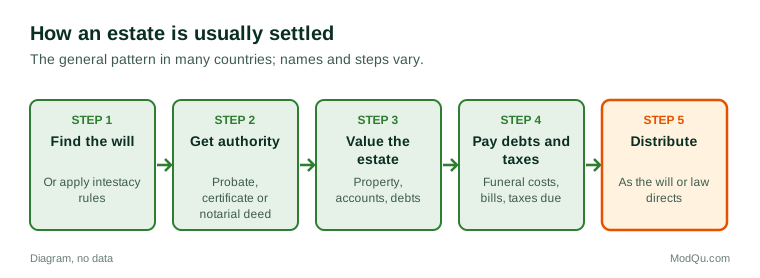
The general process is similar in many countries, even though the names and steps differ.
- Finding the will, if there is one. A will names who should receive the estate and usually names a person to carry out its instructions, often called an executor.
- Getting authority to act. In many countries the executor applies to a court or public office for a document that confirms their authority. This is called probate in many English-speaking countries; other systems use a certificate of inheritance or a notarial deed.
- Valuing the estate. Property, accounts and debts are listed and valued.
- Paying debts and taxes. Bills, loans, funeral costs and any taxes due are paid from the estate before anything is shared.
- Distributing what is left to the beneficiaries, as the will or the law directs.
When a person dies without a valid will, this is called dying intestate. The law of the country, or of the region, then sets out who inherits, usually starting with a spouse or partner and children. The person who manages the estate in that case is often called an administrator.
Example
An adult son is named as executor in his mother's will. His two sisters are equal beneficiaries. Eighteen months later the house has not been sold and the sisters have received no accounts. They ask a lawyer to write to their brother asking for a full list of what the estate holds and spends.
Why families disagree
Inheritance disputes are rarely only about money. They often follow long family histories, and grief can make ordinary disagreements sharper. Common triggers include:
- Second marriages and blended families, where children from an earlier relationship and a later partner may have different expectations.
- A carer who expected more, for example an adult child who gave up work to look after a parent for years.
- A late change to the will, made shortly before death or during an illness, which other relatives see as suspicious.
- Undue influence, a claim that someone pressured the person into changing their will.
- Lack of mental capacity, a claim that the person did not understand what they were doing when the will was made.
- Unequal lifetime gifts, such as help with a home deposit given to one child but not another.
- Homemade or very old wills, which may be unclear, unsigned or out of date.
- Property that cannot be divided easily, such as a family home, farm or business that several heirs want to keep or sell.
Example
A widower remarries and later writes a new will leaving his house to his second wife. His children from his first marriage believe he had promised the house to them. They question whether he understood the change, because he was in hospital at the time it was signed.
Who can challenge a will
Who may bring a claim, and on what grounds, varies widely between legal systems. In broad terms there are two main traditions.
- Freedom of testation. In many common law countries, such as England and Wales, Canada, Australia and the United States, people are largely free to leave their property to whomever they choose. Relatives who are left out may still be able to make a claim in some places, for example if they were financially dependent on the person, but there is no automatic share.
- Forced heirship. In many civil law countries, for example France, Spain and much of Latin America, and under Islamic inheritance rules followed in a number of countries, part of the estate must go to certain close relatives, often children and a spouse. A will that leaves them out may be reduced to protect their share.
Some countries also have separate rules for property held jointly, which usually passes straight to the surviving owner, and for pensions or life insurance, which may go to a named beneficiary outside the will. Time limits for bringing a claim can be short, sometimes measured in months. Because the rules differ so much, people in a dispute usually look for advice that applies to the country, and sometimes the region, where the estate is being settled.
Ways disputes are resolved
Disputes end in several different ways, and many pass through more than one stage.
- Informal family discussion, sometimes after a period of time has passed.
- Letters between lawyers, setting out each side's position and possible terms.
- Mediation, in which a neutral person helps the parties reach their own agreement. Some courts expect parties to try this first.
- Negotiated settlement, such as buying out another heir's share of a house or adjusting shares to recognize years of care.
- A court decision, which can confirm or set aside a will, interpret its wording, remove an executor or decide a claim for provision.
Example (hypothetical figures)
Three siblings inherit a house valued at 300,000 in their local currency. One sibling wants to live in it; the other two want to sell. They agree, through mediation, that the sibling who stays will buy out the other two. Each of the others receives one third, or 100,000, and the cost of the mediator is shared equally.
Each route has trade-offs. A court gives a binding answer but can take a long time and cost a large share of a modest estate. Mediation and settlement are often quicker and cheaper and may protect family relationships, but they rely on both sides being willing to compromise.
Costs, time and the use of lawyers
Legal costs in inheritance cases depend on the country, the complexity of the estate and how far the dispute goes. In some systems the costs of a dispute may be paid out of the estate, which reduces what everyone receives; in others each side usually pays its own costs, or the losing side pays more. Some lawyers offer fixed fees for estate administration but charge by the hour for disputes.
Preventing disputes
Many disputes are linked to things that could have been dealt with before death. People who work with estates often point to the same steps that families take to reduce disagreement:
- Making a formal will and reviewing it after major life events, such as marriage, divorce or the birth of a grandchild.
- Keeping records of large gifts or loans made during life.
- Explaining decisions to family members while still alive, or leaving a letter of wishes.
- Choosing an executor who is organized, trusted and able to deal with the work.
- Keeping documents, account details and passwords where an executor can find them.
What people and businesses want to know
Questions businesses and public bodies want answered include how often families disagree over estates, what the disagreements are usually about, how many people use a lawyer or mediator, how long disputes last, what they cost, and how satisfied people are with the result. Consumer protection bodies are also interested in whether people understand their rights, and whether they know the time limits for making a claim.
```faq Does every estate go through a court? | No. In many countries small or simple estates can be settled without a court, while others always involve a notary or public office. The rules vary by country.
Key terms
- EstateEverything a person owned and owed at the time of death.
- WillA formal document setting out who should receive a person's property after death.
- ExecutorThe person named in a will to carry out its instructions.
- IntestateDying without a valid will, so the law decides who inherits.
- BeneficiaryA person or organization that receives something from an estate.
- ProbateIn many countries, the court process that confirms a will and the executor's authority.
- Forced heirshipRules that reserve part of an estate for certain close relatives.
- Undue influencePressure on a person that leads them to make or change a will against their own wishes.
Full glossary: estate planning terms on EditingTests.com.
Inheritance disputes vocabulary test
How well do you know the language of this topic? Try 8 quick questions. Your score is shown straight away and is not saved.
What the inheritance disputes survey asks
This survey is part of ModQu's Law and Rights survey. The inheritance disputes part takes about five minutes and covers:
- Whether you have received, or expect to receive, an inheritance.
- Whether you have been involved in a disagreement over a will or an estate, and what it was about.
- Who was involved, for example siblings, a step-parent or other relatives.
- Whether you used a lawyer, a mediator or a court, and what it cost.
- How the disagreement was resolved and how long it took.
- How satisfied you were with the outcome, and what you would do differently.
After that you can choose to continue with other short parts of the Law and Rights survey, such as using a lawyer or consumer rights and complaints, or stop.
Ready to take part?
Your answers help show what people really think and do. Results are only ever reported as totals; no one can see your individual answers.
Start the surveyQuestions about this survey
Who can take part?
Adults who received or expect an inheritance.
Do I have to give my name?
No. You may be asked for your age group, region and similar details so results can be broken down, but not your name. ModQu never asks for passwords, card numbers or account numbers.
How are the results used?
Answers are combined into totals and percentages and published in ModQu reports. Individual answers are never shown.
Is the vocabulary test part of the survey?
No. It is optional and separate, and your score is not stored.