
Share your views on housing and homelessness
Tell us how housing costs affect you, how serious homelessness is where you live and what you think should be done. Your answers are combined with other people's and reported only as totals.
Start the housing and homelessness surveyAbout 5 minutes. No account needed. You can stop at any time.
What this topic covers
This topic is about two linked issues. The first is housing affordability: whether people can pay for a suitable home, rented or owned, without going short on other needs. The second is homelessness: when people have no home of their own, or only an unsafe or temporary place to stay.
They are linked because when rents and prices rise faster than incomes, more households fall behind, move into crowded or poor housing, or lose their home altogether. The same pressures affect people very differently depending on income, age, health, family situation and where they live.
Housing costs and affordability
A common rule of thumb says housing is affordable when it costs no more than about 30% of a household's income before tax. Many governments and researchers use that line or a similar one. Housing costs usually include:
- rent, or mortgage payments for owners;
- property taxes and building service charges;
- utilities such as heat, electricity and water;
- insurance and repairs.
When costs take a much larger share, households cut back on food, heating, transport or savings, or take on debt. Young adults may stay with their parents longer, families may share homes, and some people move far from work to find lower rents.
Example (hypothetical figures)
A single parent earns $3,200 a month before tax. Rent is $1,450 and utilities are $150, so housing takes $1,600, or 50% of income. When the landlord raises the rent by 8%, rent becomes $1,566 and total housing costs reach $1,716, about 54% of income. The parent starts skipping meals to keep the rent paid.
What homelessness includes
Homelessness is wider than sleeping on the street. Many definitions, including one used by the European Federation of National Organisations Working with the Homeless, describe a range:
- Rooflessness: sleeping rough, in parks, doorways, vehicles or tents.
- Houselessness: staying in emergency shelters, hostels or temporary accommodation.
- Insecure housing: staying with friends or family with no right to stay ("couch surfing"), facing eviction, or living under threat of violence.
- Inadequate housing: living in places unfit to live in, such as unsafe buildings, or in severe overcrowding.
Much homelessness is hidden. People staying temporarily with friends, or families living in a single motel room, are often not counted in street counts. In many lower-income countries, large informal settlements house millions of people in homes without secure tenure, clean water or sanitation, which is a different form of housing need again.
Why people become homeless
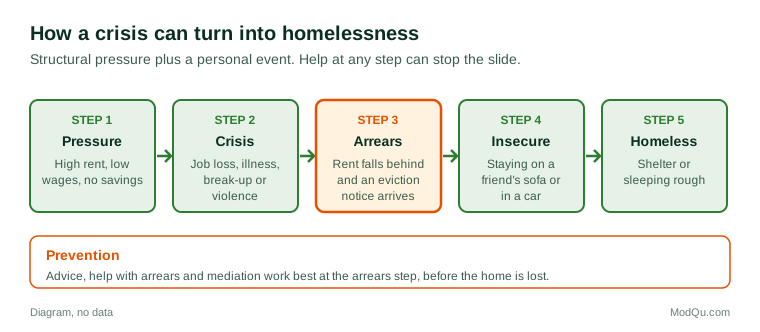
Researchers usually describe homelessness as the result of structural causes and personal events acting together.
Structural causes include high rents, a shortage of low-cost homes, low wages, gaps in welfare benefits, and discrimination in housing. Personal and family events include job loss, illness, relationship breakdown, domestic violence, leaving prison or foster care, mental illness and addiction. When housing is scarce and costly, a single crisis is more likely to end in homelessness.
Example
A warehouse worker hurts his back and cannot work for three months. His sick pay runs out after six weeks, he falls two months behind on rent and receives an eviction notice. He moves onto a friend's sofa, then into his car. He is not counted in the city's homeless count because he is never in a shelter or on the street on the night of the count.
Who is most affected
Groups at higher risk differ between countries but often include:
- people on low incomes, including people working in low-paid jobs;
- young people leaving foster care or family conflict;
- women and children escaping domestic violence;
- people with mental illness or addiction;
- people leaving prison or hospital with nowhere to go;
- Indigenous peoples and some ethnic minorities in several countries;
- recent migrants and refugees;
- older people on fixed incomes when rents rise.
Responses to homelessness
Responses usually fall into three groups:
- Prevention: help with rent arrears, legal advice before eviction, mediation with landlords or family, and planning for people leaving care, prison or hospital.
- Emergency help: shelters, hostels, meals, outreach workers, day centres and health care for people on the street.
- Long-term housing: social or public housing, rent subsidies, and support to keep a tenancy.
One approach, called Housing First, gives people who have been homeless for a long time a permanent home straight away, with support for health or addiction offered but not required. Evaluations in several countries have found that most people housed this way keep their homes. Others prefer "staircase" models, where people move through stages of shelter and transitional housing before getting their own home.
Example
A city's outreach team works with a woman who has slept rough for four years. Shelters have not worked for her because she cannot bring her dog. Under a Housing First program she moves into a small flat with her dog and weekly visits from a support worker. A year later she is still there and has started treatment for a long-standing health problem.
Building more homes
Many people see the shortage of homes as the root problem. Proposals include changing zoning rules to allow more homes on existing land, building more social or public housing, taxing empty homes, limiting short-term rentals, and offering incentives for low-cost housing. Others support rent controls or caps on rent increases to protect current tenants. Each option has costs and trade-offs, and economists and residents disagree about which work best.
What people disagree about
People disagree about how serious homelessness is where they live, who is responsible (individuals, families, landlords, governments), whether to spend more on shelters or on permanent housing, whether rough sleeping should be banned in public places, and whether new housing should be built in their own neighbourhood. Many say they support more affordable homes in general but object to particular projects nearby, an attitude sometimes called "not in my back yard".
Questions that governments, foundations, housing providers and media want answered include how many people are struggling with housing costs, how many have ever been without a home, how serious people think the problem is locally, and which responses have public support.
Key terms
- AffordabilityWhether a household can pay for housing without going short on other needs.
- Rough sleepingSleeping outdoors or in places not meant for living, such as doorways or vehicles.
- Hidden homelessnessHomelessness not seen in official counts, such as staying on friends' sofas.
- EvictionLegal removal of a tenant from a home.
- Social housingHomes owned or managed by governments or non-profit groups and let at lower rents.
- Housing FirstAn approach that gives homeless people a permanent home first, with support offered.
- Rent arrearsRent that is overdue and unpaid.
- Informal settlementAn area of housing built without legal tenure or planning permission.
Full glossary: affordable housing development terms on EditingTests.com.
Housing and homelessness vocabulary test
How well do you know the language of this topic? Try 8 quick questions. Your score is shown straight away and is not saved.
What the housing and homelessness survey asks
This survey is part of ModQu's Communities and Society survey. The housing and homelessness part takes about five minutes and covers:
- How much of your income goes on housing, and whether that has changed recently.
- Whether you have ever been without a home of your own, including staying with friends.
- How serious you think homelessness is where you live.
- Who you think should be responsible for solving it.
- Which responses you support: prevention, shelters, permanent housing, more homes or rent limits.
- Whether you would support more affordable housing in your own neighbourhood.
After that you can choose to continue with other short parts of the Communities and Society survey, such as neighbourhoods and community life or loneliness and social connection, or stop.
Ready to take part?
Your answers help show what people really think and do. Results are only ever reported as totals; no one can see your individual answers.
Start the surveyQuestions about this survey
Who can take part?
Adults.
Do I have to give my name?
No. You may be asked for your age group, region and similar details so results can be broken down, but not your name. ModQu never asks for passwords, card numbers or account numbers.
How are the results used?
Answers are combined into totals and percentages and published in ModQu reports. Individual answers are never shown.
Is the vocabulary test part of the survey?
No. It is optional and separate, and your score is not stored.
Do I have to say if I have been homeless?
No. You can skip any question. Answers are anonymous and used only in grouped results.