
Share your experience of home security
Tell us how you protect your home, whether your system is monitored and how worried you are about break-ins. Your answers are combined with other people's and reported only as totals.
Start the home security surveyAbout 5 minutes. No account needed. You can stop at any time.
What this topic covers
Home security covers the steps people take to protect their home, belongings and family from break-ins, theft and other threats. This topic includes:
- Basic measures: strong doors and locks, window locks, outdoor lighting and good habits.
- Alarm systems with sensors on doors and windows, motion detectors and sirens.
- Cameras and video doorbells.
- Professional monitoring, where a company watches for alarms around the clock.
- Smart locks and access codes.
- Safety devices connected to security systems, such as smoke, carbon monoxide and leak detectors.
- Neighbourhood measures, such as neighbourhood watch groups and community apps.
It applies to homeowners and renters, though renters may need a landlord's permission for some changes.
How worried people are
Concern about crime at home varies widely. It depends on where people live, whether they or a neighbour have had a break-in, how much time the home is empty, and what they see in the news and on social media. Perceptions do not always match local crime levels: some people in low-crime areas worry a great deal, while some in higher-crime areas worry less.
Common worries include:
- break-ins while away or at night;
- parcel theft from doorsteps;
- car theft from driveways;
- vandalism;
- safety of family members home alone, such as children after school or an older parent.
Example
A family returns from a week away to find a neighbour's house was broken into while they were gone. Although nothing happened to their own home, they install a video doorbell, buy timers for their lights and ask another neighbour to collect parcels the next time they travel.
Kinds of security systems
Security systems range from simple to complex:
- Do-it-yourself kits with sensors, a hub and an app, installed by the owner.
- Professionally installed systems, often with a contract.
- Camera-only setups, using indoor and outdoor cameras and a video doorbell.
- Smart home systems that combine security with lighting, locks and thermostats.
Many systems now connect to a phone app that sends alerts, shows live video and lets the owner arm or disarm the system from anywhere.
Monitored or self-monitored
A key choice is who responds when an alarm goes off:
- Professionally monitored systems send alarms to a monitoring centre, where staff check the alert and may call the owner, a contact or emergency services. This usually costs a monthly fee and may require a contract.
- Self-monitored systems send alerts only to the owner's phone. The owner decides what to do. This costs less but depends on the owner seeing the alert and responding.
Many municipalities in Canada have rules on false alarms, and some charge fees when police or fire services respond to repeated false alarms from monitored systems.
Example
A nurse who works night shifts chooses a professionally monitored system because she often cannot check her phone at work. Her brother, who works from home, uses a self-monitored camera system and checks alerts himself. Both say they chose what fitted their routines.
Costs
Home security costs include:
- equipment, from inexpensive cameras to full alarm systems;
- installation, unless the owner does it;
- monitoring fees, usually monthly;
- cloud video storage plans for cameras;
- contracts, which may lock a customer in for several years;
- replacement batteries and upgrades.
Some home insurers offer a discount for monitored alarm systems. People often weigh the ongoing cost against how much safer they feel, and some cancel monitoring after a few years without problems.
Example (hypothetical figures)
A homeowner compares two options over three years. A monitored system costs $300 to install and $35 a month, a total of $1,560. A self-monitored kit with two cameras costs $450 plus $10 a month for video storage, a total of $810. Their insurer offers a 10 percent discount on a $1,200 yearly premium for a monitored alarm, saving $360 over three years and bringing the monitored option's net cost to $1,200.
Cameras, privacy and neighbours
Cameras and video doorbells have become very common. They can deter theft, record evidence and show who is at the door. They also raise questions:
- recording neighbours, passers-by and the street;
- recording sound as well as video;
- sharing footage on social media or with police;
- storing video on company servers;
- false alarms from animals, weather and passing cars.
The Office of the Privacy Commissioner of Canada and provincial privacy offices have published guidance on home cameras, such as pointing them at one's own property and avoiding recording neighbours' windows or yards.
Example
A homeowner installs an outdoor camera above the garage. A neighbour mentions that it seems to cover their back yard, where their children play. The homeowner checks the view in the app, moves the camera and uses the privacy zone setting to block out the neighbour's yard. The neighbour thanks them, and they agree to share footage if either has a problem.
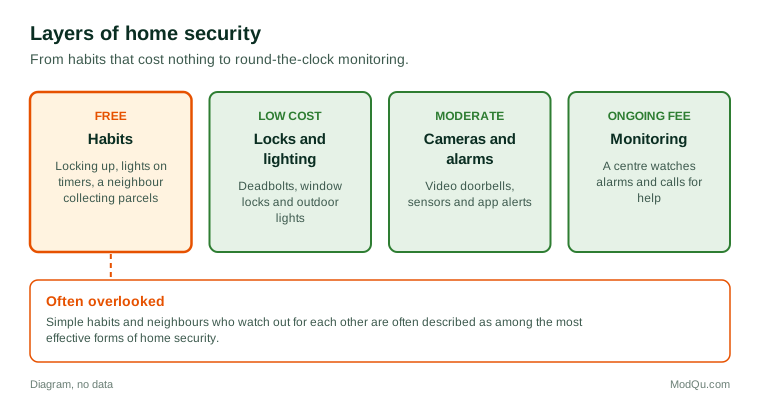
Simple habits and community
Many security measures cost little or nothing:
- locking doors and windows, including when at home;
- not leaving spare keys in obvious places;
- using timers on lights while away;
- asking a neighbour to collect mail and parcels;
- not posting travel plans publicly while away;
- trimming bushes that hide doors and windows;
- recording serial numbers of valuables.
Neighbours who know each other and watch out for one another are often described as one of the most effective forms of security. Local police services offer crime prevention advice and some run home security assessments.
What people disagree about
Opinion is divided on whether cameras make neighbourhoods safer or less private, whether monitoring is worth the monthly cost, whether sharing doorbell footage with police should be encouraged, and how much fear of crime is driven by social media. Survey questions help show how these views differ by area, age and past experience.
Key terms
- Monitored systemAn alarm watched around the clock by a monitoring centre.
- Self-monitored systemAn alarm that sends alerts only to the owner.
- Motion detectorA sensor that detects movement in a room or area.
- Contact sensorA sensor that detects when a door or window opens.
- Video doorbellA doorbell with a camera that records and sends alerts.
- False alarmAn alarm set off when there is no real threat.
- Smart lockA lock opened with a code, phone or fingerprint.
- DeadboltA lock with a bolt that cannot be pushed back without a key or turn.
Full glossary: alarm monitoring services terms on EditingTests.com.
Home security vocabulary test
How well do you know the language of this topic? Try 8 quick questions. Your score is shown straight away and is not saved.
What the home security survey asks
This survey is part of ModQu's Home and Property survey. The home security part takes about five minutes and covers:
- Whether you have a home security system, cameras or a video doorbell.
- Whether your system is professionally monitored or self-monitored, and why.
- What you pay for equipment and monitoring.
- How worried you are about break-ins, parcel theft and car theft.
- Whether your home or a neighbour's has been broken into.
- What security product or service you are most likely to buy next.
After that you can choose to continue with other short parts of the Home and Property survey, such as buying a home or renting, or stop.
Ready to take part?
Your answers help show what people really think and do. Results are only ever reported as totals; no one can see your individual answers.
Start the surveyQuestions about this survey
Who can take part?
Homeowners and renters.
Do I have to give my name?
No. You may be asked for your age group, region and similar details so results can be broken down, but not your name. ModQu never asks for passwords, card numbers or account numbers.
How are the results used?
Answers are combined into totals and percentages and published in ModQu reports. Individual answers are never shown.
Is the vocabulary test part of the survey?
No. It is optional and separate, and your score is not stored.
Will the survey ask where I live or about my security setup in detail?
You may be asked your province and the type of area you live in, but never your address or details of how your home is protected.