
Share your experience of energy bills
Tell us how you heat your home, what you pay and what you have done to save energy. Your answers are combined with other people's and reported only as totals.
Start the home energy use and bills surveyAbout 5 minutes. No account needed. You can stop at any time.
What home energy use covers
Home energy use is all the energy a household buys to run its home. In most Canadian homes it comes from one or two sources: electricity, and a heating fuel such as natural gas, heating oil, propane or wood. Some homes run entirely on electricity.
The main uses are:
- Space heating, which in a cold climate is usually the largest single use in a year.
- Water heating for showers, laundry and dishes.
- Cooling, mainly air conditioning in summer, which matters more in some regions than others.
- Appliances such as the fridge, freezer, stove, washer and dryer.
- Lighting and electronics, including televisions, computers, chargers and devices left on standby.
- Vehicles charged at home, a growing use in households with an electric car.
Where a home is, how old it is, how well it is insulated and how many people live in it all change the mix. A newer apartment in a mild city and an older detached house in a cold region can use very different amounts of energy for the same daily routine.
How an energy bill is built
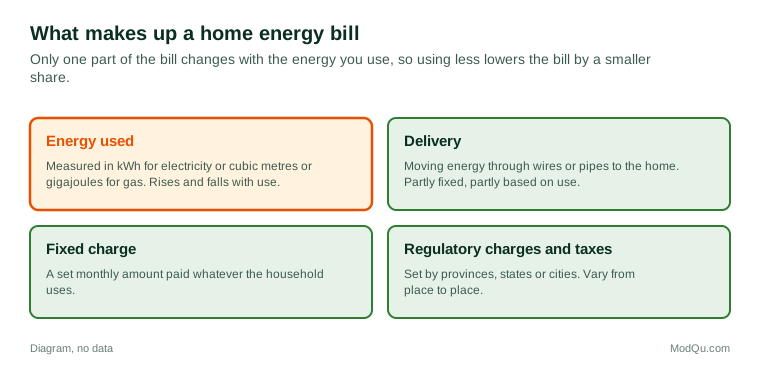
Energy bills look different from one utility to another, but most combine the same parts:
- The energy itself, measured in kilowatt-hours (kWh) for electricity and in cubic metres or gigajoules for natural gas.
- Delivery or distribution charges for moving energy through wires or pipes to the home.
- A fixed monthly charge that is paid whatever the household uses.
- Regulatory charges and taxes, which vary by province, state or city.
In Canada, electricity and natural gas rates are mostly set or approved by provincial regulators, and the companies involved range from public utilities owned by a province or city to private firms. In some places customers can buy energy from a retailer instead of the default supplier, often on a fixed-price contract.
Some electricity customers pay different prices at different times of day. Time-of-use pricing charges more during busy periods, such as weekday evenings, and less overnight and at weekends. Tiered pricing charges a lower rate for the first block of energy each month and a higher rate after that.
Example (hypothetical figures)
A household's monthly electricity bill shows 900 kWh used. At a hypothetical average price of 13 cents per kWh, the energy costs $117.00. Delivery adds $45.00, a fixed charge adds $25.00 and taxes add $9.35, for a total of $196.35. Only about 60% of the bill is for the energy itself, so using 10% less energy lowers the bill by much less than 10%.
Heating choices
Because heating is such a large part of energy use, the heating system shapes the bill more than almost anything else. The main options are:
- Natural gas furnaces and boilers, common in many Canadian cities where a gas network exists.
- Electric baseboard heaters, simple and cheap to install but often costly to run where electricity prices are high.
- Heating oil and propane, used mainly in rural homes and in places without a gas network.
- Wood and pellet stoves, used as a main or backup source in some regions.
- Heat pumps, which move heat from the outside air or the ground into the home rather than producing it by burning fuel.
Heat pumps have become a common topic. Air-source models work in winter and also cool the home in summer. Cold-climate models are designed to keep working at low outdoor temperatures, though many homes keep a backup heat source for the coldest days. Governments and utilities in Canada and elsewhere have offered rebates and loans for heat pumps, insulation and other upgrades, and these programs change over time.
Example
A family in an older house with an oil furnace is told the furnace is near the end of its life. They get three quotes: a new oil furnace, a cold-climate heat pump with the old furnace kept as backup, and a heat pump with an electric backup. The heat pump options cost more up front. They choose the second option because a provincial rebate covers part of the cost and they want to keep a backup they already trust.
How households try to save energy
Most households take at least a few steps to use less energy. The common ones fall into three groups.
Low-cost habits:
- turning the thermostat down at night or when out, often with a programmable or smart thermostat;
- washing clothes in cold water and air-drying some loads;
- switching off lights and unplugging devices;
- running the dishwasher and laundry in off-peak hours under time-of-use pricing.
Small purchases:
- LED light bulbs;
- weatherstripping and caulking around doors and windows;
- low-flow showerheads;
- choosing efficient appliances when old ones need replacing. In Canada, the ENERGY STAR label and the EnerGuide rating help buyers compare models.
Larger upgrades:
- adding insulation in the attic or walls;
- replacing windows and doors;
- replacing a furnace, boiler or water heater;
- installing a heat pump or rooftop solar panels.
A home energy evaluation, sometimes called an energy audit, uses tests such as a blower door test to find where heat is lost and which upgrades would help most.
Example
A couple renting an apartment cannot change the windows or heating system. They ask the landlord to fix a draughty balcony door, buy a draught stopper, move laundry to the evening when the off-peak rate applies and turn down the thermostat by two degrees overnight. They do not know how much they saved, but the winter bills feel more manageable.
Renters, owners and who pays
Who pays the bill affects what gets done. Owners who pay their own bills gain directly from upgrades, but they may plan to move before an expensive upgrade pays for itself. Renters may pay the bills but cannot change the building. In some apartments, heat is included in the rent, so tenants have little reason to save and landlords carry the cost.
This split is sometimes called the split incentive: the person who would pay for an improvement is not the person who would benefit. It is one reason older rental buildings are often less efficient.
Common problems and worries
People raise similar concerns about energy bills:
- Price rises they cannot control, especially in winter.
- Estimated bills that are later corrected with a large catch-up charge.
- Bills that are hard to read, with many lines of charges.
- High winter bills for homes with electric heat, which some utilities spread out with an equal-payment or budget billing plan.
- Energy poverty, where a household spends a large share of its income on energy and may cut back on heating to afford other needs.
- Door-to-door and phone sales of energy contracts or equipment rentals that some customers later regret.
Example
A senior living alone in an electrically heated bungalow gets a January bill twice the size of the October bill. They call the utility and join an equal-payment plan that spreads the yearly cost evenly over twelve months. The total for the year is the same, but there are no more winter surprises.
Trends and what people disagree about
Several changes are shaping home energy use: more electric heating and cooling through heat pumps, more electric cars charged at home, smart meters that report use by the hour, smart thermostats, home batteries and rooftop solar. Some utilities now pay customers to reduce use during peak periods.
People disagree about how quickly homes should move away from oil and gas, who should pay for the upgrades, whether rebates mainly help people who could afford the work anyway, and how much individual households can change compared with utilities and governments. Questions that businesses and governments want answered include how worried households are about bills, which energy-saving steps they have taken, what stops them from making upgrades, and whether they would consider a heat pump.
Key terms
- Kilowatt-hour (kWh)The unit used to measure electricity use: 1,000 watts used for one hour.
- Time-of-use pricingElectricity rates that change by time of day, higher at busy times and lower off-peak.
- Delivery chargeThe cost of moving energy through wires or pipes to the home.
- Heat pumpA system that moves heat into or out of a home instead of burning fuel to make heat.
- Energy auditAn inspection that finds where a home loses energy and which upgrades would help.
- Equal-payment planA billing plan that spreads the expected yearly cost evenly over the months.
- Standby powerElectricity used by devices that are switched off but still plugged in.
- Split incentiveA situation where the person who pays for an energy upgrade is not the one who saves money from it.
Full glossary: electric utility management terms on EditingTests.com.
Home energy use and bills vocabulary test
How well do you know the language of this topic? Try 8 quick questions. Your score is shown straight away and is not saved.
What the home energy use and bills survey asks
This survey is part of ModQu's Energy and Environment survey. The home energy use and bills part takes about five minutes and covers:
- How you heat and cool your home, and which fuels you use.
- Roughly what you pay for energy, and how concerned you are about your bills.
- What you have done to save energy at home, from habits to upgrades.
- Whether you would install a heat pump, and what would stop you.
- Whether you rent or own, and who pays the energy bills.
- How you would like your utility to help, such as clearer bills or payment plans.
After that you can choose to continue with other short parts of the Energy and Environment survey, such as solar power at home or recycling and waste, or stop.
Ready to take part?
Your answers help show what people really think and do. Results are only ever reported as totals; no one can see your individual answers.
Start the surveyQuestions about this survey
Who can take part?
Household bill payers.
Do I have to give my name?
No. You may be asked for your age group, region and similar details so results can be broken down, but not your name. ModQu never asks for passwords, card numbers or account numbers.
How are the results used?
Answers are combined into totals and percentages and published in ModQu reports. Individual answers are never shown.
Is the vocabulary test part of the survey?
No. It is optional and separate, and your score is not stored.
Does turning the thermostat down at night save energy?
In most homes it reduces heating energy, because a cooler home loses heat more slowly. How much it saves depends on the home and the heating system.
Is a heat pump the same as an air conditioner?
An air-source heat pump works like an air conditioner in summer and can run in reverse to heat the home in winter.