
Share your views on DNA testing
Tell us whether you have taken a DNA test, why, and how you feel about who sees your genetic data. Your answers are combined with other people's and reported only as totals.
Start the genetic testing surveyAbout 5 minutes. No account needed. You can stop at any time.
What genetic testing is
Genetic testing looks at a person's DNA, usually from a sample of blood, saliva or a cheek swab. DNA carries instructions for how the body develops and works. Tests can look at a single gene, a set of genes, or a large part of a person's genetic code. The main kinds are:
- Diagnostic tests, ordered by a doctor to confirm or rule out a genetic condition when there are symptoms.
- Carrier tests, which show whether a person carries a gene variant that could be passed to children.
- Prenatal and newborn screening, which checks for certain conditions before or soon after birth.
- Predictive tests, which look for variants that raise the risk of a condition later in life.
- Pharmacogenetic tests, which look at how a person's genes may affect their response to some medicines.
- Consumer ancestry and wellness tests, bought directly by the public, which estimate ancestry, find relatives and report on traits.
- Forensic and paternity tests, used in legal settings.
Medical tests and consumer tests
Medical genetic tests are usually ordered by a doctor or genetic counsellor, done in accredited laboratories and explained in a consultation. Consumer tests are sold directly to the public, often online, and results arrive by app or website. Consumer health reports may cover fewer variants and are not designed to diagnose disease. Health agencies in many countries advise that any health-related result from a consumer test be confirmed by a medical test before decisions are made.
Why people take a test
Reasons include:
- curiosity about ancestry and ethnic background;
- finding unknown relatives, birth parents or donors;
- a family history of a condition;
- planning a pregnancy;
- a doctor's recommendation after symptoms;
- wanting to know about health risks;
- a gift from a relative.
Example
A man adopted as a baby buys a consumer ancestry test to learn about his background. The results link him to a cousin in another country, who helps him find his birth mother's family. He says the result changed his life, but he was not prepared for how quickly it happened.
What results can and cannot show
Genetic results are often less certain than people expect:
- many conditions depend on many genes and on lifestyle and environment, so a variant usually raises or lowers risk rather than deciding the outcome;
- some results are "variants of uncertain significance" whose meaning is not yet known;
- ancestry estimates depend on the reference groups a company uses and can change as the database grows;
- a negative result for some variants does not mean no risk.
Genetic counsellors help people understand results and decide what to do.
Example (hypothetical figures)
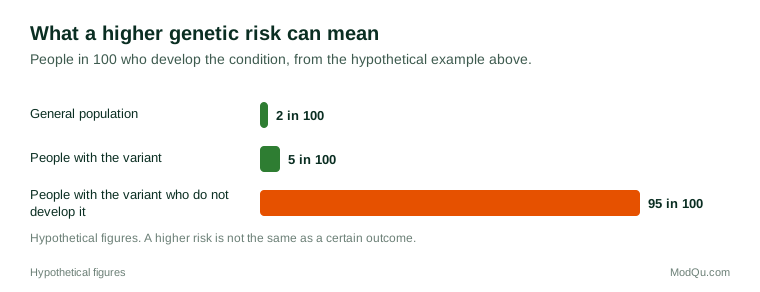
A consumer report says a woman has a variant linked to a higher risk of a condition. The report explains that in the general population about 2 in 100 people develop the condition, and with this variant about 5 in 100 do. That means 95 in 100 people with the variant do not develop it. Her doctor orders a medical test to confirm the result.
The figure below shows these hypothetical numbers.
Privacy and who sees the data
Genetic data is sensitive because it is unique, cannot be changed and also reveals information about relatives. People raise questions such as:
- who stores the data and for how long;
- whether it is shared with researchers, partners or police;
- whether insurers or employers could use it;
- what happens to data if a company is sold or closes;
- whether a person can delete their data and sample.
Laws differ. Some countries ban the use of genetic data in employment or some kinds of insurance; others have weaker rules. Some police forces have used consumer genetic databases to identify suspects through relatives, which led to debate and new rules in some places.
Family effects
Because relatives share DNA, one person's test can reveal information about others: a health risk that siblings may also carry, a previously unknown relative or a different biological parent than expected. Some families welcome these discoveries; others find them painful. Genetic counsellors often discuss whether and how to share results with family.
Example
Two sisters disagree about testing for a condition that affected their mother. One wants to know so she can plan; the other does not want to know. When the first sister tests positive, she has to decide whether to tell her sister, who had said she did not want the information.
Cost and access
Consumer tests are sold at a range of prices, and medical tests may be covered by public health systems, insurance or paid privately, depending on the country and the reason for testing. Access to genetic counselling is uneven, and waiting times can be long in some areas.
What people disagree about
- Whether health tests should be sold directly to the public.
- Whether police should be allowed to search consumer databases.
- How to protect people from genetic discrimination.
- Whether newborns should be screened for more conditions.
- How to handle results that a person did not ask for.
Why surveys ask about genetic testing
Questions that researchers, universities, health bodies and technology firms want answered include how many people have taken a test, why, how they felt about the results and how worried they are about who sees their data. Answers are grouped and every question can be skipped.
Genetic testing in research
Many large research projects ask volunteers to share genetic data along with health records, so that scientists can study how genes and lifestyle affect disease. Some are run by public health systems or universities, and some consumer testing companies ask customers whether their data may be used in research. People who take part often say they want to help future patients. Common conditions for agreeing include clear consent, the option to withdraw, strong security, and knowing who will use the data and for what purpose.
Key terms
- DNAThe molecule that carries genetic instructions in living things.
- GeneA section of DNA that carries instructions for a particular function.
- VariantA difference in DNA sequence between people; some variants affect health.
- CarrierA person who has a gene variant they can pass on but who usually does not have the condition.
- Genetic counsellorA health professional who helps people understand genetic tests and results.
- Predictive testA test for variants that may raise the risk of a condition later in life.
- Variant of uncertain significanceA DNA change whose effect on health is not yet known.
- Genetic discriminationUnfair treatment based on a person's genetic information.
Full glossary: genetic counseling terms on EditingTests.com.
Genetic testing vocabulary test
How well do you know the language of this topic? Try 8 quick questions. Your score is shown straight away and is not saved.
What the genetic testing survey asks
This survey is part of ModQu's Science and Technology Attitudes survey. The genetic testing part takes about five minutes and covers:
- Whether you have taken a DNA test, and what kind.
- Why you took it, or why not.
- How you felt about the results, and whether you shared them.
- How worried you are about who sees your genetic data.
- Whether you would allow your data to be used for research.
- Your views on rules for genetic testing and data.
After that you can choose to continue with other short parts of the Science and Technology Attitudes survey, such as trust in science or space exploration, or stop.
Ready to take part?
Your answers help show what people really think and do. Results are only ever reported as totals; no one can see your individual answers.
Start the surveyQuestions about this survey
Who can take part?
Adults.
Do I have to give my name?
No. You may be asked for your age group, region and similar details so results can be broken down, but not your name. ModQu never asks for passwords, card numbers or account numbers.
How are the results used?
Answers are combined into totals and percentages and published in ModQu reports. Individual answers are never shown.
Is the vocabulary test part of the survey?
No. It is optional and separate, and your score is not stored.
Will the survey ask for my test results?
No. It asks about your experiences and views, never for your genetic results.
Can I take part if I have never had a test?
Yes. Views of people who have not tested are an important part of the results.