
Share your views on gender equality
Tell us how tasks are shared in your home and how fairly you think people are treated where you live. Your answers are combined with other people's and reported only as totals.
Start the gender equality surveyAbout 5 minutes. No account needed. You can stop at any time.
What gender equality covers
Gender equality is the idea that a person's gender should not limit their rights, safety, pay, opportunities or voice. The United Nations includes it among its Sustainable Development Goals, and most countries have laws against some forms of discrimination based on sex or gender. In daily life, though, people often see a gap between what the law says and what happens.
The topic usually covers several areas:
- Home: who does the housework, cooking, child care and care for older relatives.
- Education: whether girls and boys have the same access to school and the same choices of subject.
- Work: hiring, pay, promotion, and treatment in the workplace.
- Money and property: control over income, bank accounts, land and inheritance.
- Public life: voting, holding office, leading organizations and being heard in the media.
- Safety: freedom from harassment and violence at home, at work and in public.
- Health: access to care, including reproductive health care.
Different countries are at very different points on each of these. In some, legal rights for women to own land, open a bank account or work in certain jobs are recent or still limited. In others, legal equality is long established, and debate centres on pay gaps, leadership and the sharing of unpaid work.
Sharing work at home
Unpaid work at home includes cooking, cleaning, laundry, shopping, caring for children and looking after sick or elderly relatives. Time-use studies in many countries have found that women, on average, do more of this work than men, including in couples where both work full time. The size of the gap varies a great deal between countries and between households.
Surveys on this topic often ask who usually does each task, how much time it takes and whether people think the split is fair. People's sense of fairness does not always match the hours: some couples with an uneven split say it suits them, while others with a fairly even split still argue about it.
Example (hypothetical figures)
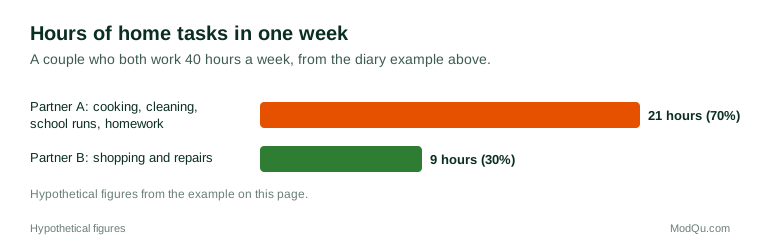
A couple both work 40 hours a week. They each keep a one-week diary of home tasks. One partner records 21 hours of cooking, cleaning, school runs and homework help; the other records 9 hours, mostly shopping and repairs. Together that is 30 hours, so the first partner does 70% of it. Before the diary, both had guessed the split was "about 60 to 40".
The "mental load" is a term people use for the planning work behind tasks: remembering appointments, noticing that the children need new shoes, keeping track of birthdays. It is harder to measure than hours, and many people say it is the part they find least visible.
Equality at work
At work, the main issues are:
- Pay: the gender pay gap compares the average or median earnings of women and men. It reflects differences in hours, jobs, industries and career breaks, as well as unequal pay for the same work, which is illegal in many countries.
- Hiring and promotion: whether women and men with the same skills are hired and promoted at the same rate.
- Occupational segregation: some jobs are mostly done by women (such as nursing and early childhood education) and others mostly by men (such as construction and engineering). Jobs with more women are often paid less.
- Parental leave and flexibility: whether both parents can take leave and work flexibly without harming their careers.
- Harassment: sexual harassment and hostile behaviour at work.
Many countries now require larger employers to publish their gender pay gap or to prove equal pay for equal work. Some offer parental leave that is reserved for each parent, so that fathers take more leave.
Example
A software company publishes its pay figures for the first time and finds that men earn more on average, mainly because more men are in senior engineering roles. Staff surveys show that women leave the company more often after their first child. The company introduces paid leave reserved for each parent and reviews how promotions are decided.
Public life and leadership
Women are under-represented in parliaments, senior government jobs, boards of large companies and senior roles in sport, media and religion in most countries, though the share has risen in many places. Some countries use quotas for candidate lists or company boards; others rely on voluntary targets. People disagree about whether quotas are fair or effective.
Public life also includes daily experiences: whether women feel safe using public transport at night, whether their opinions are taken seriously in meetings, and how women are portrayed in advertising and news.
Changes over time
Many people feel that equality has improved in their lifetime, especially in education, where in many countries girls now stay in school as long as boys or longer, and women make up a large share of university graduates. Others point to slower change in pay, leadership, unpaid work and violence. In some places rights have moved backwards, for example where access to school or work for women has been restricted.
How people's views differ
Answers to the question "Are men and women treated equally where you live?" vary with a person's gender, age, country, religion, education and personal experience. Common patterns in survey research include:
- Women are more likely than men to say that equality has not yet been achieved.
- Younger people often hold different views from their parents, though not always in the same direction for young men and young women.
- People may support equality in general but hold traditional views on specific roles, such as who should care for young children.
Because the topic is sensitive, people may give the answer they think is expected rather than their own view. Survey designers use neutral wording, anonymous answers and questions about behaviour (such as "Who cooked dinner last night?") as well as attitudes.
Gender beyond two categories
Some people do not identify as either a woman or a man, and some countries recognize a third gender or a non-binary option on official documents. Views on this differ widely between and within countries. Surveys increasingly offer more than two options for gender and let people choose not to answer.
Example
A community centre asks visitors to fill in a short survey about whether they feel welcome. The first version offers only two options for gender, and several people skip the question. The next version adds "another gender" and "prefer not to say", and the number of skipped answers falls.
What people disagree about
People disagree about the causes of gaps (choices, discrimination, social expectations or biology), about which policies help (quotas, pay transparency, leave reserved for fathers, subsidized child care), and about how much governments should get involved in family life. They also disagree about whether some gaps, such as men's lower rates of university entry in some countries, get enough attention.
Questions that governments, foundations, employers and media want answered include how housework and care are shared, how fairly people feel treated at work, whether people think things are getting better, and which changes would make the biggest difference.
Key terms
- Gender pay gapThe difference between the average or median earnings of women and men.
- Equal payThe right to the same pay for the same work or work of equal value.
- Unpaid care workHousework and caring for others that is not paid.
- Mental loadThe planning and remembering behind household tasks.
- Occupational segregationThe concentration of women and men in different jobs.
- Parental leaveTime off work to care for a new child, sometimes paid.
- QuotaA required minimum share of a group, such as women on candidate lists or boards.
- Non-binaryA gender identity that is not only woman or man.
Full glossary: social psychology terms on EditingTests.com.
Gender equality vocabulary test
How well do you know the language of this topic? Try 8 quick questions. Your score is shown straight away and is not saved.
What the gender equality survey asks
This survey is part of ModQu's Communities and Society survey. The gender equality part takes about five minutes and covers:
- Whether you think women and men are treated equally where you live, at home, at work and in public life.
- Who usually does each main task in your home, and whether the split feels fair.
- Whether you have experienced or seen unequal treatment at work.
- Whether you think equality has improved in the last ten years.
- Which changes you think would make the biggest difference.
After that you can choose to continue with other short parts of the Communities and Society survey, such as neighbourhoods and community life or loneliness and social connection, or stop.
Ready to take part?
Your answers help show what people really think and do. Results are only ever reported as totals; no one can see your individual answers.
Start the surveyQuestions about this survey
Who can take part?
Adults.
Do I have to give my name?
No. You may be asked for your age group, region and similar details so results can be broken down, but not your name. ModQu never asks for passwords, card numbers or account numbers.
How are the results used?
Answers are combined into totals and percentages and published in ModQu reports. Individual answers are never shown.
Is the vocabulary test part of the survey?
No. It is optional and separate, and your score is not stored.