
Share your experience of gardening
Tell us what you grow, what you spend on your garden and whether you hire a landscaper. Your answers are combined with other people's and reported only as totals.
Start the gardens and yards surveyAbout 5 minutes. No account needed. You can stop at any time.
What this topic covers
This topic covers outdoor spaces at home and what people do with them:
- Yards and lawns around houses.
- Flower and ornamental gardens.
- Vegetable, herb and fruit gardens.
- Balconies, patios and rooftops, including container gardening.
- Community gardens and allotments, where people rent a plot.
- Landscaping: patios, paths, fences, decks, lighting and planting.
- Yard care: mowing, watering, weeding, leaf raking and snow clearing.
It covers people with any outdoor space, from a single window box to a rural property.
Why people garden
People give many reasons for gardening:
- enjoyment and relaxation;
- growing food, for freshness, taste and saving money;
- making the home look good, including for neighbours and resale;
- exercise and time outdoors;
- mental wellbeing, often mentioned by gardeners;
- supporting wildlife, such as birds, bees and butterflies;
- family tradition, passing on skills from parents and grandparents;
- a project with children.
Others see yard work as a chore and do as little as possible, or pay someone to do it for them.
Example
A retired machinist plants a small vegetable garden in raised beds for the first time. They grow tomatoes, beans, lettuce and herbs, and spend an hour most mornings watering and weeding. They say they enjoy the routine more than the harvest, though the tomatoes are the best they have eaten.
What people grow
Gardens vary by climate, space and interest. Canada's short growing season and plant hardiness zones, which describe the conditions plants can survive, shape what grows well in each region. Common choices include:
- vegetables: tomatoes, peppers, lettuce, beans, cucumbers, squash and garlic;
- herbs: basil, parsley, mint and chives;
- fruit: strawberries, raspberries, apples and other fruit trees in suitable areas;
- flowers: annuals for colour each year and perennials that return;
- native plants that suit local conditions and support pollinators;
- trees and shrubs for shade, privacy and shelter.
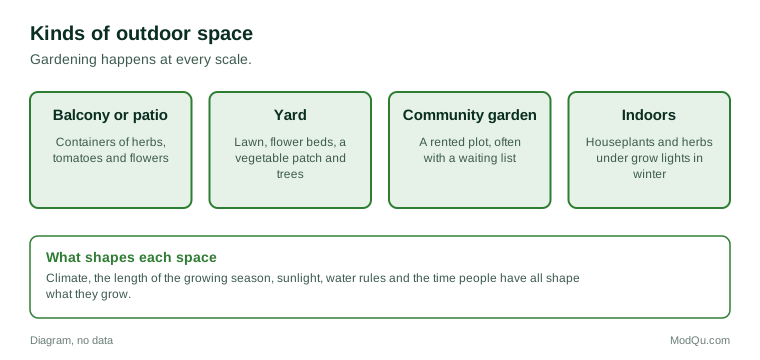
People with balconies often grow herbs, tomatoes and flowers in containers. Indoor growing, from houseplants to herbs under grow lights, extends gardening through the winter.
Lawns and changing yards
The traditional green lawn takes water, mowing, fertilizer and time. Some homeowners are replacing part of their lawn with:
- native plant and pollinator gardens;
- clover or low-growing ground covers;
- vegetable beds;
- patios and gravel areas;
- rain gardens that soak up runoff from roofs and driveways.
Many Canadian municipalities limit lawn watering in summer, and several provinces and cities restrict the use of certain pesticides for cosmetic purposes on lawns and gardens. Some municipal bylaws also set rules on grass height, which has led to debate about natural yards.
Example
A family in a suburb replaces half of their front lawn with native flowers and grasses. A neighbour asks whether it is allowed. The family checks the city's bylaw, which permits naturalized gardens if they are kept tidy and away from the sidewalk, and adds a small sign explaining the pollinator garden.
Spending on outdoor space
Spending ranges from a few seed packets to major landscaping projects. Common costs include:
- plants, seeds and bulbs;
- soil, compost and mulch;
- tools and equipment, such as mowers, trimmers and hoses;
- containers and raised beds;
- outdoor furniture, barbecues and lighting;
- landscaping services;
- water in areas with metered water.
Spending tends to rise in spring, and many garden centres do much of their year's business in a few weeks.
Example (hypothetical figures)
A household spends $120 on vegetable seedlings and seeds, $180 on soil and compost for three raised beds, and $60 on a hose and nozzle. Over the summer they harvest produce they estimate would cost about $300 at a grocery store. They are $60 behind in the first year, but the beds and hose will be reused, so the next season should cost much less.
Hiring landscapers and yard services
Many households hire help for some or all yard work:
- lawn care companies for mowing, fertilizing and aerating;
- landscapers and landscape designers for planting plans and building patios, walls and paths;
- arborists for tree pruning and removal, especially near power lines and buildings;
- seasonal services, such as spring and fall clean-ups;
- snow removal in winter.
Reasons for hiring include lack of time, physical limits, age, wanting a professional result, and larger projects that need skills and equipment. Older adults often hire help to stay in their homes longer.
Example
A widower in his eighties has kept the same garden for forty years but can no longer kneel to weed or push a mower. He hires a local student to mow every week and a landscaper for a spring and fall clean-up. He still tends the roses by the back door himself, using a stool and long-handled tools.
Questions businesses want answered here include how many households hire yard services, which services, how they find providers and what they spend in a year.
Trends in gardening
Recent trends include:
- food gardening for cost savings and self-reliance;
- native and pollinator plantings;
- water-wise gardening with drought-tolerant plants and rain barrels;
- battery-powered tools replacing gas mowers and blowers, in part because of noise and emissions rules in some cities;
- small-space gardening on balconies and in containers;
- community gardens, which often have waiting lists in cities.
Extreme heat, drought, heavy rain and new pests have also changed what some gardeners plant. Some now choose plants rated for warmer zones than their parents could grow, while others protect beds from sudden storms and late frosts.
What people disagree about
Opinion is divided on whether lawns should be replaced, whether cities should allow natural yards, whether gas-powered yard tools should be banned, whether growing food saves money, and how much water gardens should use in dry summers. These views often differ between people who garden for enjoyment and people who see yard work as a chore.
Key terms
- AnnualA plant that lives for one growing season.
- PerennialA plant that comes back year after year.
- Hardiness zoneAn area rated by the conditions plants can survive there.
- Native plantA plant that grows naturally in a region.
- PollinatorAn animal, such as a bee, that carries pollen between flowers.
- CompostDecayed plant material used to improve soil.
- Raised bedA garden bed built above ground level, often in a frame.
- ArboristA trained specialist in the care of trees.
Full glossary: landscape architecture terms on EditingTests.com.
Gardens and yards vocabulary test
How well do you know the language of this topic? Try 8 quick questions. Your score is shown straight away and is not saved.
What the gardens and yards survey asks
This survey is part of ModQu's Home and Property survey. The gardens and yards part takes about five minutes and covers:
- What outdoor space you have: yard, garden, balcony, community plot or none.
- Whether you grow plants, flowers or food, and which.
- How much you spent on your garden and yard this year.
- Whether you hire a landscaper or yard service, and for what.
- How you care for your lawn, if you have one, and whether you plan changes.
- What you enjoy most and least about gardening and yard work.
After that you can choose to continue with other short parts of the Home and Property survey, such as buying a home or renting, or stop.
Ready to take part?
Your answers help show what people really think and do. Results are only ever reported as totals; no one can see your individual answers.
Start the surveyQuestions about this survey
Who can take part?
Households with a garden, yard or balcony.
Do I have to give my name?
No. You may be asked for your age group, region and similar details so results can be broken down, but not your name. ModQu never asks for passwords, card numbers or account numbers.
How are the results used?
Answers are combined into totals and percentages and published in ModQu reports. Individual answers are never shown.
Is the vocabulary test part of the survey?
No. It is optional and separate, and your score is not stored.
Can I take part if I only have a balcony?
Yes. Balcony, container and indoor gardeners are asked about what they grow and spend.