
Share your views on future technology
Tell us which new technologies excite or worry you and whether you think technology will make life better in ten years. Your answers are combined with other people's and reported only as totals.
Start the future technologies surveyAbout 5 minutes. No account needed. You can stop at any time.
Which technologies people mean
When people talk about future technologies, they usually mean technologies that exist in early form today and may spread widely in the next decade or two. Common examples include:
- Artificial intelligence: systems that write, translate, recognize images, recommend and make predictions.
- Self-driving and electric vehicles, including delivery robots and drones.
- Clean energy and storage: improved solar panels, batteries, hydrogen and new grid technologies.
- Medical advances: gene therapies, personalized medicine, new vaccines and wearable health monitors.
- Virtual and augmented reality for gaming, work, training and shopping.
- Smart homes and cities, with connected sensors and automated services.
- Quantum computing, a new kind of computing still mostly in research.
- Space technology, such as satellite internet and commercial spaceflight.
- Brain-computer interfaces, devices that link the brain to computers, now mostly in medical research.
How people judge new technology
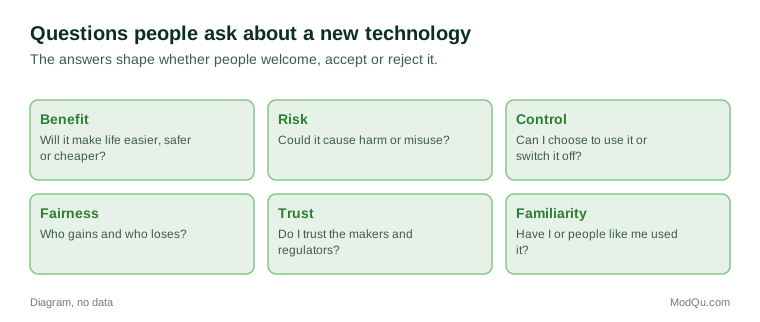
People tend to weigh a few questions when they form a view:
- Benefit: will it make life easier, safer, healthier or cheaper for me and others?
- Risk: could it cause harm, accidents, job loss or misuse?
- Control: can I choose whether to use it, and can I switch it off?
- Fairness: who gains and who loses?
- Trust: do I trust the companies and governments behind it?
- Familiarity: have I used it, or seen it used by people like me?
The figure below sets out these questions. People who have used a technology often view it differently from people who have only heard about it.
What excites people
People often say they are excited by technologies that:
- cure or prevent disease and help people live longer in good health;
- cut pollution and the cost of energy;
- save time on chores and paperwork;
- help people with disabilities live more independently;
- make learning and information easier to reach;
- connect people in remote areas.
Example
A grandmother with poor eyesight uses a phone app that reads printed text aloud and describes objects through the camera. She says it has given her back the ability to read her own mail. Her view of new technology is far more positive than it was five years ago.
What worries people
Common concerns include:
- job losses and changes to work;
- privacy, surveillance and the use of personal data;
- false information and fake images or videos;
- safety of automated vehicles and machines;
- dependence on screens and devices, especially for children;
- technology widening gaps between rich and poor;
- loss of human contact in services and care;
- misuse by criminals or for military purposes.
Example
A delivery driver is interested in self-driving vehicles but worries about his job. He says he would feel better if he knew there would be training for new roles and if he could see how the vehicles perform in bad weather before they are widely used.
Expectations differ between groups
Views on future technology often differ by age, education, income, country and experience. Younger people are often more willing to try new devices, but they may also be more concerned about certain issues such as privacy and the climate. Older people may be more cautious but welcome technologies that help with health and independence. People in different countries may expect technology to bring very different things, depending on local needs.
Example (hypothetical figures)
A survey of 1,000 adults asks whether technology will make life better in ten years. Among people under 35, 62 percent say yes; among people 35 to 59, 51 percent; and among people 60 and over, 44 percent. Across all three groups, the most common hope is better health care and the most common worry is privacy.
Hype and reality
New technologies are often promoted with large claims. Some arrive faster than expected; others take decades or never spread. Researchers and journalists sometimes describe a cycle in which early excitement is followed by disappointment and then gradual, practical use. Surveys can track how expectations change as technologies become real.
Rules and regulation
Governments are working out rules for many new technologies, such as safety standards for automated vehicles, rules on the use of AI in decisions about people, data protection laws and approval systems for new medical treatments. People differ on whether rules should come early to prevent harm or later to avoid slowing useful inventions.
What people disagree about
- Whether new technology will make life better or worse overall.
- How fast new technologies should be introduced.
- How much companies should be regulated.
- Who should benefit from gains in productivity.
- How to protect jobs, privacy and children.
Why surveys ask about future technologies
Questions that technology firms, universities, research bodies and public agencies want answered include which new technologies people are most excited and worried about, whether they would use them, what would make them trust them and what they expect in ten years. Answers are grouped and every question can be skipped.
Technology in different parts of the world
Expectations of new technology depend on local conditions. In places where many people lack reliable electricity, banking or health care, technologies such as solar home systems, mobile money and remote medical advice can change daily life quickly, sometimes skipping older technologies altogether. In places where these services are already widespread, people may focus more on convenience, privacy and the effect of technology on jobs. Surveys that reach people in many countries can show how hopes and worries differ, and which technologies people in each region feel would make the biggest difference.
Key terms
- Emerging technologyA technology in early use that may spread widely in coming years.
- Artificial intelligenceComputer systems that perform tasks usually needing human intelligence, such as understanding language.
- Augmented realityTechnology that adds digital images or information to a view of the real world.
- Virtual realityA computer-generated environment a person can enter, usually with a headset.
- Quantum computingComputing that uses quantum physics to process some problems in new ways.
- Early adopterA person who uses a new technology soon after it appears.
- Hype cycleA pattern of high expectations, disappointment and then practical use of a new technology.
- RegulationRules set by governments to control how products and services are made and used.
Full glossary: artificial intelligence terms on EditingTests.com.
Future technologies vocabulary test
How well do you know the language of this topic? Try 8 quick questions. Your score is shown straight away and is not saved.
What the future technologies survey asks
This survey is part of ModQu's Science and Technology Attitudes survey. The future technologies part takes about five minutes and covers:
- Which new technology excites you most.
- Which new technology worries you most.
- Whether you have used technologies such as AI tools, smart home devices or virtual reality.
- Whether you think technology will make life better in ten years.
- What would make you trust new technologies more.
- Whether you think new technologies should be regulated more, less or about the same.
After that you can choose to continue with other short parts of the Science and Technology Attitudes survey, such as trust in science or space exploration, or stop.
Ready to take part?
Your answers help show what people really think and do. Results are only ever reported as totals; no one can see your individual answers.
Start the surveyQuestions about this survey
Who can take part?
Adults.
Do I have to give my name?
No. You may be asked for your age group, region and similar details so results can be broken down, but not your name. ModQu never asks for passwords, card numbers or account numbers.
How are the results used?
Answers are combined into totals and percentages and published in ModQu reports. Individual answers are never shown.
Is the vocabulary test part of the survey?
No. It is optional and separate, and your score is not stored.
Do I need to be good with technology to take part?
No. Views of people who use little technology are just as important.
Will I be asked which brands I use?
No. Questions are about kinds of technology, not brands.