
Share your view of fast fashion
Tell us how many new clothes you buy, what you do with old clothes and how you feel about fast fashion. Your answers are combined with other people's and reported only as totals.
Start the fast fashion and clothing waste surveyAbout 5 minutes. No account needed. You can stop at any time.
What fast fashion is
Fast fashion describes a way of making and selling clothes in which:
- new designs reach shops within weeks of appearing on catwalks, on social media or in the street;
- new styles are added very often, sometimes every week or every day online;
- prices are low enough for people to buy on impulse;
- production is spread across large supply chains, often in countries with lower labour costs;
- garments are made in large volumes from cheap materials, often synthetic fibres such as polyester.
Traditional fashion worked in a small number of seasons each year. Fast fashion replaced that with a constant flow of new items, and online-only retailers have sped this up further with very large ranges and very low prices.
Why people buy fast fashion
People give many reasons for buying low-cost, trend-led clothes:
- Price. For many households cheap clothing is what they can afford, especially for growing children.
- Choice and novelty. New styles appear constantly, and people enjoy updating their look.
- Trends and social media. Seeing outfits online can create a wish to try them, often for a particular event or photo.
- Convenience. Fast delivery and easy returns make shopping simple.
- Occasion wear. People buy cheap outfits for one event rather than paying more for something they may not wear again.
Example
A student is invited to three parties in a month. They buy a new outfit for each from an online shop with low prices, spending less than one mid-price dress would cost. Afterwards they wear one of the outfits again and the other two stay in their wardrobe.
Researchers who study consumer behaviour note a gap between what people say and what they do: many people say they are worried about fast fashion but continue to buy it, often because of price, habit or convenience.
How long clothes are worn
A common concern is that clothes are worn fewer times before being discarded than in the past. Low prices make clothes feel disposable, quality may be lower, and trends change quickly. People also keep clothes they rarely wear: most wardrobes contain items that have not been worn for a year or more.
Example (hypothetical figures)
A shopper counts their wardrobe: 80 items in total. Over three months they wear 30 of them at least once. The other 50 items, 62.5% of the wardrobe (50 ÷ 80), are not worn at all in that time, including 12 items bought in the last year.
What happens to unwanted clothes
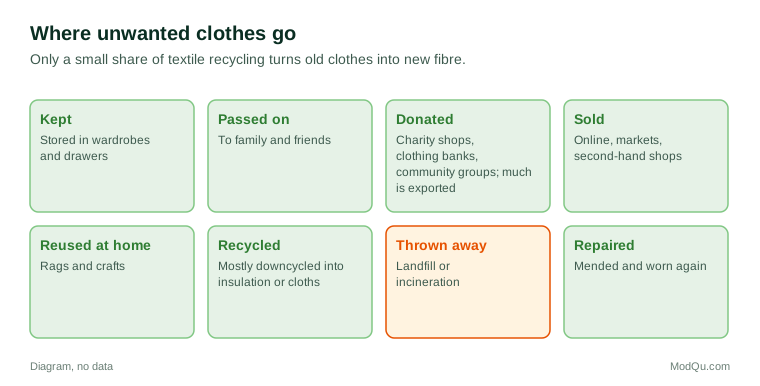
When people stop wearing clothes, the items go in several directions:
- Kept in wardrobes, drawers or storage.
- Passed on to family and friends.
- Donated to charity shops, clothing banks, places of worship and community groups.
- Sold online, at markets or to second-hand shops.
- Reused at home as rags or for crafts.
- Recycled through textile collection points, though most recycling turns clothes into lower-grade products such as insulation or cleaning cloths; turning old clothes into new fibre is still limited.
- Thrown away with household rubbish, ending in landfill or incineration.
Donated clothes do not always stay local. A large share of donated clothing in many wealthy countries is sorted and exported to second-hand markets in other parts of the world, where some is sold and worn and some becomes waste. Countries receiving these clothes have raised concerns about the volume and quality, and some have restricted imports.
Online shopping, returns and unsold stock
Online shopping has changed fast fashion. Very large ranges, frequent discounts and free delivery encourage people to buy more items at once, and free returns make it easy to order several sizes or styles and send most back. Returned items need to be checked, repackaged and sometimes cleaned, and some cannot be resold at full price. Retailers also deal with unsold stock at the end of each season. It may be discounted, sold to outlet or off-price shops, sent to other markets, recycled, or in some cases destroyed. Some regions have moved to limit the destruction of unsold clothing.
Environmental and social concerns
Concerns raised about fast fashion include:
- Resource use, such as the water used to grow cotton and the energy used to make synthetic fibres.
- Pollution from dyeing and finishing, and microfibres shed when synthetic clothes are washed.
- Greenhouse gas emissions from production and transport.
- Waste, both unsold stock and clothes discarded by consumers.
- Working conditions in garment factories, including low wages, long hours and safety risks. Factory disasters have drawn attention to these risks, and international organisations such as the International Labour Organization work on standards for the sector.
Estimates of the industry's exact impact vary between studies, and figures quoted in the media are sometimes not well sourced.
What people and governments are doing
Responses come from several directions:
- Shoppers buying fewer, longer-lasting items, buying second-hand, repairing, or setting personal limits on new purchases.
- Brands offering take-back schemes, repair services, recycled materials or longer-lasting ranges.
- Governments in some regions introducing rules that make producers responsible for collecting and recycling textiles, banning the destruction of unsold clothing, or requiring separate textile collection.
- Community groups running swaps, repair cafés and sewing classes.
Example
A family sets a rule that each person can buy one new item of clothing for each item they donate, sell or recycle. After a year they find they have bought fewer items in total and wear more of what they own.
What people disagree about
Fast fashion is debated from several angles. Some argue that cheap clothes give people on low incomes access to new clothing, and that criticism places blame on consumers who have few alternatives. Others argue that the low prices hide environmental and social costs that someone else pays. People also disagree about whether responsibility lies mainly with shoppers, brands or governments, and about whether recycling and second-hand markets can deal with the volume of clothing produced. A survey can show how buying habits, attitudes and feelings of guilt differ between countries, age groups and income levels.
Key terms
- Fast fashionTrend-led clothing designed, made and sold quickly and cheaply in large volumes.
- Supply chainThe steps and companies involved in making and delivering a product.
- Textile wasteDiscarded clothing and fabric, from factories or households.
- LandfillA site where waste is buried.
- DowncyclingRecycling a material into a lower-value product, such as clothing into insulation.
- Take-back schemeA program where a retailer collects used clothing from customers.
- Extended producer responsibilityA policy that makes producers responsible for products at the end of their life.
- Attitude-behaviour gapThe difference between what people say they value and what they do.
Full glossary: circular economy solutions terms on EditingTests.com.
Fast fashion and clothing waste vocabulary test
How well do you know the language of this topic? Try 8 quick questions. Your score is shown straight away and is not saved.
What the fast fashion and clothing waste survey asks
This survey is part of ModQu's Fashion and Style survey. The fast fashion and clothing waste part takes about five minutes and covers:
- How many new clothing items you bought in the last year, and where.
- How often you buy clothes for a single event or trend.
- What you do with clothes you no longer wear: keep, pass on, donate, sell, recycle or throw away.
- How many items in your wardrobe you have not worn in the last year.
- Whether you feel guilty about fast fashion, and whether it changes what you buy.
- Who you think is most responsible for reducing clothing waste.
After that you can choose to continue with other short parts of the Fashion and Style survey, such as footwear or sportswear and athleisure, or stop.
Ready to take part?
Your answers help show what people really think and do. Results are only ever reported as totals; no one can see your individual answers.
Start the surveyQuestions about this survey
Who can take part?
Adults.
Do I have to give my name?
No. You may be asked for your age group, region and similar details so results can be broken down, but not your name. ModQu never asks for passwords, card numbers or account numbers.
How are the results used?
Answers are combined into totals and percentages and published in ModQu reports. Individual answers are never shown.
Is the vocabulary test part of the survey?
No. It is optional and separate, and your score is not stored.