
Share your brow and lash habits
Tell us which brow or lash treatments you have had, how often and what they cost. Your answers are combined with other people's and reported only as totals.
Start the eyebrows, lashes and brow treatments surveyAbout 5 minutes. No account needed. You can stop at any time.
What brow and lash care covers
Brow and lash care includes anything people do to shape, colour, thicken or lengthen their eyebrows and eyelashes. It ranges from plucking stray hairs at home to semi-permanent treatments done by trained technicians. Styles change over time, from thin arched brows to fuller, natural-looking ones, and vary by culture and age.
The main categories are:
- Shaping: removing hair to change the outline of the brows.
- Colouring: tinting brows or lashes to make them darker or more defined.
- Setting and lifting: treatments that change the direction or curl of hairs.
- Adding hair or the look of hair: lash extensions, false lashes, brow make-up and semi-permanent tattooing.
- Growth products: serums that claim to help lashes or brows look longer or thicker.
Brow shaping
Common methods for shaping brows include:
- Tweezing: removing hairs one by one. Cheap and precise, often done at home.
- Waxing: removing hair with warm wax and strips. Quick, usually done in a salon.
- Threading: twisting a cotton thread to remove rows of hair. The technique comes from South and West Asia and is now offered in many countries.
- Trimming: cutting long hairs rather than removing them.
- Brow mapping: measuring the face to plan the shape before removing any hair.
Results last from a couple of weeks to around a month, depending on how fast hair grows back.
Example
A student who has always plucked her own brows books a threading appointment before a job interview. The technician suggests leaving the brows fuller at the front. She likes the result and returns every four weeks.
Tinting and lamination
Tinting uses a dye made for brows or lashes to darken hairs. It can make fair or grey hairs more visible and usually lasts a few weeks.
Brow lamination uses a chemical solution to make brow hairs more flexible, so they can be brushed up and set in place for a fuller, groomed look. Results often last six to eight weeks.
Lash lifts use a similar process to curl natural lashes upward from the root, often combined with a tint. They usually last until the lashes shed naturally, around six to eight weeks.
These treatments use chemicals close to the eyes. Many salons do a patch test, putting a small amount of product on the skin a day or two before, to check for an allergic reaction. In some countries this is a legal or insurance requirement for tints.
Lash extensions and false lashes
Lash extensions are individual synthetic fibres glued to natural lashes one by one, or in small fans. Styles range from natural to dramatic, and appointments can take one to two hours. Extensions fall out as natural lashes shed, so most people return for infills every two to four weeks.
False lashes are strips or clusters applied at home with glue for a day or an event. Newer home kits offer clusters that last several days.
Points people weigh include cost, time, upkeep, comfort, and the effect on natural lashes if extensions are too heavy or removed roughly.
Example (hypothetical figures)
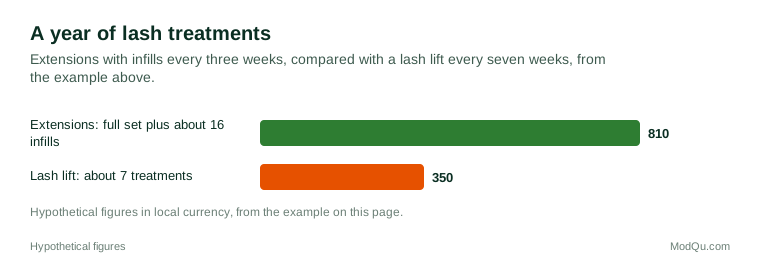
A person has a full set of lash extensions for 90 in their local currency and infills every three weeks for 45 each. Over a year that is one full set plus about 16 infills, costing 90 + 720 = 810. A lash lift every seven weeks at 50 would be about 7 treatments, or 350 a year.
Microblading and semi-permanent brows
Microblading is a form of semi-permanent tattooing in which a technician uses a hand tool with fine needles to draw hair-like strokes into the skin. Related techniques include powder brows, which give a shaded look, and combination brows. Results usually fade over one to three years and need touch-ups.
Because microblading breaks the skin, it carries risks such as infection and allergic reaction, and results that people dislike are hard to reverse. Rules differ widely. In some countries and regions technicians need a licence or registration and premises are inspected, as for tattooing; in others there are few rules. People considering these treatments often check training, hygiene practices, healed results from previous clients, and whether the procedure suits their skin and health.
Example
A woman whose eyebrows have thinned after medical treatment chooses microblading. Before booking, she checks that the technician is registered with the local authority, asks to see healed photos of previous clients and asks about aftercare. The appointment includes a follow-up visit six weeks later.
Home products
Many people manage brows and lashes at home with:
- Brow pencils, powders, pomades and gels.
- Mascara and lash primers.
- Home tint kits.
- Lash curlers.
- False lash strips and clusters.
- Lash and brow serums.
Some serums sold for lash growth contain ingredients that are also used in medicines and can have side effects; rules on selling them differ by country. Packaging and claims for growth products are a common area of consumer confusion.
Safety and hygiene
Because treatments take place near the eyes, safety concerns include:
- Allergic reactions to tints, glues and lamination solutions.
- Eye irritation from products or fumes.
- Infection from poor hygiene or reused tools.
- Damage to natural lashes or brow hair.
- Treatments done by people without training.
Customers often look for salons that do patch tests, use clean or single-use tools, explain aftercare and have reviews from other clients.
Trends and debates
Current trends include fuller natural brows, lamination, lash lifts as a lower-upkeep alternative to extensions, men's brow grooming, and home kits that copy salon results. People debate the cost and upkeep of these treatments, the pressure to change natural features, and whether semi-permanent work should be regulated in the same way as tattoos.
What people and businesses want to know
Questions businesses want answered include which brow and lash treatments people have tried, how often they repeat them, what they spend, how they choose a technician, whether they do treatments at home, and what worries them about safety.
Key terms
- ThreadingRemoving rows of hair by twisting a cotton thread.
- TintingDarkening brows or lashes with a special dye.
- Brow laminationA chemical treatment that sets brow hairs in a brushed-up shape.
- Lash liftA treatment that curls natural lashes upward from the root.
- Lash extensionsSynthetic fibres glued to individual natural lashes.
- InfillA follow-up appointment to replace extensions that have fallen out.
- MicrobladingSemi-permanent tattooing that draws hair-like strokes into the brows.
- Patch testA small test application to check for an allergic reaction.
Full glossary: cosmetology terms on EditingTests.com.
Eyebrows, lashes and brow treatments vocabulary test
How well do you know the language of this topic? Try 8 quick questions. Your score is shown straight away and is not saved.
What the eyebrows, lashes and brow treatments survey asks
This survey is part of ModQu's Beauty and Personal Care survey. The eyebrows, lashes and brow treatments part takes about five minutes and covers:
- Which brow and lash treatments you have had, such as shaping, tinting, lamination, lifts, extensions or microblading.
- How often you have them, and where.
- How much you spent on your last treatment and in a typical year.
- How you choose a technician or salon.
- Which brow and lash products you use at home.
- Any problems you have had, and what worries you about these treatments.
After that you can choose to continue with other short parts of the Beauty and Personal Care survey, such as skin care or hair care and salons, or stop.
Ready to take part?
Your answers help show what people really think and do. Results are only ever reported as totals; no one can see your individual answers.
Start the surveyQuestions about this survey
Who can take part?
Adults.
Do I have to give my name?
No. You may be asked for your age group, region and similar details so results can be broken down, but not your name. ModQu never asks for passwords, card numbers or account numbers.
How are the results used?
Answers are combined into totals and percentages and published in ModQu reports. Individual answers are never shown.
Is the vocabulary test part of the survey?
No. It is optional and separate, and your score is not stored.
Can I wear make-up after a brow or lash treatment?
Technicians often advise avoiding make-up, water or heat on the area for a day or two after tinting, lamination or a lift. Instructions vary by treatment and salon.