
Share your experience of power cuts
Tell us how many power cuts you had last year, whether you have backup power and how outages affect you. Your answers are combined with other people's and reported only as totals.
Start the electricity outages and reliability surveyAbout 5 minutes. No account needed. You can stop at any time.
Why power cuts happen
Electricity reaches homes through a chain: power stations or other generators, high-voltage transmission lines, substations and local distribution lines. A problem anywhere in the chain can cause an outage. Common causes include:
- weather: storms, high winds, lightning, ice, floods, heatwaves and wildfires;
- equipment failure: ageing cables, transformers and substations;
- trees and animals touching lines;
- accidents, such as vehicles hitting poles or digging through cables;
- not enough supply: when demand exceeds available generation, operators may cut power to some areas on a planned basis;
- fuel shortages at power stations;
- planned maintenance;
- theft of cables or illegal connections that overload local networks;
- cyber attacks on grid systems, which are rare but possible.
Kinds of outages
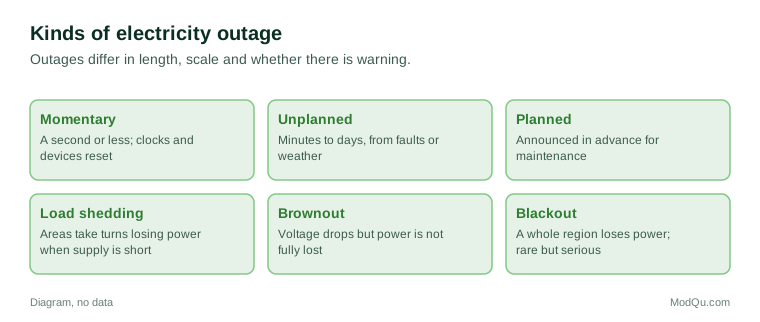
Outages differ in length, scale and warning:
- Momentary interruptions of a second or less, which can reset clocks and devices.
- Unplanned outages of minutes to days, caused by faults or weather.
- Planned outages for maintenance, usually announced in advance.
- Rotating outages or load shedding, where operators cut power to different areas in turn because supply is short. In some countries this happens on published schedules for long periods.
- Brownouts, where voltage drops but power is not fully lost, which can damage equipment.
- Large-scale blackouts affecting whole regions or countries, which are rare but can last days.
How often outages happen varies enormously. In some countries most households go years without a long outage. In others, daily cuts are common. Rural areas and areas at the end of long distribution lines often have more outages than cities.
How outages affect households
The effects of an outage depend on its length, timing and the household's needs:
- food in fridges and freezers can spoil;
- heating, cooling and fans stop, which can be dangerous in extreme heat or cold;
- water pumps may stop, cutting water supply in some homes and buildings;
- phones, internet and lighting fail;
- people working from home cannot work;
- medical equipment, such as oxygen concentrators or home dialysis, may stop;
- lifts in tall buildings stop;
- small businesses lose trade and stock.
Example
A storm cuts power to a village for two days. A family loses the contents of their freezer, has no water because their well pump is electric, and cannot charge phones. An elderly neighbour who uses an oxygen concentrator is taken to stay with relatives in town, where power has stayed on.
Backup power
Households and businesses that face frequent or long outages use a range of backup options:
- torches, candles and battery lamps;
- power banks for phones;
- uninterruptible power supplies (UPS) for computers and routers;
- inverters with batteries that charge when power is on and supply it when off, widely used in some countries;
- petrol or diesel generators, from small portable units to large standby systems;
- solar panels with batteries;
- electric vehicles that can supply power to a home, in some cases.
Generators are noisy, need fuel and must be used outdoors because of the risk of carbon monoxide poisoning. Batteries are quiet and clean but cost more and hold limited energy.
Example (hypothetical figures)
A small shop faces about 4 hours of power cuts a day. The owner compares a petrol generator costing 300, in local currency, plus about 3 a day in fuel, with a battery inverter system costing 900 and no fuel. Over a year of 300 trading days, the generator costs 300 plus 900 in fuel, which is 1,200, more than the 900 battery system. The battery system is also quiet, so the owner chooses it.
How reliability is measured
Utilities and regulators measure reliability using standard indices:
- SAIFI (System Average Interruption Frequency Index): the average number of interruptions per customer per year.
- SAIDI (System Average Interruption Duration Index): the average total minutes without power per customer per year.
- CAIDI (Customer Average Interruption Duration Index): the average length of an interruption.
Regulators in many countries set targets for these measures and may reward or penalize utilities. Some require compensation to customers after long outages. Official figures may exclude major events such as severe storms, so they do not always match what households experience. Surveys of households can show how often people actually lose power and how it affects them.
Example
A town's utility reports an average of 90 minutes without power per customer last year. Residents of one street say they had more than ten hours of outages. The difference comes partly from one long outage during a storm that the utility classed as a major event, and partly because the street is at the end of an old line.
Preparing for outages
Emergency agencies and utilities in many countries advise households to keep torches and batteries, a charged power bank, some drinking water and food that does not need cooking, and a list of emergency numbers. People who rely on medical equipment are often advised to register with their utility, where such registers exist, and to have a backup plan.
What people disagree about
People disagree about how much should be spent to make grids more reliable, who should pay, whether power lines should be buried underground, and how utilities should be held to account. In some countries, debates focus on the cost of keeping power stations available during peak demand; in others, on chronic shortages, unpaid bills and theft that weaken utilities' finances.
Questions that utilities, regulators, backup power suppliers and governments want answered include how many outages households experience, how long they last, how they affect people and what backup power people have.
Key terms
- Power outageA loss of electricity supply to an area.
- Load sheddingPlanned rotating power cuts when supply cannot meet demand.
- BlackoutA complete loss of power over a wide area.
- BrownoutA drop in voltage without a complete loss of power.
- GeneratorA machine that produces electricity, usually from fuel.
- InverterA device that converts stored battery power into household electricity.
- SAIDIA measure of the average total minutes without power per customer per year.
- GridThe network that carries electricity from generators to users.
Full glossary: electric utility management terms on EditingTests.com.
Electricity outages and reliability vocabulary test
How well do you know the language of this topic? Try 8 quick questions. Your score is shown straight away and is not saved.
What the electricity outages and reliability survey asks
This survey is part of ModQu's Energy and Environment survey. The electricity outages and reliability part takes about five minutes and covers:
- How many power cuts you had in the last year, and how long they lasted.
- Whether outages were announced in advance.
- How the last outage affected your household or business.
- What backup power you have, if any.
- How satisfied you are with the reliability of your electricity.
- Whether you received information or compensation from your utility.
After that you can choose to continue with other short parts of the Energy and Environment survey, such as home energy use and bills or solar power at home, or stop.
Ready to take part?
Your answers help show what people really think and do. Results are only ever reported as totals; no one can see your individual answers.
Start the surveyQuestions about this survey
Who can take part?
Adults.
Do I have to give my name?
No. You may be asked for your age group, region and similar details so results can be broken down, but not your name. ModQu never asks for passwords, card numbers or account numbers.
How are the results used?
Answers are combined into totals and percentages and published in ModQu reports. Individual answers are never shown.
Is the vocabulary test part of the survey?
No. It is optional and separate, and your score is not stored.
Does the survey ask about electricity prices?
Only briefly. Prices and bills are covered in a separate home energy topic.
What counts as a power cut?
Any loss of electricity to your home, from a brief interruption to an outage of several days. The survey asks about short and long cuts separately.
Do I need exact numbers?
No. Estimates are fine, and the survey uses ranges.
Can businesses take part?
This survey is for households. Small business owners can answer about their home and mention business effects where asked.