
Share your views on electric vehicles
Tell us how likely your next vehicle is to be electric, what worries you and where you could charge. Your answers are combined with other people's and reported only as totals.
Start the electric vehicles surveyAbout 5 minutes. No account needed. You can stop at any time.
What counts as an electric vehicle
"Electric vehicle", or EV, is used for several kinds of car that use electricity to drive the wheels, in whole or in part. The differences matter, because they change how the car is fuelled and what it costs to run.
- Battery electric vehicles (BEVs) run only on electricity stored in a large battery. They have no gasoline engine and are charged by plugging in.
- Plug-in hybrid electric vehicles (PHEVs) have a smaller battery that can be charged by plugging in, plus a gasoline engine. They can drive a limited distance on electricity, then switch to gasoline.
- Hybrid electric vehicles (HEVs) have a gasoline engine and a small battery charged by the engine and by braking. They cannot be plugged in, and most people do not count them as EVs, although they use less fuel than conventional cars.
- Fuel cell electric vehicles use hydrogen to make electricity on board. They are rare and depend on hydrogen stations, which are few.
In Canada, the federal government has set targets for an increasing share of new light-duty vehicle sales to be zero-emission, and several provinces have their own rules. The details have changed several times, so the pace at which EVs replace gasoline cars is still uncertain.
How charging works
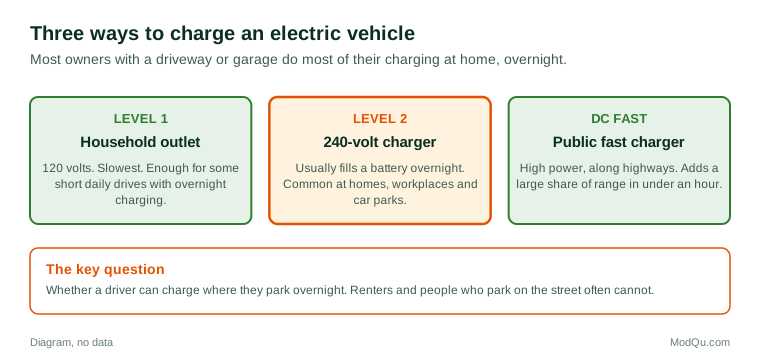
Charging is the part of EV ownership that is most different from owning a gasoline car. There are three main levels:
- Level 1: a standard household outlet (120 volts in North America). It is slow and adds only a small amount of driving distance per hour, but it is enough for some people who drive short distances and can charge overnight.
- Level 2: a 240-volt charger, like the circuit used for an electric dryer or stove. It can usually fill a battery overnight and is the most common option at home, at workplaces and in public car parks.
- DC fast charging: high-power public chargers, usually along highways and in commercial areas. They can add a large share of range in well under an hour, depending on the car and the charger.
Most EV owners do most of their charging at home. That makes access to home charging one of the biggest factors in whether an EV is practical. A homeowner with a driveway or garage can install a Level 2 charger. A renter, a condominium owner, or someone who parks on the street may have to rely on public chargers or workplace charging, which costs more and takes more planning.
Example
A family with a detached house and a garage has a Level 2 charger installed. They plug in each evening and start every day with a full battery, so they rarely use public chargers except on long trips. Their neighbours across the street live in an apartment with no charging in the parking garage. They like the idea of an EV but decide against one for now, because they would have to visit a public charger every week.
Range and range anxiety
Range is how far a vehicle can travel on a full charge. Ranges have increased as batteries have improved, and many current battery electric models can cover a typical week of local driving on one charge. Long highway trips usually involve one or more fast-charging stops.
Range anxiety is the worry that a vehicle will run out of charge before reaching a charger. It is one of the concerns people mention most often before buying an EV. Owners often say it fades with experience, as they learn how far they really drive in a day, but it can return on long trips in areas with few chargers.
Cold weather matters in Canada. Batteries work less efficiently in the cold, and heating the cabin uses energy, so winter range is lower than summer range. Many EVs have heat pumps and allow the cabin and battery to be warmed while the car is still plugged in, which reduces the loss.
Example (hypothetical figures)
A driver's EV has a rated range of 400 km. In summer they get close to that. On a winter day at minus 20°C, with the heater on, they find they can count on about 280 km, a reduction of 30%. Their daily round trip is 70 km, so the winter loss makes no difference on workdays, but they plan an extra charging stop for a holiday drive of 450 km.
What EVs cost
The costs of owning an EV fall into a few groups, and they balance out differently for different people.
- Purchase price: EVs have usually cost more to buy than similar gasoline models, although the gap has narrowed for some models. Used EVs are becoming more common.
- Incentives: governments in Canada, the United States and elsewhere have offered rebates or tax credits for EVs and home chargers at different times. Programs open, change and close, so buyers check what is available when they buy.
- Energy: electricity at home usually costs less per kilometre than gasoline, though this depends on local electricity prices and fuel prices. Public fast charging costs more than home charging.
- Maintenance: EVs have no oil changes, spark plugs or exhaust systems, and regenerative braking reduces brake wear. Tires may wear faster because EVs are heavy.
- Insurance and repairs: insurance can be higher for some models, and repairs after a collision can be costly.
- Home charger: installing a Level 2 charger costs money, and older homes may need an electrical upgrade.
- Depreciation: how well EVs hold their value over time is still being learned, partly because the technology changes fast.
People who drive a lot and can charge at home tend to save the most on running costs. People who drive little, or rely on public fast charging, may not save as much.
Batteries
The battery is the most expensive part of an EV and the one buyers worry about most. Batteries lose some capacity as they age, which is called battery degradation. Manufacturers usually offer a separate battery warranty covering a set number of years or kilometres, promising that capacity will not fall below a stated level.
Other questions people ask about batteries include how long they last, what a replacement would cost, how they behave in extreme heat or cold, and what happens to them at the end of their life. Battery recycling and reuse, for example as storage for homes or the electricity grid, are growing industries.
What worries drivers
When people are asked what holds them back from buying an EV, the reasons usually fall into a few groups:
- Charging access, especially for people without a driveway.
- Range, especially for long trips and in winter.
- Price, compared with a gasoline car.
- Public charger reliability, including broken chargers and waits at busy stations.
- Uncertainty, about battery life, resale value and how fast the technology will change.
- Fit, for people who tow trailers, drive long rural distances or need a particular size of vehicle.
Example
A rural driver who commutes 120 km a day and tows a boat in summer looks at an electric pickup. The commute would be fine with home charging, but towing would cut the range sharply and the nearest fast charger on their route to the lake is far away. They choose a plug-in hybrid instead, using electricity for most commuting and gasoline for towing.
Trends and what people disagree about
The number of EV models, public chargers and used EVs for sale has grown. Charging connectors in North America are moving toward a common standard, which should let more cars use more chargers. Bidirectional charging, which lets a car send power back to a home or the grid, is being tested and offered on some models.
There are also real disagreements. People differ on how large the environmental benefit of EVs is, which depends on how the electricity is generated and how the battery is made. They disagree about whether governments should require a rising share of EV sales or leave the choice to buyers, and whether incentives are a good use of public money. And opinions differ on whether plug-in hybrids are a useful step or a delay.
Key terms
- BEVA battery electric vehicle, powered only by electricity from its battery.
- PHEVA plug-in hybrid with a rechargeable battery and a gasoline engine.
- RangeThe distance a vehicle can travel on a full charge.
- Range anxietyWorry that a vehicle will run out of charge before reaching a charger.
- Level 2 chargingCharging from a 240-volt supply, common at homes and workplaces.
- DC fast chargingHigh-power public charging that adds range quickly.
- Regenerative brakingUsing the motor to slow the car and recover energy into the battery.
- Battery degradationThe gradual loss of a battery's capacity as it ages.
Full glossary: electric vehicle charging networks terms on EditingTests.com.
Electric vehicles vocabulary test
How well do you know the language of this topic? Try 8 quick questions. Your score is shown straight away and is not saved.
What the electric vehicles survey asks
This survey is part of ModQu's Cars and Getting Around survey. The electric vehicles part takes about five minutes and covers:
- How likely your next vehicle is to be electric, a plug-in hybrid, a hybrid or gasoline.
- What worries you most about owning an EV.
- Whether you have, or could get, charging at home or at work.
- How far you drive on a typical day and on your longest trips.
- What you know about incentives for EVs and home chargers.
- If you own an EV, how satisfied you are and what you would change.
After that you can choose to continue with other short parts of the Cars and Getting Around survey, such as buying a car or public transit, or stop.
Ready to take part?
Your answers help show what people really think and do. Results are only ever reported as totals; no one can see your individual answers.
Start the surveyQuestions about this survey
Who can take part?
Drivers.
Do I have to give my name?
No. You may be asked for your age group, region and similar details so results can be broken down, but not your name. ModQu never asks for passwords, card numbers or account numbers.
How are the results used?
Answers are combined into totals and percentages and published in ModQu reports. Individual answers are never shown.
Is the vocabulary test part of the survey?
No. It is optional and separate, and your score is not stored.
Do I need to own an electric vehicle to take part?
No. Drivers of any vehicle can take part, and the survey asks non-owners about their plans and concerns.