
Share your experience of help at home
Tell us whether you pay someone to clean or help at home, how often, and how you found them. Your answers are combined with other people's and reported only as totals.
Start the domestic help and cleaners surveyAbout 5 minutes. No account needed. You can stop at any time.
What domestic help covers
Domestic help means paid work done in a private home, such as cleaning, cooking, laundry, childcare and care for older people. The International Labour Organization estimates that tens of millions of people worldwide work as domestic workers, most of them women, and many of them migrants.
The main kinds of domestic help include:
- Regular cleaners, who visit weekly, fortnightly or monthly.
- One-off or deep cleans, for example before moving out or after building work.
- Housekeepers, who manage cleaning, laundry, shopping and sometimes cooking.
- Live-in domestic workers, who live in the household and do a range of tasks.
- Nannies and au pairs, mainly for childcare, sometimes with light housework.
- Home carers, who help older or disabled people with daily tasks.
- Ironing, laundry and window-cleaning services.
How common paid domestic help is varies greatly by country. In parts of Asia, the Middle East, Latin America and Africa, live-in domestic workers are common in middle-income households. In many European and North American countries, paid help is more often a cleaner who visits for a few hours.
Why people use domestic help
Reasons people give include:
- Lack of time, especially in households where all adults work.
- Health, disability or age, which make cleaning difficult.
- Childcare needs.
- Avoiding conflict within households over chores.
- Higher standards or deep cleaning they cannot do themselves.
- Preferring to spend free time on other things.
Some people feel uncomfortable paying for help at home, for reasons of cost, privacy or a sense that they should do it themselves.
Example
Two parents who both work full time argue regularly about housework. They hire a cleaner for three hours every two weeks. They say the arguments have reduced, though they still share daily tidying and cooking.
How people find help
Common ways to find domestic help include:
- Recommendations from friends, family and neighbours, often the most trusted route.
- Cleaning companies and agencies, which employ or arrange cleaners and may handle insurance and replacements.
- Online platforms and apps, where people book cleaners by the hour.
- Local adverts and community groups.
- Recruitment agencies, for live-in workers, sometimes from other countries.
People choose between working with an individual directly and using a company or platform. Companies may cost more but often offer vetting, insurance and replacement cover if a cleaner is ill. Hiring an individual directly can cost less and allow a more personal relationship, but the household may take on responsibilities as an employer, depending on the country.
Costs
Costs vary widely by country, city and type of help. Cleaners are commonly paid by the hour, by the visit or by the month. Live-in domestic workers are usually paid a monthly wage plus food and accommodation. Extra costs may include cleaning products, travel, agency fees and, in some countries, social security contributions.
Example (hypothetical figures)
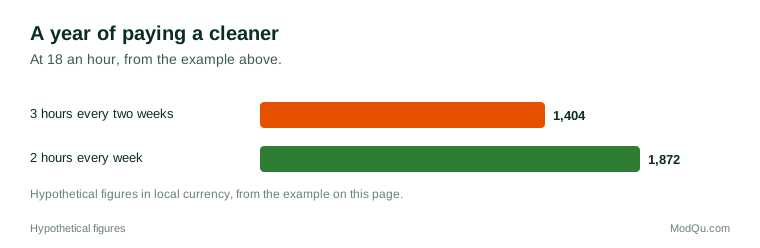
A household pays a cleaner 18 an hour in their local currency for 3 hours every two weeks, so 54 a visit. With 26 visits a year, that comes to 1,404. Switching to weekly visits of 2 hours would cost 36 a visit, or 1,872 a year, which is 468 more.
Trust, safety and privacy
Letting someone into the home involves trust on both sides. Households often think about:
- Keys and access, including who holds a key or door code.
- Valuables and privacy, such as personal documents.
- References and background checks, which some agencies carry out.
- Insurance, in case of accidents or damage.
- Cameras, which some households use; rules on recording workers differ by country, and it raises questions of workers' privacy.
Domestic workers also face risks, such as unsafe chemicals, heavy lifting, accusations of theft, and harassment. Live-in workers can be isolated and depend heavily on their employers.
Example
A cleaner who works for several households keeps a written record of the keys she holds and returns them when a job ends. One client asks her to clean while they are on holiday, and they agree in writing on the dates and what will be done.
Domestic workers' rights
Domestic workers have historically had fewer protections than other workers in many countries. The ILO's Domestic Workers Convention, adopted in 2011, sets standards such as reasonable hours, weekly rest, minimum wage coverage, clear terms of employment and protection from abuse. A number of countries have ratified it, and others have improved their laws.
Rules still differ widely. In some countries households that hire directly must register as employers and pay social contributions, and some offer tax credits or voucher schemes to encourage formal employment, as in France and Belgium. In others much domestic work is informal and cash-based. Concerns raised by worker groups and human rights organizations include low pay, long hours, withheld passports, and recruitment debts in some migrant labour systems.
Formal and informal work
Many domestic workers are paid informally in cash. This can suit both sides in the short term but can leave workers without pensions, sick pay or protection, and households without insurance or clear agreements. Some households and workers prefer written agreements covering pay, hours, tasks, holidays and notice, even when the law does not require it.
Trends and debates
Current trends include:
- App-based cleaning platforms, with debate about whether cleaners are employees or self-employed.
- Rising demand for home care as populations age.
- Eco-friendly cleaning services.
- Fair pay campaigns for domestic workers.
- Debate about the ethics of paid domestic work, including how it affects gender roles and inequality.
What people and businesses want to know
Questions businesses and public bodies want answered include how many households pay for help at home, what kind, how often, how they found the person or service, what they pay, how much they trust their help, and whether arrangements are formal or informal.
Key terms
- Domestic workerA person paid to do work such as cleaning or caring in a private home.
- HousekeeperA person who manages cleaning, laundry and other household tasks.
- Live-in workerA domestic worker who lives in the employer's household.
- Au pairA young person from abroad who helps with childcare in exchange for a room and an allowance.
- Cleaning agencyA company that employs or arranges cleaners for households.
- Deep cleanA thorough one-off clean of areas not covered in regular cleaning.
- Informal workWork done without a formal contract or registration.
- Domestic Workers ConventionAn ILO agreement of 2011 setting standards for domestic work.
Full glossary: household cleaning supplies terms on EditingTests.com.
Domestic help and cleaners vocabulary test
How well do you know the language of this topic? Try 8 quick questions. Your score is shown straight away and is not saved.
What the domestic help and cleaners survey asks
This survey is part of ModQu's Household Life survey. The domestic help and cleaners part takes about five minutes and covers:
- Whether you pay someone to clean or help in your home, and what kind of help.
- How often they come, and how long each visit lasts.
- How you found them: a recommendation, an agency, an app or another way.
- How much you pay, and whether you think it is fair.
- How much you trust your help, and what affects that trust.
- Whether the arrangement is written down, formal or informal.
After that you can choose to continue with other short parts of the Household Life survey, such as cleaning and laundry or household chores and time use, or stop.
Ready to take part?
Your answers help show what people really think and do. Results are only ever reported as totals; no one can see your individual answers.
Start the surveyQuestions about this survey
Who can take part?
Adults.
Do I have to give my name?
No. You may be asked for your age group, region and similar details so results can be broken down, but not your name. ModQu never asks for passwords, card numbers or account numbers.
How are the results used?
Answers are combined into totals and percentages and published in ModQu reports. Individual answers are never shown.
Is the vocabulary test part of the survey?
No. It is optional and separate, and your score is not stored.
Should a cleaner bring their own products?
Arrangements differ. Some cleaners bring their own supplies and include them in the price, while others use the household's products.