
Share your experience of fair treatment
Tell us whether you have faced unfair treatment, where it happened, and whether you reported it. Your answers are combined with other people's and reported only as totals.
Start the discrimination and equal rights surveyAbout 5 minutes. No account needed. You can stop at any time.
What discrimination means
Discrimination is unfair treatment of a person or group because of a characteristic they have, or are thought to have. Most legal systems do not ban every difference in treatment. They ban treatment that is based on certain protected characteristics and that happens in certain areas of life, such as work, education, housing and services.
Equality is also a principle in international human rights law. The Universal Declaration of Human Rights and later United Nations treaties state that rights apply to everyone without distinction. Countries then put these principles into their own constitutions and laws, and the detail varies a great deal.
Protected characteristics
The grounds that laws protect differ from country to country, but many lists include:
- Sex and gender, including pregnancy and maternity.
- Race, colour, ethnic or national origin.
- Religion or belief.
- Disability, including long-term health conditions.
- Age.
- Sexual orientation.
- Gender identity.
- Marital or family status.
Some countries add other grounds, such as language, caste, political opinion, social origin, trade union membership or criminal record. Others protect fewer grounds, or protect them only in some settings. The same characteristic can be protected at work but not in housing, or in public services but not in private clubs.
Kinds of discrimination
Laws and courts often distinguish between several forms:
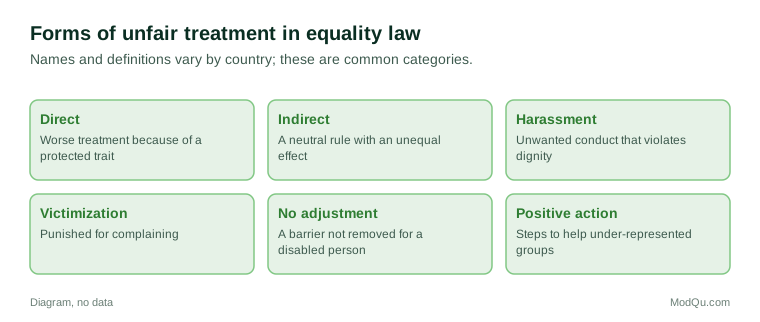
- Direct discrimination: treating someone worse because of a protected characteristic, for example refusing to interview a candidate because of their age.
- Indirect discrimination: applying a rule to everyone that puts one group at a particular disadvantage without good reason, such as a height requirement that excludes more women than men and is not needed for the job.
- Harassment: unwanted conduct linked to a protected characteristic that violates a person's dignity or creates a hostile environment.
- Victimization or retaliation: treating someone badly because they complained or supported a complaint.
- Failure to make reasonable adjustments: not making practical changes that would remove a barrier for a disabled person, where the law requires this.
Example
A job advertisement asks for applicants with "no more than five years' experience" for a role that does not need recent training. A 52-year-old with twenty years in the field is turned down at the first stage. They wonder whether the rule disadvantages older applicants more than younger ones.
Where discrimination happens
People report unfair treatment in many settings. The most commonly discussed are:
- Work: recruitment, pay, promotion, training, dismissal and day-to-day treatment by colleagues and managers.
- Housing: renting or buying a home, and treatment by landlords and neighbours.
- Shops, restaurants and services: being refused service, followed in a shop or treated with less respect.
- Education: admissions, discipline and support for students with disabilities.
- Health care: access to treatment and how people are listened to.
- Policing and public services: stops, searches and how complaints are handled.
- Online: abuse on social media, and automated systems that treat groups differently.
Example
A wheelchair user books a table at a restaurant by phone and is told the venue is accessible. On arrival the only entrance has three steps and staff say there is no ramp. The person leaves and later considers making a complaint.
Why many people do not report it
Surveys in many countries have found that most people who say they experienced discrimination did not make a formal report. People give a range of reasons:
- They did not think anything would change.
- They did not know where or how to report.
- They feared it would make things worse, for example at work.
- They felt they could not prove it.
- The incident seemed minor or common.
- They did not want to relive it or be seen as a complainer.
- They were unsure whether what happened counted as discrimination.
Because of this, official complaint numbers tend to show only part of the picture. Asking people directly about their experiences, in a way that protects their privacy, is one way to learn more.
How complaints are handled
The routes for a complaint depend on the setting and the country, but often include:
- Raising it informally with the person or organization involved.
- Using an internal complaints or grievance process, such as at an employer, school or shop.
- Contacting an equality body or human rights commission. Many countries have one, for example national human rights institutions in much of Europe, Africa, Asia and the Americas. Some investigate, some help settle complaints and some give advice.
- Mediation or conciliation, to agree an outcome.
- A claim to a tribunal or court, which can award compensation or order changes.
Time limits apply in most systems. In many places the person complaining must show facts that suggest discrimination, and the other side must then show that it had a non-discriminatory reason.
Example (hypothetical figures)
A workplace receives 40 complaints about treatment at work in a year. Staff surveys suggest that for every complaint made, about four people had an experience they did not report. That would mean around 200 people with experiences, of whom only 40, or one in five, made a complaint.
Positive action and equal pay
Many laws go beyond banning discrimination. Some allow or require positive action, such as targeted recruitment, mentoring programs or, in a few countries, quotas for company boards or public bodies. Others require equal pay for equal work, or for work of equal value, and some ask large employers to publish pay gap figures by sex or ethnicity.
These measures are often debated. Supporters say they correct long-standing disadvantages. Critics argue that some measures treat individuals unfairly or that results should come from choice and merit alone. Where the law allows them, and how far they can go, varies between countries.
Trends and debates
Current discussions about discrimination and equality include:
- Algorithms and automated decisions in hiring, lending and insurance, and whether they repeat existing patterns.
- Accessibility of websites and apps for people with disabilities.
- Pay transparency and new reporting requirements.
- Age discrimination as working lives get longer.
- Freedom of religion and freedom of expression, and how they are balanced against other rights.
- Collecting equality data, which helps measure problems but raises privacy concerns.
Questions businesses and public bodies want answered include how many people experience unfair treatment, where it happens, which groups are most affected, how many report it and what the results are.
Key terms
- Protected characteristicA personal trait, such as age or religion, covered by equality law.
- Direct discriminationTreating someone worse because of a protected characteristic.
- Indirect discriminationA rule applied to everyone that disadvantages one group without good reason.
- HarassmentUnwanted conduct linked to a protected characteristic that violates dignity.
- VictimizationTreating someone badly because they complained or helped a complaint.
- Reasonable adjustmentA practical change that removes a barrier for a disabled person.
- Equality bodyA public organization that promotes equal treatment and handles or supports complaints.
- Positive actionSteps to help groups that are under-represented or disadvantaged.
Full glossary: legal services terms on EditingTests.com.
Discrimination and equal rights vocabulary test
How well do you know the language of this topic? Try 8 quick questions. Your score is shown straight away and is not saved.
What the discrimination and equal rights survey asks
This survey is part of ModQu's Law and Rights survey. The discrimination and equal rights part takes about five minutes and covers:
- Whether you have faced unfair treatment in the last year, and what you think it was based on.
- Where it happened, for example at work, in a shop, in housing, online or with a public service.
- Whether you reported it, to whom, and what happened next.
- If you did not report it, the main reasons why.
- How well you think equality laws protect people where you live.
- Which changes, if any, you would like to see.
After that you can choose to continue with other short parts of the Law and Rights survey, such as using a lawyer or consumer rights and complaints, or stop.
Ready to take part?
Your answers help show what people really think and do. Results are only ever reported as totals; no one can see your individual answers.
Start the surveyQuestions about this survey
Who can take part?
Adults.
Do I have to give my name?
No. You may be asked for your age group, region and similar details so results can be broken down, but not your name. ModQu never asks for passwords, card numbers or account numbers.
How are the results used?
Answers are combined into totals and percentages and published in ModQu reports. Individual answers are never shown.
Is the vocabulary test part of the survey?
No. It is optional and separate, and your score is not stored.