
Share your view of digital ID
Tell us whether you have a digital government ID, how you prove who you are online and how much you trust the government with your data. Your answers are combined with other people's and reported only as totals.
Start the digital id and government records surveyAbout 5 minutes. No account needed. You can stop at any time.
What digital identity means
Identity means the information that shows who a person is: name, date of birth, place of birth, nationality and an identifying number. Traditionally, people prove identity with paper or plastic documents such as birth certificates, ID cards, passports and driving licences.
Digital identity lets people prove who they are electronically. It can take several forms:
- national ID cards with a chip that can be read by a card reader or phone;
- mobile ID apps that store an identity credential on a phone;
- government login systems used to access many public services with one account;
- digital driving licences and other documents on a phone;
- biometric identity systems that use fingerprints, iris scans or face images.
Digital ID systems differ in who runs them, whether they are compulsory, what data they hold and how that data is shared.
Examples around the world
Countries have taken different approaches:
- Estonia issues a national ID card with a chip that citizens use to sign documents, vote online and access almost all public services.
- India's Aadhaar gives a 12-digit number linked to biometric data to residents, used for benefits, banking and phone connections. It is one of the largest identity systems in the world.
- The European Union has adopted rules for European Digital Identity Wallets that member states are required to offer to citizens.
- Several countries offer government login systems for tax, benefits and health services without a national ID card.
- In some countries, there is no national ID, and people use passports, driving licences or other documents.
The World Bank estimates that hundreds of millions of people worldwide lack any official proof of identity, which can prevent access to services, banking and voting. United Nations Sustainable Development Goal target 16.9 calls for legal identity for all, including birth registration, by 2030.
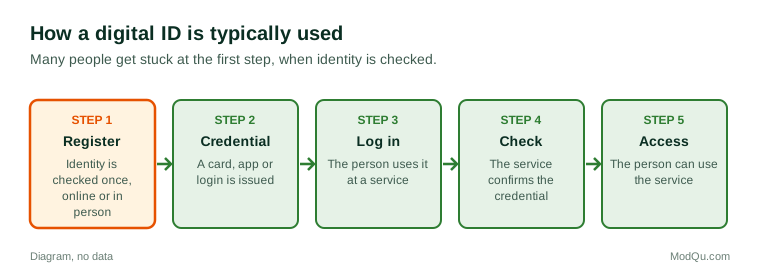
How people prove identity online
Without a national digital ID, people prove identity online in other ways:
- uploading a photo of a passport or ID card and taking a selfie for a face match;
- answering questions based on credit or public records;
- logging in through a bank's identity service, used in some countries;
- receiving codes by text message or post;
- visiting an office in person to verify once.
Each method has trade-offs between convenience, security and who it excludes. People without documents, a smartphone, a bank account or a credit history can struggle.
Example
A newcomer to a country tries to set up an online tax account. The system asks questions based on credit history, which they do not have yet. After three failed attempts, they book an appointment at a government office, bring their passport and residence permit, and are verified in person.
Benefits
Supporters of digital ID point to:
- faster access to public services, benefits and tax systems;
- fewer forms and less repeated paperwork;
- reduced fraud and duplicate records;
- access to banking and mobile services for people without other documents;
- easier signing of contracts and documents remotely;
- better data for planning services.
Example (hypothetical figures)
A government service handles 200,000 applications a year. Each paper application takes staff 30 minutes to check identity documents. After a digital ID login is introduced, 150,000 applicants use it and need no manual identity check. Staff time on identity checks falls from 100,000 hours to 25,000 hours a year.
Risks and concerns
Concerns about digital ID include:
- privacy: how much data is collected, who can see it, and whether it is linked across agencies;
- security: risk of data breaches and identity theft;
- surveillance: fear that governments could track people's activities;
- exclusion: people without phones, internet, skills or documents may be shut out, and biometric systems may fail for some people, such as manual workers with worn fingerprints;
- errors: wrong records can be hard to correct and may block access to services;
- compulsion: whether people can choose not to use digital ID.
Courts in several countries have ruled on the limits of digital ID systems, and data protection laws set rules on how personal data may be used.
Government records and data sharing
Governments hold many records about people: births, marriages and deaths, tax, benefits, health, education, vehicles, property and criminal records. Increasingly, agencies share data to reduce form-filling and target services, such as automatically paying benefits to eligible people. This can save time but raises questions about consent and control.
Example
A parent registers their baby's birth. In their country, this automatically creates a health record, starts child benefit payments and adds the child to school planning lists. They find it convenient, but a friend in another country prefers a system where each agency asks separately.
Trust
Trust in how governments handle data varies widely between countries and groups. It depends on past experience, data breaches in the news, trust in government in general, and how open the government is about what data it holds and why. People tend to be more willing to share data when they understand the purpose, can see what is held about them and can correct mistakes.
What people disagree about
People disagree about whether digital ID should be compulsory, which data should be linked, whether biometrics should be used, who should run identity systems (governments, banks or tech firms), and how to protect people who cannot or will not use digital systems.
Questions that governments, public agencies and identity technology firms want answered include who has a digital ID, how people prove identity online, what problems they meet and how much they trust the government with their data.
Key terms
- Digital identityA way to prove who you are electronically.
- National ID cardAn official identity card issued by a government.
- BiometricsBody measurements such as fingerprints, face or iris used to identify people.
- CredentialA record that proves something about a person, such as identity.
- VerificationChecking that a person is who they say they are.
- Data breachUnauthorized access to or release of personal data.
- Data protectionLaws and practices that govern how personal data is collected and used.
- Legal identityOfficial recognition of a person's identity, such as through birth registration.
Full glossary: digital identity platforms terms on EditingTests.com.
Digital ID and government records vocabulary test
How well do you know the language of this topic? Try 8 quick questions. Your score is shown straight away and is not saved.
What the digital id and government records survey asks
This survey is part of ModQu's Government and Public Services survey. The digital id and government records part takes about five minutes and covers:
- Whether you have a digital government ID or online government account.
- How you prove your identity online, and what problems you have had.
- Which services you use your digital ID for.
- How much you trust the government to keep your data safe.
- Whether you are comfortable with government agencies sharing your data.
- What would make you more willing to use digital ID.
After that you can choose to continue with other short parts of the Government and Public Services survey, such as local services or trust in government, or stop.
Ready to take part?
Your answers help show what people really think and do. Results are only ever reported as totals; no one can see your individual answers.
Start the surveyQuestions about this survey
Who can take part?
Adults.
Do I have to give my name?
No. You may be asked for your age group, region and similar details so results can be broken down, but not your name. ModQu never asks for passwords, card numbers or account numbers.
How are the results used?
Answers are combined into totals and percentages and published in ModQu reports. Individual answers are never shown.
Is the vocabulary test part of the survey?
No. It is optional and separate, and your score is not stored.
Will the survey ask for my ID number?
No. ModQu never asks for ID numbers, passwords or document images.
Can people without a digital ID take part?
Yes. Their experiences and reasons are an important part of the results.
Does the survey cover private ID apps?
It focuses on government ID, but it asks whether you use banks or other services to prove identity.
Is this survey run by a government?
No. ModQu is independent and does not share answers in a way that identifies you.