
Share how you dance
Tell us whether you dance as a hobby or exercise, whether you take classes and what you spend on dancing. Your answers are combined with other people's and reported only as totals.
Start the dance surveyAbout 5 minutes. No account needed. You can stop at any time.
What dance as a hobby covers
Dance is found in every culture. As a leisure activity it takes several forms:
- Social dancing at parties, weddings, clubs, festivals and community events.
- Partner dancing, such as salsa, tango, swing, ballroom and bachata, often learned in classes and practised at social nights.
- Traditional and folk dance, from Irish step dance and Bharatanatyam to Highland dance and many regional forms, often linked to cultural identity.
- Studio styles, such as ballet, contemporary, jazz, tap and hip-hop, taught in graded classes.
- Fitness dance: dance-based workouts in gyms and community halls, and online classes.
- Line dancing and group dances where everyone follows the same steps.
- Competitive dance, from children's dance schools to adult ballroom and street dance competitions.
Some people dance once a year at a celebration; others train several times a week. Surveys about dance often separate occasional social dancing from regular classes and practice.
Why people dance
People give many reasons for dancing:
- Exercise that does not feel like exercise, improving fitness, strength, balance and coordination.
- Social contact: meeting people, especially in partner dancing and community groups.
- Music and expression: enjoying music and moving to it.
- Culture and heritage: keeping traditions alive and passing them to children.
- Confidence: many adults start dance to feel more at ease, for example before a wedding.
- Mental wellbeing: many dancers say it helps them relax and forget daily worries.
Health organizations, including the World Health Organization, list dancing among activities that can count towards recommended levels of physical activity.
Example
A 45-year-old accountant who disliked gyms starts a weekly salsa class with a friend. After six months they attend two classes a week and a monthly social night. They say they started for fitness but stayed because of the people they met.
Classes, socials and learning online
Most adults who dance regularly learn through classes. Common formats include:
- drop-in classes, paid per session with no commitment;
- courses of six to ten weeks for beginners or improvers;
- graded classes with exams, common in ballet, tap and ballroom;
- workshops and weekend festivals with visiting teachers;
- private lessons, often for couples before a wedding;
- online classes and video tutorials, which many people use alongside in-person learning.
Social dances, sometimes called socials, milongas (in tango) or practicas, are events where people dance with others rather than follow a lesson. Many partner dance communities hold them weekly in cities around the world.
Costs
The cost of dancing varies widely:
- class fees, per session or per term;
- entry to social nights and festivals;
- shoes, which matter more in some styles than others;
- clothes and costumes, especially for shows and competitions;
- exam and competition fees;
- travel to events.
Example (hypothetical figures)
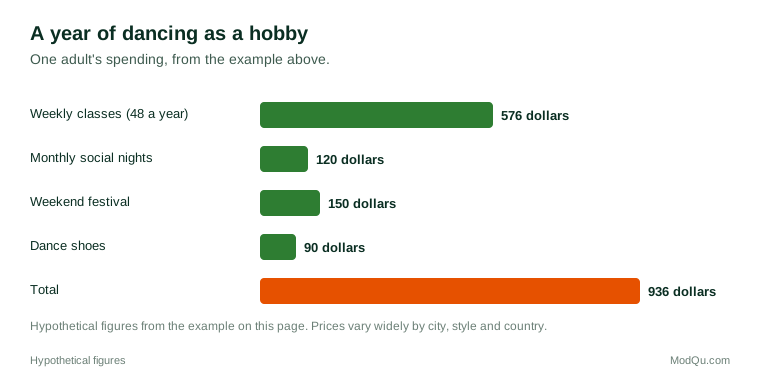
An adult takes one class a week at 12 dollars and attends a monthly social night at 10 dollars. Over a month of four classes, that comes to 48 dollars plus 10 dollars, or 58 dollars. In the same year they buy dance shoes for 90 dollars and go to one weekend festival for 150 dollars. Their total for the year is 58 times 12, or 696 dollars, plus 240 dollars, about 936 dollars.
Costs are usually much higher for children and adults who compete, because of private lessons, costumes and travel.
Children and young people
Many children take dance classes, often starting with ballet, tap, jazz or a traditional form. Parents often mention fitness, confidence, discipline and friendship as reasons. Classes may lead to shows, exams and competitions. As children reach their teens, many stop, while others move into school dance groups, hip-hop crews or more serious training.
Example
A parent enrols a six-year-old in a weekly ballet class. By age ten the child takes three styles and performs in a yearly show. The parent says the costs of costumes and show tickets grew more than expected, and asks the school whether costumes can be reused.
Barriers to dancing
Many people say they would like to dance but do not. Common reasons include:
- feeling self-conscious or "not a dancer";
- no partner, for partner styles;
- class times that clash with work or childcare;
- cost, especially for regular classes;
- injury, health problems or worries about fitness;
- not knowing where to start or which style suits them;
- for some, religious or cultural views on mixed dancing.
Classes for beginners, adult-only classes, chair-based dance for older people and inclusive dance for disabled people aim to address some of these.
Example
A retired woman with arthritis joins a seated dance class at a community centre. The class uses music from her youth and simple arm and foot movements. She says she would never have joined a standard class but now looks forward to it every week.
Dance at home and online
Many people now dance at home, following online fitness dance classes, dance games on consoles, or short dance trends shared on social media. Some learn steps from videos before trying a class; others prefer to dance only at home. Online learning makes dance easy to try but offers no feedback on technique and no social contact.
Dance events and festivals
Beyond classes, many dancers travel to events. Partner dance communities hold weekend festivals and congresses with workshops by day and social dancing late into the night. Folk and traditional dance groups perform at cultural festivals, weddings and national holidays. Dance schools put on yearly shows, often in local theatres, where students of all ages perform.
Watching dance is a separate activity from doing it. Many people who never dance themselves go to ballet, contemporary dance, musicals or cultural performances, while some dancers rarely watch professional shows. Surveys often ask about both, because they attract different audiences and spending.
What people disagree about
Dance raises a few debates:
- whether dance should be taught in schools as part of physical education or the arts;
- whether competitive dance for young children puts too much focus on appearance;
- how traditional dances should be taught and adapted by people outside the culture they come from;
- whether online dance learning can replace a teacher.
Questions dance schools, venues and event organizers want answered include who dances, which styles they choose, how they learn, what they spend and what would get more people dancing.
Key terms
- Partner dancingStyles danced in pairs, such as salsa, tango and ballroom.
- Social danceAn event where people dance freely with others rather than take a lesson.
- Drop-in classA class paid for per session with no commitment.
- Graded examA formal assessment of dance skill at a set level.
- ChoreographyA planned sequence of dance movements.
- Leader and followerThe two roles in many partner dances.
- Fitness danceA workout made up of dance moves set to music.
- Folk danceA traditional dance linked to a particular culture or region.
Full glossary: performing arts administration terms on EditingTests.com.
Dance vocabulary test
How well do you know the language of this topic? Try 8 quick questions. Your score is shown straight away and is not saved.
What the dance survey asks
This survey is part of ModQu's Arts, Culture and Sport survey. The dance part takes about five minutes and covers:
- Whether you dance as a hobby or exercise, and how often.
- Which styles you dance and where: classes, socials, home or events.
- Whether you take classes, and in what format.
- How much you spend on dancing in a typical month.
- What stops you dancing more, if anything.
- Whether your children dance, and what that costs.
After that you can choose to continue with other short parts of the Arts, Culture and Sport survey, such as museums and galleries or live events and theatre, or stop.
Ready to take part?
Your answers help show what people really think and do. Results are only ever reported as totals; no one can see your individual answers.
Start the surveyQuestions about this survey
Who can take part?
Adults.
Do I have to give my name?
No. You may be asked for your age group, region and similar details so results can be broken down, but not your name. ModQu never asks for passwords, card numbers or account numbers.
How are the results used?
Answers are combined into totals and percentages and published in ModQu reports. Individual answers are never shown.
Is the vocabulary test part of the survey?
No. It is optional and separate, and your score is not stored.