
Share your hobbies
Tell us what hobbies you have, how much you spend on them each month and where you learn new skills. Your answers are combined with other people's and reported only as totals.
Start the hobbies and crafts surveyAbout 5 minutes. No account needed. You can stop at any time.
What hobbies and crafts cover
A hobby is an activity people do regularly in their free time for enjoyment. Crafts are hobbies that involve making things by hand. Common hobbies and crafts include:
- Textile and fibre crafts: knitting, crocheting, sewing, quilting, embroidery and weaving.
- Woodworking, carving and furniture restoration.
- Visual arts: drawing, painting, pottery, printmaking and photography.
- Paper crafts: scrapbooking, card making, calligraphy and bookbinding.
- Jewellery making and beadwork, including Indigenous beadwork traditions.
- Model building: model trains, cars, aircraft and miniatures.
- Cooking and baking, bread making and preserving.
- Gardening and growing plants indoors.
- Collecting, such as coins, stamps, cards and records.
- Games and puzzles: board games, jigsaw puzzles and tabletop games.
- Music: playing an instrument or singing in a choir.
- Technology hobbies: electronics, 3D printing and coding projects.
Sport, fitness and outdoor activities are covered on separate pages.
Why people take up hobbies
People give many reasons for their hobbies:
- Relaxation and a break from work and screens.
- The satisfaction of making something with their own hands.
- Learning and challenge, and getting better over time.
- Creativity and self-expression.
- Social connection, through clubs, classes and online groups.
- Family tradition, such as learning to knit or bake from a grandparent.
- Practical results, such as repairing things, growing food or making gifts.
- Wellbeing: many people say hobbies help them manage stress.
Life changes often lead to new hobbies: retirement, a move, having children, recovering from an illness, or more time at home.
Example
A nurse takes up pottery after a stressful year at work. They sign up for an eight-week evening class at a community arts centre. They say the two hours each week at the wheel are the only time they stop thinking about work. After the course ends, they buy a membership to use the studio on weekends.
How people learn
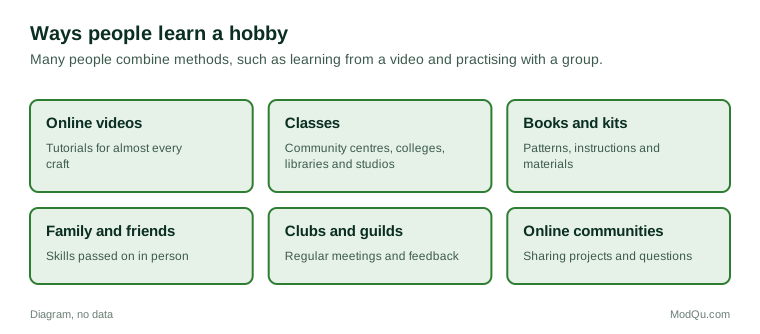
People learn hobby skills in different ways:
- Online videos and tutorials, which have become a main source for many people.
- Classes and workshops at community centres, colleges, libraries, craft stores and studios.
- Books and magazines, including pattern books and instructions.
- Family and friends teaching each other.
- Clubs and guilds, such as quilting guilds, woodworking clubs and camera clubs.
- Online communities and forums where people share projects and ask questions.
- Kits that include materials and step-by-step instructions.
Many people combine methods: watching a video to learn a technique, then joining a group to practise and get feedback.
Example
A man who wants to learn woodworking watches online videos for a few months but feels unsafe using power tools alone. He joins a community workshop that offers safety training and shared tools. After the training, he books bench time each week and gets advice from more experienced members.
What people spend
Spending on hobbies varies from almost nothing to thousands of dollars a year. Common costs include:
- Materials and supplies, such as yarn, fabric, paint, clay, wood and seeds.
- Tools and equipment, from needles and brushes to sewing machines, kilns and table saws.
- Classes and memberships.
- Subscriptions, such as craft subscription boxes or online learning platforms.
- Space: a sewing room, workshop or garden plot.
- Travel to shows, retreats and conventions.
Many hobbyists say they buy more supplies than they use, a common joke among knitters and quilters about their "stash".
Example (hypothetical figures)
A quilter tracks their spending for a year. Fabric costs $65 a month on average, thread and notions $10 a month, and a guild membership $60 a year. They also take one weekend retreat for $240. The year's total is ($65 + $10) × 12 + $60 + $240 = $1,200, or $100 a month on average.
Clubs, communities and events
Hobbies are often social. People meet at:
- Clubs and guilds, with regular meetings, shows and shared projects.
- Community centres and libraries, which run classes, maker spaces and drop-in groups.
- Craft fairs, shows and conventions, where people buy supplies, see others' work and take workshops.
- Repair cafés, where volunteers help people fix items.
- Online groups, which connect people with very specific interests across the world.
For older adults and people living alone, hobby groups can be an important source of friendship.
Selling handmade work
Some hobbyists sell what they make, at craft fairs, markets, online marketplaces or through social media. For most it is a way to cover the cost of materials rather than a main income, but some build a small business. People who sell often find that pricing is difficult: many underprice their work by not counting their time. In Canada, income from selling crafts may need to be reported for tax purposes, and the line between a hobby and a business depends on factors such as whether the activity is carried on with a reasonable expectation of profit.
Example
A retiree who makes wooden toys sells them at three craft fairs a year. They price each toy by adding the cost of wood and finish to a small amount for their time. A friend points out that they are earning less than two dollars an hour. They raise their prices slightly, sell almost as many and say they now feel their time is valued.
Trends
Hobbies go in and out of fashion. Recent trends that hobby stores and organizations have noted include renewed interest in crafts such as knitting, sourdough baking and puzzles during periods when people spent more time at home, growth of maker spaces and 3D printing, interest in repairing and upcycling, and younger people learning traditional crafts through online videos.
What people disagree about
People disagree about whether online tutorials are as good as in-person classes, whether hobby spending is good value, how much public money should support community arts centres and maker spaces, and how handmade sellers should compete with mass-produced goods sold as "handmade". Questions that retailers and community organizations want answered include what hobbies people have, how much they spend on them each month and where they learn new skills.
Key terms
- CraftA hobby or skill that involves making things by hand.
- GuildA club for people who share a craft, such as quilting or woodworking.
- Maker spaceA shared workspace with tools and equipment for making things.
- PatternInstructions or a template for making an item, such as a garment or quilt.
- KilnAn oven used to fire pottery and ceramics.
- UpcyclingMaking something new and more useful or valuable from old or discarded items.
- StashA hobbyist's collection of supplies, such as yarn or fabric, kept for future projects.
- Repair caféA free event where volunteers help people fix broken items.
Full glossary: art terms on EditingTests.com.
Hobbies and crafts vocabulary test
How well do you know the language of this topic? Try 8 quick questions. Your score is shown straight away and is not saved.
What the hobbies and crafts survey asks
This survey is part of ModQu's Arts, Culture and Sport survey. The hobbies and crafts part takes about five minutes and covers:
- Which hobbies and crafts you do, and how often.
- Why you took them up and what you get from them.
- How much you spend on your hobbies each month, and on what.
- Where you learn new skills: classes, online videos, books or groups.
- Whether you belong to a club, guild or online community.
- Whether you sell or give away what you make.
After that you can choose to continue with other short parts of the Arts, Culture and Sport survey, such as museums and galleries or live events and theatre, or stop.
Ready to take part?
Your answers help show what people really think and do. Results are only ever reported as totals; no one can see your individual answers.
Start the surveyQuestions about this survey
Who can take part?
Adults.
Do I have to give my name?
No. You may be asked for your age group, region and similar details so results can be broken down, but not your name. ModQu never asks for passwords, card numbers or account numbers.
How are the results used?
Answers are combined into totals and percentages and published in ModQu reports. Individual answers are never shown.
Is the vocabulary test part of the survey?
No. It is optional and separate, and your score is not stored.
How do I find a class or club for a hobby?
Community centres, public libraries, colleges and craft stores often list classes. Guilds and clubs usually welcome beginners and can be found through local community listings.