
Share how you follow sport
Tell us which sports you follow, how you watch games and whether you attended a game this year. Your answers are combined with other people's and reported only as totals.
Start the sports fans surveyAbout 5 minutes. No account needed. You can stop at any time.
What being a sports fan covers
A sports fan is someone who follows a sport, a team or an athlete, whether by watching, attending, reading or talking about it. Fans range from people who watch only a championship final to people who follow every game, attend regularly and spend a lot on tickets and merchandise.
Sports with large followings in Canada include hockey, which is widely seen as the national winter sport, along with football (both Canadian and American), basketball, baseball, soccer, curling and lacrosse, which is Canada's national summer sport. Many people also follow tennis, golf, motor racing, mixed martial arts, figure skating and the Olympic and Paralympic Games.
Fans may follow:
- Professional leagues and their teams.
- National teams at the Olympics, World Cups and other international events.
- University and college sport, and junior leagues such as junior hockey.
- Women's professional sport, which has grown in recent years with new leagues and larger audiences.
- Individual athletes, including Canadians competing abroad.
- Local and amateur teams, including children's sport.
How people become fans
People usually become fans in a few ways:
- Family: following the team a parent or grandparent supported.
- Place: supporting the team from their city or region.
- Playing: following the sport they played as children.
- Friends and school, where following a team is part of social life.
- A memorable moment, such as a championship run or an Olympic gold medal.
- A star player who draws attention to a team or sport.
Once formed, team loyalty tends to be strong and long-lasting, even when the team loses. Many fans keep their team after moving to another city or country.
Example
A newcomer to Canada knows little about hockey. Their coworkers organize a lunchtime pool during the playoffs and explain the rules. By the end of the season, they are watching games with their children, who play in a local house league. Two years later, the whole family supports the city's team.
How fans watch and follow games
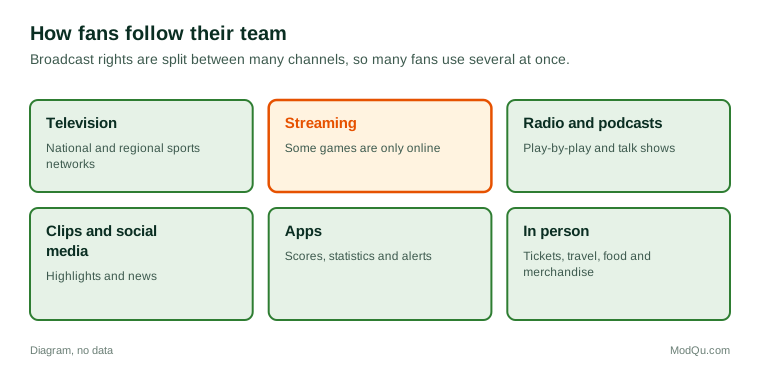
Fans follow sport through many channels:
- Television, including national and regional sports networks.
- Streaming services, which now carry many games, sometimes only online.
- Radio and podcasts.
- Highlights and clips on social media and video sites.
- League and team apps with scores, statistics and news.
- Sports bars and restaurants, and watching with friends.
- Attending in person.
Broadcast rights are split between many channels and services, and blackout rules may stop some games being shown in some areas. As a result, many fans pay for several subscriptions to follow one team, and some say they cannot work out where a game is being shown.
Example (hypothetical figures)
A fan wants to watch every game of their hockey team and their favourite soccer league. They need a cable sports package at $30 a month and two streaming services at $20 and $15 a month. That totals $65 a month, or $780 a year. They drop the cable package in the summer for four months, saving $120, so they pay $660 for the year.
Attending games
Going to a game is a highlight for many fans, but costs can add up: tickets, parking or transit, food and drinks, and merchandise. Ticket prices vary widely between leagues, teams and seats, and many teams use dynamic pricing, raising prices for popular games. Season ticket holders commit to many games in advance, often for the same seats and with playoff priority.
Many fans also attend lower-cost games, such as junior hockey, minor league baseball, university sport and women's leagues, which often offer a closer view and a family-friendly setting.
Example
A family of four that cannot afford regular tickets to the city's professional hockey team buys a few junior hockey games each winter instead. Tickets cost much less, the arena is close to home and the children can get autographs after the game. They still watch the professional team on TV.
Merchandise, fantasy sports and betting
Fans spend money in other ways too:
- Merchandise: jerseys, hats, scarves and collectibles.
- Fantasy sports: games where fans pick real players and score points based on their performances.
- Sports betting: wagering on game results and events. Single-game sports betting became legal in Canada in 2021, after a change to the Criminal Code, and provinces now regulate it. Advertising for betting has become a topic of public debate, and Ontario has introduced limits on the use of athletes and celebrities in betting advertising.
- Trading cards and memorabilia, which are collected and sold by some fans.
Many fans enjoy these activities as part of following a sport. Others worry about the growth of betting, especially among young people, and about gambling harms. Public health and gambling support services offer help to people concerned about their betting.
Being a fan in a community
Sport brings people together. Fans watch games in groups, wear team colours on game days, talk about results at work and join online communities. Big events such as playoff runs and Olympic medals can bring a whole city or country together. Fans also describe less positive sides: rivalries that turn hostile, abuse of players and officials online and at games, and the cost of following a team.
Example
A fan who moved across the country for work keeps following their hometown team. They join an online fan group and find a local bar that shows the team's games. They meet other fans from the same city and form a weekly viewing group. They say supporting the team helps them feel connected to home.
What fans complain about
Common complaints from fans include:
- the rising cost of tickets, food and drinks at games;
- not knowing where to watch games because of split broadcast rights and blackouts;
- too many advertisements during broadcasts;
- team owners moving or threatening to move teams, and public money for new arenas and stadiums;
- the growth of betting advertising;
- players leaving, and long rebuilding periods.
What people disagree about
People disagree about whether public money should help build stadiums and arenas, how much betting advertising should be allowed, whether women's sport gets enough coverage and support, and how leagues should handle broadcast rights and blackouts. Questions that sports leagues and venues want answered include which sports people follow, how they watch games and whether they attended a game this year.
Key terms
- Broadcast rightsThe right to show a sport's games on television, radio or online.
- BlackoutA rule that stops a game being shown in a certain area.
- Season ticketA ticket package for all or most of a team's home games in a season.
- Dynamic pricingChanging ticket prices up or down based on demand.
- Fantasy sportsGames where fans choose real players and score points based on their real performances.
- Sports bettingPlacing money on the result of games or events.
- PlayoffsGames after the regular season that decide a league champion.
- MerchandiseProducts sold with a team's name or logo, such as jerseys and hats.
Full glossary: sports management terms on EditingTests.com.
Sports fans vocabulary test
How well do you know the language of this topic? Try 8 quick questions. Your score is shown straight away and is not saved.
What the sports fans survey asks
This survey is part of ModQu's Arts, Culture and Sport survey. The sports fans part takes about five minutes and covers:
- Which sports, teams and athletes you follow, and how closely.
- How you watch games: TV, streaming, radio, apps or in person.
- Whether you attended a game this year, and what you spent.
- Whether you buy merchandise, play fantasy sports or bet on sport.
- What frustrates you most about following your sport.
- How being a fan fits into your social life.
After that you can choose to continue with other short parts of the Arts, Culture and Sport survey, such as museums and galleries or live events and theatre, or stop.
Ready to take part?
Your answers help show what people really think and do. Results are only ever reported as totals; no one can see your individual answers.
Start the surveyQuestions about this survey
Who can take part?
Adults who follow a sport.
Do I have to give my name?
No. You may be asked for your age group, region and similar details so results can be broken down, but not your name. ModQu never asks for passwords, card numbers or account numbers.
How are the results used?
Answers are combined into totals and percentages and published in ModQu reports. Individual answers are never shown.
Is the vocabulary test part of the survey?
No. It is optional and separate, and your score is not stored.