
Share how you golf or ski
Tell us whether you golf or ski, whether you have a membership or season pass and how much you spend per season. Your answers are combined with other people's and reported only as totals.
Start the golf, skiing and resort sports surveyAbout 5 minutes. No account needed. You can stop at any time.
What resort sports cover
This page covers sports that people usually play at a dedicated facility that charges for access:
- Golf, at public courses, private clubs, resort courses, executive and par-3 courses, and driving ranges.
- Downhill skiing and snowboarding, at local ski hills and larger mountain resorts.
- Related activities, such as indoor golf simulators, footgolf, terrain parks, tubing and resort mountain biking in summer.
Cross-country skiing, snowshoeing and hiking are covered on the outdoor recreation page.
Canada has many golf courses and ski areas, from small community-run hills in the Prairies to major mountain resorts in British Columbia, Alberta and Quebec, and courses in every province. Many ski resorts also run summer operations, and some golf courses become cross-country ski areas in winter.
How people take part
People golf and ski in very different ways:
- Occasional players who go a few times a season with friends or family.
- Regular players who play weekly or more, often with a membership or season pass.
- Families who ski together on weekends or golf on holidays.
- League and club players, such as weekly golf leagues and ski racing clubs.
- Travellers who plan trips around golf or skiing.
- Beginners trying the sport for the first time through lessons or a group outing.
Both sports have reputations for being expensive and exclusive, but both also have lower-cost options, such as municipal golf courses, small local ski hills, twilight rates and night skiing.
Example
A family with two young children skis at a small local hill an hour from home. The hill has a few lifts, night skiing and lessons for children. They buy a family season pass and go most Saturdays. Once a winter, they take a trip to a large mountain resort, which costs more for one weekend than the whole season at the local hill.
Memberships, passes and green fees
Golf is usually paid for in one of these ways:
- Green fees, a charge per round, often with lower rates for twilight play, weekdays or nine holes.
- Memberships at private clubs, which may include an initiation fee, annual dues and minimum spending in the clubhouse.
- Public course memberships or season passes, with unlimited or discounted play.
- Cart fees, range balls and equipment rental.
Skiing and snowboarding are usually paid for through:
- Day lift tickets, often cheaper online in advance and more expensive at the window.
- Season passes, which pay off for people who ski many days.
- Multi-resort passes, which give access to several resorts, sometimes in different countries.
- Equipment rental, lessons and lockers.
Many resorts now use dynamic pricing for day tickets, with higher prices on weekends and holidays.
Example (hypothetical figures)
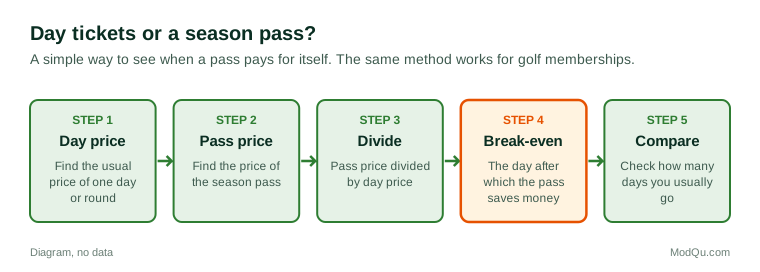
A skier is deciding between day tickets and a season pass at a local resort. Day tickets bought in advance average $85. The season pass costs $650. Dividing $650 by $85 gives about 7.6, so the pass pays for itself on the eighth day. The skier usually skis 12 days a season, which would cost $1,020 in day tickets, so the pass saves $370.
What a season costs
Beyond passes and fees, people spend on:
- Equipment: clubs, bags and balls for golf; skis or snowboards, boots, bindings, helmets and goggles for skiing.
- Clothing, such as golf shoes and ski jackets.
- Lessons and coaching.
- Travel: fuel, flights, accommodation and parking.
- Food and drinks at the clubhouse or lodge.
- Tuning and maintenance, such as ski waxing and club fitting.
Many people buy used equipment, rent, use ski swaps and buy previous-year models to save money.
Travel and resorts
Both golf and skiing drive tourism. People travel:
- to mountain resorts in western Canada and the Rockies, Quebec and the eastern United States for skiing;
- to golf destinations in Canada in summer, and to warmer places such as the southern United States in winter;
- on group trips with friends, clubs or work colleagues;
- for family holidays where some members ski or golf and others do other activities.
Resort towns depend heavily on these visitors, which also brings debates about housing costs for workers, traffic and the environment.
Example
A group of four friends plans a yearly golf trip. They compare a resort package that includes three rounds and two nights' accommodation with booking each part separately. The package costs slightly more but includes cart fees and a guaranteed tee time on the most popular course. They choose the package to avoid the risk of not getting the tee times they want.
Learning and getting started
Both sports can be hard to start. Barriers people mention include cost, not having equipment, not knowing the rules or etiquette, and worrying about being slow or holding others up. Ways people get started include:
- Lessons with a certified instructor, including group lessons and learn-to-ski or learn-to-golf packages that include rentals.
- School and youth programs, such as school ski trips and junior golf programs.
- Driving ranges and indoor simulators, which let people practise without playing a full round.
- Beginner terrain and magic carpet lifts at ski hills.
- Friends and family who introduce them to the sport.
Example
A newcomer to Canada has never seen snow before their first winter. A community program offers a learn-to-ski day with transport, rentals and a lesson for a low price. They enjoy it and return twice more that winter with friends from the program. Without the package, they say they would not have known where to start.
Weather, climate and the future
Golf and skiing both depend on weather. Ski areas rely on snow and cold temperatures and use snowmaking to extend seasons. Warm spells, rain in winter and shorter seasons are concerns for many ski areas, especially at lower elevations. Golf courses deal with drought, heavy rain and water restrictions. Both sports are looking at ways to reduce their environmental impact, such as efficient snowmaking, water management on courses and protecting wildlife habitat.
Other trends include the growth of indoor golf simulators, multi-resort ski passes, more interest in golf among younger players in recent years, and the closure of some small local ski hills and golf courses, sometimes for housing development.
What people disagree about
People disagree about whether golf courses are a good use of land and water, whether multi-resort passes are good for skiers or bad for small hills, how much public money should support municipal courses and community ski hills, and whether these sports can become more affordable and welcoming. Questions that resorts, clubs and tourism groups want answered include whether people golf or ski, whether they have a membership or season pass and how much they spend per season.
Key terms
- Green feeThe charge to play a round of golf at a course.
- Tee timeA booked start time for a round of golf.
- HandicapA number that measures a golfer's ability, used to make play between players of different skill fair.
- Lift ticketA pass that allows a skier or snowboarder to use the lifts for a set time.
- Season passA pass that gives unlimited use of a facility for a whole season.
- SnowmakingProducing artificial snow to cover ski runs.
- Terrain parkAn area of a ski resort with jumps, rails and other features.
- Twilight rateA lower green fee for rounds started late in the day.
Full glossary: ski resort operations terms on EditingTests.com.
Golf, skiing and resort sports vocabulary test
How well do you know the language of this topic? Try 8 quick questions. Your score is shown straight away and is not saved.
What the golf, skiing and resort sports survey asks
This survey is part of ModQu's Arts, Culture and Sport survey. The golf, skiing and resort sports part takes about five minutes and covers:
- Whether you golf, ski or snowboard, and how often.
- Whether you have a membership, season pass or multi-resort pass.
- How much you spend per season, including equipment, lessons and travel.
- Where you play or ski, and how far you travel.
- What stops you from playing or skiing more.
- How weather and changing seasons have affected your plans.
After that you can choose to continue with other short parts of the Arts, Culture and Sport survey, such as museums and galleries or live events and theatre, or stop.
Ready to take part?
Your answers help show what people really think and do. Results are only ever reported as totals; no one can see your individual answers.
Start the surveyQuestions about this survey
Who can take part?
Adults who golf or ski.
Do I have to give my name?
No. You may be asked for your age group, region and similar details so results can be broken down, but not your name. ModQu never asks for passwords, card numbers or account numbers.
How are the results used?
Answers are combined into totals and percentages and published in ModQu reports. Individual answers are never shown.
Is the vocabulary test part of the survey?
No. It is optional and separate, and your score is not stored.