
Share how you take and share photos
Tell us whether photography is a hobby for you, whether you use a camera or only a phone, and where you share your photos. Your answers are combined with other people's and reported only as totals.
Start the photography surveyAbout 5 minutes. No account needed. You can stop at any time.
What photography as a hobby covers
For most people, photography means taking pictures of family, friends, food, holidays and daily life on a phone. For a smaller group it is a hobby they spend time and money on, learning skills and often buying dedicated equipment.
Hobby photography includes many kinds:
- Landscape and nature photography, including wildlife and bird photography.
- Portraits of family, friends and paid clients.
- Street photography of daily life in public places.
- Travel photography.
- Macro photography of very small subjects, such as insects and flowers.
- Night and astrophotography of cities, stars and the Milky Way.
- Sports and action.
- Film photography, using analogue cameras and developing film, which has seen renewed interest.
- Event photography, such as weddings, which some hobbyists turn into paid work.
Phones or cameras
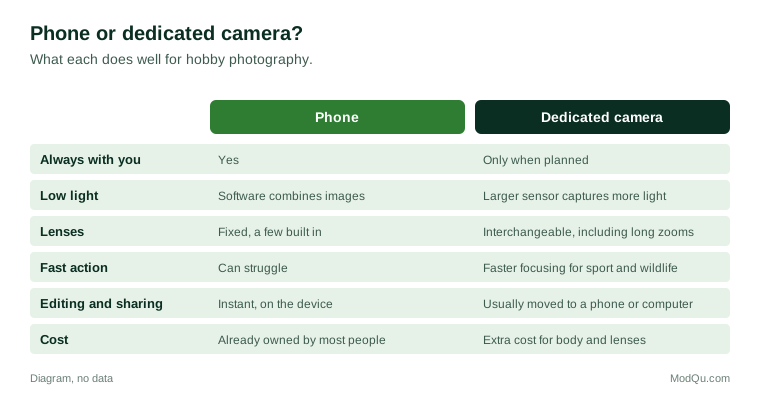
Phone cameras have improved quickly, and many people no longer see a need for a separate camera. Phones use software to combine several images, brighten dark scenes and blur backgrounds, which helps in everyday situations.
Dedicated cameras still offer advantages that keen photographers value:
- larger sensors that capture more detail and handle low light better;
- interchangeable lenses, including long telephoto lenses for wildlife and sport;
- faster focusing for moving subjects;
- more manual control;
- the feel of using a camera, which many hobbyists enjoy.
The main camera types are mirrorless cameras, which have largely replaced DSLRs, plus compact cameras, action cameras and drones. Many hobbyists use both: a phone for everyday shots and a camera for planned outings.
Example
A parent takes thousands of phone photos of their children each year. When their child starts playing football, the phone struggles with fast action from the touchline. They buy a second-hand mirrorless camera with a zoom lens and join an online beginners' course to learn how to use it.
Learning the basics
People who take up photography often start by learning a few core ideas:
- Exposure: how bright an image is, controlled by aperture, shutter speed and ISO.
- Aperture: the size of the lens opening, which also affects how much of the scene is sharp.
- Shutter speed: how long the sensor is exposed, which freezes or blurs motion.
- ISO: how sensitive the sensor is to light; higher settings add grain or noise.
- Composition: arranging the frame, such as placing a subject off-centre or using lines that lead the eye.
- Light: noticing direction and quality of light, such as soft light on a cloudy day.
People learn through online videos, books, courses, local camera clubs and photo walks. Camera clubs in many countries also run competitions and talks.
Editing and storing photos
Most hobbyists edit their photos, from simple crops and colour changes on a phone to detailed editing on a computer. Some shoot in RAW format, which keeps more information for editing than standard JPEG files.
Storing photos has become a problem for many households. Large collections are spread across phones, computers, memory cards and cloud services. Common worries include losing photos when a phone breaks, running out of storage and paying monthly subscriptions. Many photographers follow a backup rule of keeping copies in more than one place, including one away from home.
Example (hypothetical figures)
A hobbyist takes about 400 photos a month on a camera, at about 25 megabytes each in RAW format. That is 10,000 megabytes, or about 10 gigabytes, a month and about 120 gigabytes a year. They keep their best photos in a cloud service and copy everything to two external drives, one kept at a relative's home.
Sharing photos
People share photos in many ways:
- messaging apps and family groups, the most common way for everyday photos;
- social media, where photos and short videos compete for attention;
- photo-sharing communities where hobbyists post work and get feedback;
- printed photos, albums and photo books, which many families still value;
- exhibitions and competitions, including camera club shows;
- selling prints or licensing photos through stock photo sites.
Example
A retired engineer posts one landscape photo a week to a photography community and gets detailed comments on composition. They also print a calendar of their best photos each year for family members, who say they prefer it to seeing the pictures online.
Costs
Photography can cost very little or a great deal:
- a phone, which most people have already;
- a camera body and lenses, new or second-hand;
- editing software, sometimes by subscription;
- storage: memory cards, drives and cloud plans;
- accessories such as tripods, bags and filters;
- courses, club fees and travel to locations;
- printing and framing.
Many hobbyists buy used equipment, and lenses often keep their value longer than camera bodies.
Photography as a side income
Some hobbyists earn money from photography. Common routes are photographing friends' weddings and events, family portraits, product photos for small businesses, selling prints at markets or online, and licensing images through stock photo sites. Earnings are usually modest and irregular. People who take paid work often need insurance, contracts and model releases, which are forms in which people agree to the use of their image, and they may need to register income for tax.
Privacy, consent and rules
Photography raises questions about other people's rights. Rules differ by country. In many places it is legal to photograph people in public, but some countries have stronger image rights, and many have rules about using a person's image in advertising. Photographing children, private property, military sites and some government buildings may be restricted. Drone flying is regulated in many countries, often requiring registration and limits on where and how high drones can fly.
Many photographers ask permission before photographing people up close, and some avoid posting photos of children online.
What people disagree about
Photography raises several debates:
- whether heavy editing and software effects make photos less honest;
- whether images made or changed by software should be labelled;
- whether people should post photos of their children online;
- how street photographers should balance their work with others' privacy;
- whether phones have made dedicated cameras unnecessary for most people.
Questions camera makers, retailers, software firms and print services want answered include how people take and share photos, what equipment they use, what they pay for storage and editing, and what would make them print more.
Key terms
- ExposureHow bright a photo is, set by aperture, shutter speed and ISO.
- ApertureThe size of the lens opening.
- Shutter speedHow long the camera sensor is exposed to light.
- ISOHow sensitive the sensor is to light.
- CompositionHow the elements of a photo are arranged in the frame.
- RAW fileAn image file that keeps more data for editing than a JPEG.
- Mirrorless cameraA camera with interchangeable lenses and no internal mirror.
- Depth of fieldHow much of a photo, from near to far, appears sharp.
Full glossary: aerial photography terms on EditingTests.com.
Photography vocabulary test
How well do you know the language of this topic? Try 8 quick questions. Your score is shown straight away and is not saved.
What the photography survey asks
This survey is part of ModQu's Arts, Culture and Sport survey. The photography part takes about five minutes and covers:
- Whether you take photographs as a hobby, and how often.
- Whether you use a phone, a camera or both, and which kinds.
- Which kinds of photography you enjoy.
- How you edit, store and back up your photos.
- Where you share your photos, and whether you print them.
- What you spend on photography in a year.
After that you can choose to continue with other short parts of the Arts, Culture and Sport survey, such as museums and galleries or live events and theatre, or stop.
Ready to take part?
Your answers help show what people really think and do. Results are only ever reported as totals; no one can see your individual answers.
Start the surveyQuestions about this survey
Who can take part?
Adults.
Do I have to give my name?
No. You may be asked for your age group, region and similar details so results can be broken down, but not your name. ModQu never asks for passwords, card numbers or account numbers.
How are the results used?
Answers are combined into totals and percentages and published in ModQu reports. Individual answers are never shown.
Is the vocabulary test part of the survey?
No. It is optional and separate, and your score is not stored.