
Share your dairy habits
Tell us what kind of milk you drink most, whether you have cut down on dairy and why. Your answers are combined with other people's and reported only as totals.
Start the dairy and dairy alternatives surveyAbout 5 minutes. No account needed. You can stop at any time.
Dairy in everyday eating
Dairy foods are made from the milk of cows and, less often, goats, sheep and other animals. The main products are:
- Milk: skim, 1%, 2% and homogenized (whole), plus lactose-free, chocolate milk, cream and evaporated milk.
- Cheese: from cheddar and mozzarella to hundreds of specialty cheeses, many made in Québec and Ontario.
- Yogurt and kefir: plain, flavoured, Greek-style and drinkable.
- Butter and ice cream.
- Sour cream, cottage cheese and cream cheese.
- Dairy ingredients in many foods, such as baked goods, chocolate and sauces.
People use dairy in drinks, cereal, cooking, baking and snacks. Habits vary with age, culture, diet and taste. Some households go through several litres of milk a week; others buy mainly cheese and yogurt.
How dairy works in Canada
Canada's dairy industry operates under supply management, a system that also covers eggs and poultry. In simple terms:
- national and provincial bodies set how much milk farmers produce, through quotas, to match expected demand;
- farm prices for milk are set based on production costs;
- imports above set amounts face high tariffs.
Supporters say supply management gives farmers stable incomes, keeps family farms viable and ensures a steady supply of Canadian milk. Critics say it leads to higher prices for consumers and limits choice and trade. It is regularly discussed in trade negotiations with other countries.
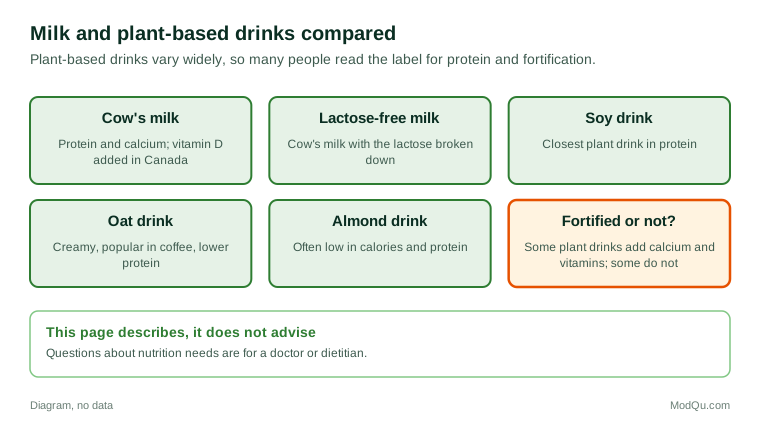
Canadian milk must meet rules set by Health Canada and the Canadian Food Inspection Agency. Milk sold in Canada is pasteurized, and cow's milk has added vitamin D.
Plant-based alternatives
Plant-based alternatives to dairy are made from plants and are designed to be used in the same ways. They include:
- Oat drinks, popular in coffee for their creamy texture.
- Soy drinks, the most similar to cow's milk in protein.
- Almond drinks, often lower in calories and protein.
- Coconut, rice, pea, cashew and hemp drinks.
- Plant-based yogurts, cheeses, butters and frozen desserts.
In Canada, these products are usually labelled as "beverages" or "drinks" rather than "milk", because "milk" on its own refers to milk from animals under food rules.
Plant-based drinks vary widely in nutrition. Some are fortified with calcium, vitamin D and other nutrients to be closer to cow's milk; others are not. Protein content ranges from similar to cow's milk, for soy and pea drinks, to very low, for almond and rice drinks.
Example
A family of four drinks 2% milk at home. One teenager switches to oat drink after watching videos about the environment, and the parents start using it in coffee too. The younger child still drinks cow's milk with meals. The household now buys two kinds of milk, and the fridge door is full.
Why people cut down or switch
People who have reduced dairy or switched to alternatives give several reasons:
- Lactose intolerance: difficulty digesting lactose, the natural sugar in milk, which is common in many populations. Lactose-free milk is one option, made from cow's milk with the lactose broken down.
- Milk allergy, an immune reaction to milk proteins, more common in young children.
- Vegan or plant-based diets.
- Environmental concerns, such as greenhouse gas emissions, land and water use.
- Animal welfare.
- Taste and texture, especially oat drinks in coffee.
- Health beliefs, such as wanting less saturated fat, though views and evidence vary.
- Curiosity and trying new products.
Other people are increasing dairy, for example eating more yogurt and cheese for protein, or choosing whole milk again.
Questions that businesses want answered here include what kinds of milk people drink, how many use both dairy and plant-based products, and why people switch or switch back.
Price and value
Price affects dairy choices. Plant-based drinks often cost more per litre than cow's milk, though prices vary by brand and size. Milk is usually cheapest in larger bags or jugs, and in many provinces milk is sold in bags.
Example (hypothetical figures)
A shopper compares a week's milk for coffee and cereal. A 4 L bag of 2% milk costs $6.50, or about $1.63 per litre. A 1.75 L carton of oat drink costs $4.99, or about $2.85 per litre. If the household uses 4 L a week, cow's milk costs $6.50 and oat drink about $11.40, a difference of about $4.90 a week or $255 a year.
Where people buy dairy and what they look for
Most people buy dairy products at grocery stores, with smaller amounts bought at convenience stores, specialty cheese shops, farm stores and farmers markets. When choosing, shoppers often compare:
- fat level, such as skim, 1%, 2% or homogenized milk;
- package size and format, including bags, jugs and cartons;
- price and sales;
- brand and origin, including logos showing milk from Canadian farms;
- organic and grass-fed options;
- specialty products, such as lactose-free, higher-protein or flavoured milk;
- for plant-based drinks, protein content, added sugar and whether the drink is fortified.
Shoppers also say they look at best before dates more closely for milk than for most foods, because milk spoils quickly once opened.
Nutrition and what people disagree about
Milk and dairy products provide protein, calcium and, in Canada, vitamin D in fortified milk. Canada's Food Guide, revised in 2019, no longer has a separate "milk and alternatives" group; it puts dairy among protein foods and encourages choosing plant-based proteins more often. That change was welcomed by some and criticized by others, including some in the dairy industry.
People disagree about several dairy topics:
- Health: the role of dairy fat, whether whole milk or low-fat milk is better, and how plant-based drinks compare.
- Names: whether plant-based products should be allowed to use words such as "milk" or "cheese".
- Environment: how dairy compares with plant-based alternatives, and how much depends on how and where milk is produced.
- Supply management: whether it should be kept, changed or removed.
- Raw milk: the sale of unpasteurized milk is banned in Canada for safety reasons, which some people disagree with.
Example
A person in their sixties is told by their doctor to pay attention to calcium and vitamin D. They had switched to an almond drink for its taste, but on checking the label they find their brand is not fortified. They switch to a fortified version and add yogurt to their breakfast. This page does not give dietary advice; questions like theirs are for a doctor or dietitian.
Key terms
- PasteurizationHeating milk to kill harmful bacteria.
- Homogenized milkWhole milk, about 3.25% fat, in which the fat is evenly mixed.
- LactoseThe natural sugar in milk.
- Lactose intoleranceDifficulty digesting lactose, causing digestive discomfort.
- Plant-based beverageA drink made from plants, such as oats or soy, used like milk.
- FortifiedHaving vitamins or minerals added.
- Supply managementCanada's system of quotas, set prices and import controls for dairy, eggs and poultry.
- KefirA fermented milk drink.
Full glossary: dairy science terms on EditingTests.com.
Dairy and dairy alternatives vocabulary test
How well do you know the language of this topic? Try 8 quick questions. Your score is shown straight away and is not saved.
What the dairy and dairy alternatives survey asks
This survey is part of ModQu's Food and Drink survey. The dairy and dairy alternatives part takes about five minutes and covers:
- What kind of milk or plant-based drink you use most, and for what.
- Which dairy products you buy regularly.
- Whether you have cut down on dairy, or increased it, and why.
- Which plant-based alternatives you have tried, and what you thought.
- How price affects what you buy.
- How much you trust information about dairy and nutrition.
After that you can choose to continue with other short parts of the Food and Drink survey, such as eating habits or coffee, tea and beverages, or stop.
Ready to take part?
Your answers help show what people really think and do. Results are only ever reported as totals; no one can see your individual answers.
Start the surveyQuestions about this survey
Who can take part?
Adults.
Do I have to give my name?
No. You may be asked for your age group, region and similar details so results can be broken down, but not your name. ModQu never asks for passwords, card numbers or account numbers.
How are the results used?
Answers are combined into totals and percentages and published in ModQu reports. Individual answers are never shown.
Is the vocabulary test part of the survey?
No. It is optional and separate, and your score is not stored.
I do not eat dairy at all. Can I take part?
Yes. The survey asks about plant-based alternatives and your reasons for avoiding dairy.