
Share what is in your kitchen
Tell us which kitchen appliances you use every week, what you bought last and what sits unused. Your answers are combined with other people's and reported only as totals.
Start the cooking appliances and kitchen gadgets surveyAbout 5 minutes. No account needed. You can stop at any time.
What kitchen appliances cover
Kitchen appliances are the machines and devices people use to store, prepare and cook food and drinks. They are often grouped into two kinds:
- Major appliances, sometimes called large or white goods: cookers, hobs, ovens, range hoods, refrigerators, freezers and dishwashers.
- Small appliances and gadgets: microwaves, kettles, toasters, air fryers, slow cookers, pressure cookers, rice cookers, blenders, food processors, stand mixers, coffee machines and many more.
What counts as essential varies a great deal between countries and households. An electric kettle is found in most homes in some countries and is unusual in others. A rice cooker is a basic item in many Asian households. Some homes cook with gas, some with electricity, and many households around the world still cook with wood, charcoal or other solid fuels.
Hobs, ovens and microwaves
The main cooking appliance in most homes is a hob (also called a cooktop or stovetop), often combined with an oven. Common types include:
- Gas hobs, which give an instant visible flame and are popular with many cooks.
- Electric coil and ceramic hobs, which heat a surface.
- Induction hobs, which use a magnetic field to heat compatible pans directly. They heat quickly and the surface stays cooler, but need pans with a magnetic base.
- Ovens, conventional or fan-assisted, built in or freestanding, and in some homes combined with steam or microwave functions.
- Microwaves, used for reheating, defrosting and quick cooking. In many homes the microwave is used more often than the oven.
Some cities and countries have started to restrict gas connections in new buildings for climate or air quality reasons, which has increased interest in induction cooking.
Small cooking appliances
Small appliances let people cook particular foods more easily or quickly:
- Air fryers: compact convection ovens that circulate hot air. They became very popular in many countries and are often used instead of a full-size oven.
- Slow cookers: cook food at low heat over many hours.
- Pressure cookers and multi-cookers: cook quickly under pressure; many electric models also slow cook, steam and make rice.
- Rice cookers: cook rice automatically and keep it warm.
- Toasters and sandwich makers.
- Grills and griddles for indoor use.
- Bread makers.
Example
A couple living in a small flat with only a two-ring hob buys an air fryer. Within a month they use it for most evening meals, and they rarely turn on the small oven, which takes longer to heat up.
Food preparation and drink appliances
Other appliances help with preparing food and drinks:
- Kettles, electric or stovetop.
- Coffee machines, from filter machines to espresso machines and pod machines.
- Blenders, for smoothies, soups and sauces.
- Food processors, for chopping, slicing and making dough.
- Stand mixers and hand mixers, for baking.
- Juicers.
- Water filters and dispensers.
- Scales, thermometers and timers.
Energy use and running costs
Running costs matter more when energy prices rise. Points people often weigh include:
- Size and heating time: small appliances that heat a smaller space can use less energy than a full oven for small portions.
- Efficiency labels: many countries require energy labels on large appliances, and some on small ones.
- Standby power: some appliances use a little electricity when switched on at the wall but not in use.
- Water use, for dishwashers and some coffee machines.
- Pods and consumables, which can cost more over time than the machine itself.
Example (hypothetical figures)
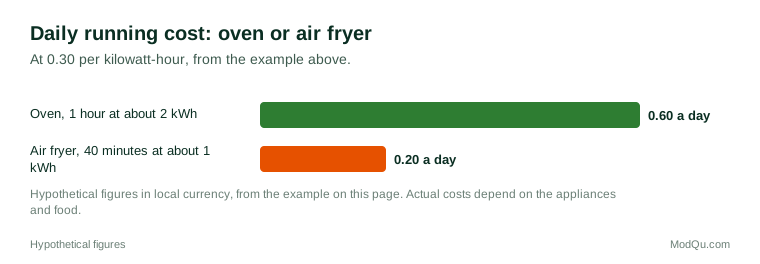
A household uses its oven for 1 hour a day at about 2 kilowatt-hours per hour. They switch to an air fryer for most meals, using it for 40 minutes a day at about 1 kilowatt-hour per hour, or about 0.67 kilowatt-hours. At 0.30 in their local currency per kilowatt-hour, the oven costs about 0.60 a day and the air fryer about 0.20, a saving of about 0.40 a day, or about 146 a year.
Actual savings depend on the appliances, the food and how they are used.
How people choose and buy
When buying kitchen appliances, people often consider:
- Price, including the cost of accessories and replacement parts.
- Space, especially in small kitchens.
- What they cook, and how often.
- Reviews and recommendations, online or from friends.
- Brand reputation and warranty.
- Energy efficiency.
- Ease of cleaning.
- Design and colour, to match a kitchen.
Many small appliances are bought during sales events, as gifts, or after seeing them on social media. Large appliances are often bought when an old one breaks, when moving home, or during a kitchen renovation.
Gadgets that go unused
Many households own appliances they rarely use. Common examples include bread makers, juicers, pasta machines, spiralizers, sandwich makers, waffle makers and specialist gadgets bought for one recipe. Reasons include:
- The gadget takes up too much space or is hard to store.
- It is difficult or slow to clean.
- The person's interest or diet changed.
- It was a gift they did not choose.
- Another appliance does the same job.
Unused gadgets are often given away, sold second-hand or donated. Some people now borrow appliances from friends or community libraries of things before buying.
Example
A person receives a juicer as a birthday gift and uses it every day for two weeks. Cleaning the parts takes longer than making the juice, so it moves to a high cupboard. A year later they sell it online and buy a blender, which is easier to clean.
Trends and debates
Current trends include:
- Multi-function appliances that replace several single-use ones.
- Smart appliances connected to phone apps, with debates about whether connectivity adds value.
- Induction cooking and the move away from gas in some places.
- Repairability, including right-to-repair rules in some countries that require spare parts to be available.
- Clean cooking programs in parts of Africa, Asia and Latin America to replace smoky solid-fuel stoves, which the World Health Organization links to household air pollution.
What people and businesses want to know
Questions businesses want answered include which kitchen appliances people own and use each week, what they bought most recently and why, how much they spent, where they bought it, which gadgets they rarely use, and what would make them replace or upgrade an appliance.
Key terms
- Major applianceA large kitchen appliance such as a cooker, fridge or dishwasher.
- Small applianceA portable kitchen device such as a kettle, toaster or blender.
- HobThe flat cooking surface with burners or heating zones; also called a cooktop.
- InductionCooking with a magnetic field that heats compatible pans directly.
- Air fryerA compact appliance that cooks by circulating hot air.
- Multi-cookerAn electric appliance that can pressure cook, slow cook, steam and more.
- Energy labelA label showing how much energy an appliance uses.
- Standby powerElectricity used by an appliance when it is switched on but not in use.
Full glossary: appliance manufacturing terms on EditingTests.com.
Cooking appliances and kitchen gadgets vocabulary test
How well do you know the language of this topic? Try 8 quick questions. Your score is shown straight away and is not saved.
What the cooking appliances and kitchen gadgets survey asks
This survey is part of ModQu's Household Life survey. The cooking appliances and kitchen gadgets part takes about five minutes and covers:
- Which kitchen appliances you use at least once a week.
- What kitchen appliance or gadget you bought most recently, why, and what it cost.
- Where you buy kitchen appliances, and what matters most when choosing.
- Which appliances or gadgets you own but rarely use.
- Whether energy costs affect how you cook.
- Which appliance you would buy or replace next.
After that you can choose to continue with other short parts of the Household Life survey, such as cleaning and laundry or household chores and time use, or stop.
Ready to take part?
Your answers help show what people really think and do. Results are only ever reported as totals; no one can see your individual answers.
Start the surveyQuestions about this survey
Who can take part?
Adults.
Do I have to give my name?
No. You may be asked for your age group, region and similar details so results can be broken down, but not your name. ModQu never asks for passwords, card numbers or account numbers.
How are the results used?
Answers are combined into totals and percentages and published in ModQu reports. Individual answers are never shown.
Is the vocabulary test part of the survey?
No. It is optional and separate, and your score is not stored.