
Share your experience of a contract dispute
Tell us about disagreements you have had with a business over a contract and how they ended. Your answers are combined with other people's and reported only as totals.
Start the contracts and small claims surveyAbout 5 minutes. No account needed. You can stop at any time.
What a contract is
A contract is an agreement that the law will enforce. It does not have to be a long signed document. Buying a coffee, booking a flight or agreeing a price with a plumber over the phone can all create contracts. Most legal systems look for a few basic elements:
- An offer and acceptance: one side proposes terms and the other agrees.
- Something given in exchange, usually money for goods or services.
- An intention to be bound by the agreement.
- Capacity: both sides are legally able to make the agreement, for example adults of sound mind.
- Clear enough terms, such as what is being supplied and at what price.
Some contracts must be in writing to be valid, such as many property sales. Others are valid whether they are written, spoken or agreed by clicking a button online.
Everyday contracts people make
Ordinary households make many contracts, often without thinking of them as legal agreements:
- Phone, internet and energy plans.
- Gym memberships and subscriptions.
- Home repairs, building work and removals.
- Car purchases, servicing and repairs.
- Rental agreements.
- Holidays, flights and event tickets.
- Online purchases from shops and marketplaces.
- Private sales between individuals.
Many of these are standard form contracts, written by the business and offered on a take-it-or-leave-it basis. Consumer protection laws in many countries limit unfair terms in such contracts and give buyers rights that cannot be removed by the small print.
Why disputes arise
Common causes of disagreement include:
- Goods that are faulty, not as described or not delivered.
- Services done badly, late or not at all.
- Unexpected charges, such as fees that were not made clear.
- Cancellation problems, including difficulty ending a subscription.
- Deposits not returned, for example by landlords or for cancelled events.
- Disagreement about what was agreed, especially when nothing was written down.
- Unpaid bills, when the business says the customer owes money.
Example
A household pays a builder a deposit to replace a back door. The builder fits the frame but leaves without finishing, and stops answering calls. The household has the original quote by text message and photographs of the work left undone.
The usual steps in a dispute
Most disputes are settled before any court is involved. People commonly move through these steps:
- Complaining directly to the business, by phone, in person or in writing.
- Putting it in writing, setting out what went wrong, what was agreed and what outcome is wanted.
- Using the business's formal complaints process, if it has one.
- Going to an ombudsman or alternative dispute resolution scheme, available in many sectors such as energy, telecoms, finance and travel. These are often free for consumers.
- Using a card provider's chargeback process, if the payment was made by card and the rules allow it.
- Sending a formal letter before action, warning that court action will follow if the matter is not settled.
- Making a small claim in court.
The order and names vary by country. In some places, a court expects people to have tried to settle the matter first and may take this into account when deciding costs.
How small claims courts work
Many countries have a simpler court process for lower-value cases. It is designed to be used without a lawyer, with lower fees, simpler forms and less formal hearings. Names and limits differ: examples include the small claims track in England and Wales, small claims courts in Canadian provinces and Australian states, small claims courts in most United States states, and the European Small Claims Procedure for some cross-border cases within the European Union.
The usual features include:
- A maximum value, which differs widely by country and region.
- A court fee, often based on the amount claimed.
- Simple claim forms, increasingly online.
- Limited legal costs, so that the losing side usually pays only small amounts towards the other side's costs.
- Mediation, offered by many courts before a hearing.
- A short hearing in front of a judge or adjudicator, sometimes by phone or video, or a decision made on paper.
Example (hypothetical figures)
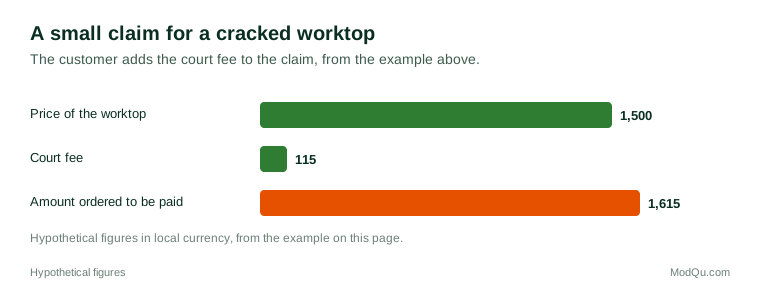
A customer pays 1,500 in their local currency for a kitchen worktop that arrives cracked. The retailer refuses a refund. The customer files a small claim with a court fee of 115 and adds the fee to the claim. The court decides in their favour and orders the retailer to pay 1,615, the price plus the fee.
Winning is not the same as being paid
A judgment in favour of the person who made the claim does not always mean they receive the money. If the other side does not pay, a separate enforcement step may be needed, such as an order to take money from wages or a bank account, or a visit by enforcement officers. This can add time and cost, and some businesses close or have no assets. People weighing up a claim often consider whether the other side is able to pay.
Evidence and record-keeping
Contract disputes often turn on evidence of what was agreed and what happened. Useful records include:
- Quotes, receipts, invoices and order confirmations.
- Emails, text messages and chat logs.
- Photographs and videos, with dates.
- Advertisements or product descriptions.
- Notes of phone calls, with dates and names.
- Bank and card statements.
Example
A traveller's flight is cancelled and the airline offers only a voucher. The traveller keeps the cancellation email and the booking terms and writes to the airline asking for a refund. When the airline does not reply in the stated time, they take the complaint to the national body that handles air passenger rights.
Trends and debates
Several changes are affecting how contract disputes are handled:
- Online courts and online dispute resolution, which let people file and settle claims without attending a building.
- Subscription traps, and new rules in some countries that make cancelling as easy as signing up.
- Marketplace sales, where it can be unclear whether the platform or the seller is responsible.
- Cross-border purchases, which raise questions about which country's law and courts apply.
- Access to advice, and whether people know that small claims routes exist.
Questions businesses and consumer bodies want answered include how many people have had a dispute with a business, what about, how many complained, how many used an ombudsman or court, and how satisfied they were with the result.
Key terms
- ContractAn agreement that the law will enforce.
- Standard form contractA contract written by one side and offered on fixed terms.
- Unfair termA term that consumer law may not allow because it is one-sided.
- OmbudsmanAn independent body that handles complaints about organizations in a sector.
- ChargebackA card provider's process for reversing a payment in certain disputes.
- Letter before actionA formal letter warning that court action will follow if a dispute is not settled.
- Small claims courtA simpler court process for lower-value cases.
- EnforcementSteps to make someone pay money a court has ordered.
Full glossary: civil mediation terms on EditingTests.com.
Contracts and small claims vocabulary test
How well do you know the language of this topic? Try 8 quick questions. Your score is shown straight away and is not saved.
What the contracts and small claims survey asks
This survey is part of ModQu's Law and Rights survey. The contracts and small claims part takes about five minutes and covers:
- Whether you have had a dispute with a business over a contract in the last three years, and what it was about.
- How much money was involved.
- What steps you took, such as complaining, using an ombudsman, a chargeback or a court.
- Whether you used a small claims court, and how easy you found it.
- What the outcome was, and whether you were actually paid.
- How confident you feel about your rights when buying goods and services.
After that you can choose to continue with other short parts of the Law and Rights survey, such as using a lawyer or consumer rights and complaints, or stop.
Ready to take part?
Your answers help show what people really think and do. Results are only ever reported as totals; no one can see your individual answers.
Start the surveyQuestions about this survey
Who can take part?
Adults.
Do I have to give my name?
No. You may be asked for your age group, region and similar details so results can be broken down, but not your name. ModQu never asks for passwords, card numbers or account numbers.
How are the results used?
Answers are combined into totals and percentages and published in ModQu reports. Individual answers are never shown.
Is the vocabulary test part of the survey?
No. It is optional and separate, and your score is not stored.