
Share your experience of coaching or mentoring
Tell us whether you have had a coach or mentor, what they helped with and whether it was worth it. Your answers are combined with other people's and reported only as totals.
Start the coaching and mentoring surveyAbout 5 minutes. No account needed. You can stop at any time.
What coaching and mentoring are
Coaching and mentoring are both forms of one-to-one or small-group support in which one person helps another learn, grow or reach a goal. The terms are often used loosely, but they usually mean different things.
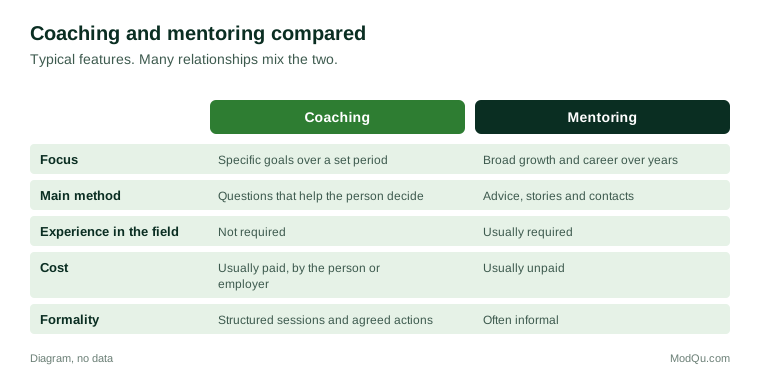
- Coaching is a structured relationship, usually for a set period, focused on specific goals. A coach mostly asks questions, helps the person think through options and holds them to the actions they choose. A coach does not need to have done the person's job.
- Mentoring is usually a longer, less formal relationship in which a more experienced person shares knowledge, advice and contacts with someone earlier in their path. A mentor normally works in the same field.
Both are different from therapy, which is treatment of mental health problems by a qualified professional, and from training, which teaches a defined set of skills to a group. Some people use several of these at once. The figure below compares coaching and mentoring.
The main kinds of coaching
Coaching has many specialties. Common ones include:
- Executive and leadership coaching, for managers and senior staff, often paid for by employers.
- Career coaching, for people choosing, changing or returning to work.
- Life coaching, covering personal goals, confidence, relationships and life changes.
- Health and wellness coaching, focused on habits such as diet, exercise and sleep.
- Performance coaching in sports, music and the arts.
- Business coaching for owners of small businesses.
- Academic coaching for students, including study skills and organisation.
Coaching is mostly unregulated in many countries: anyone can call themselves a coach. Professional bodies offer training standards, codes of ethics and credentials, and many clients look for these when choosing a coach.
How mentoring works
Mentoring happens in several ways:
- Informal mentoring: a senior colleague, teacher or family friend who offers guidance over years without any formal arrangement.
- Workplace mentoring programs that match newer employees with experienced ones.
- Professional and alumni schemes run by associations, universities and community groups.
- Mentoring for young people through schools, youth organisations and charities.
- Peer mentoring, where people at a similar stage support each other.
- Reverse mentoring, where a younger employee helps a senior one with topics such as new technology.
Mentoring is usually unpaid. The mentor often benefits too, through the satisfaction of helping, new perspectives and stronger networks.
Example
A first-generation university student joins a mentoring scheme run by their faculty. They are matched with a graduate working in the field they hope to enter. Over a year they meet monthly by video. The mentor reviews their CV, explains how hiring works in the sector and introduces them to two people who offer short work placements.
What people seek help with
People come to coaches and mentors for a wide range of reasons:
- deciding whether to change job or career;
- preparing for a promotion or a first management role;
- handling conflict with a manager or colleague;
- building confidence, including in public speaking;
- managing time and stress;
- starting or growing a business;
- returning to work after a break, such as parental leave or illness;
- settling into a new country's job market;
- making a major life decision.
Some topics are better suited to other kinds of help. A good coach will suggest a doctor, therapist, lawyer or financial adviser when a problem is outside their scope.
Finding a coach or mentor and what it costs
People find coaches through personal recommendations, employers, professional bodies, online directories and social media. They often have a short first conversation to check whether the coach's style suits them.
Costs vary widely by country, specialty and the coach's experience. Coaching is often sold per session or as a package of several sessions. Employers may pay for coaching for staff, especially managers, while individuals usually pay for life and career coaching themselves. Mentoring through schools, employers and associations is usually free.
Example (hypothetical figures)
A mid-career manager compares two coaching offers. Coach A charges $150 per one-hour session, and the manager expects to need eight sessions: $1,200. Coach B offers a package of six sessions plus email support for $1,050, which works out to $175 per session. The manager's employer will cover up to $1,000 of professional development a year, so either way the manager pays the rest: $200 with Coach A or $50 with Coach B.
Was it worth it?
People judge the value of coaching and mentoring in different ways:
- Concrete results: a new job, a promotion, a business milestone or a finished project.
- Clarity: knowing what they want or what to do next.
- Confidence and a better sense of their own strengths.
- New skills, such as giving feedback or running meetings.
- Contacts and opportunities, especially from mentors.
- Feeling supported through a difficult period.
Research on workplace coaching has generally found positive effects on goals, wellbeing and performance, though studies vary in quality and many rely on what participants report. It is hard to know what would have happened without the coaching.
People also report poor experiences: coaches who talked more than they listened, offered generic advice, pushed their own views, or kept selling more sessions. A poor fit between the person and the coach or mentor is one of the most common reasons it does not work.
Example
A small business owner hires a business coach for six months. They say the most valuable part was not any advice but having a fixed monthly meeting where they had to report on their own targets. They stop after six months because the cost is hard to justify in a slow season, but keep the habit of a monthly review with a friend who also runs a business.
Trends in coaching and mentoring
Several changes are visible in many countries:
- Online sessions by video have become normal, so people can work with coaches and mentors in other cities or countries.
- Group coaching and coaching circles offer a lower cost per person.
- Coaching apps and digital programs offer structured exercises with limited human contact.
- Employer programs extend coaching beyond senior managers to wider groups of staff.
- Mentoring for underrepresented groups aims to widen access to fields where some groups have been excluded.
What people disagree about
- Should coaching be regulated? Some want formal licensing; others prefer voluntary credentials.
- Is it worth the cost? Some see coaching as a sound investment; others think a good friend or mentor gives similar benefits for free.
- Who gets access? Coaching paid by employers often goes to senior staff, which some see as unfair.
Questions that businesses want answered here include how many people have used a coach or mentor, what for, how they found them and how they judge the value.
Key terms
- CoachA person who helps someone reach specific goals, mostly by asking questions and supporting their actions.
- MentorA more experienced person who shares knowledge, advice and contacts.
- MenteeThe person who receives mentoring.
- Executive coachingCoaching for managers and senior leaders, often paid for by employers.
- Peer mentoringSupport between people at a similar stage.
- Reverse mentoringA younger or newer person mentoring a more senior one.
- CredentialA qualification from a professional body showing training and standards.
- Chemistry sessionA short first meeting to check whether a coach and client are a good fit.
Full glossary: business coaching terms on EditingTests.com.
Coaching and mentoring vocabulary test
How well do you know the language of this topic? Try 8 quick questions. Your score is shown straight away and is not saved.
What the coaching and mentoring survey asks
This survey is part of ModQu's Personal Development survey. The coaching and mentoring part takes about five minutes and covers:
- Whether you have had a coach, a mentor or both.
- What they helped you with, and how you found them.
- How the relationship worked: how often you met, for how long, and online or in person.
- Who paid, and roughly what it cost.
- Whether it was worth it, and what you gained.
- Whether you would use a coach or mentor again, or become one.
After that you can choose to continue with other short parts of the Personal Development survey, such as self-improvement or productivity and time management, or stop.
Ready to take part?
Your answers help show what people really think and do. Results are only ever reported as totals; no one can see your individual answers.
Start the surveyQuestions about this survey
Who can take part?
Adults.
Do I have to give my name?
No. You may be asked for your age group, region and similar details so results can be broken down, but not your name. ModQu never asks for passwords, card numbers or account numbers.
How are the results used?
Answers are combined into totals and percentages and published in ModQu reports. Individual answers are never shown.
Is the vocabulary test part of the survey?
No. It is optional and separate, and your score is not stored.