
Share your views on climate change
Tell us how concerned you are, what you have changed and who you think should do more. Your answers are combined with other people's and reported only as totals.
Start the climate change attitudes surveyAbout 5 minutes. No account needed. You can stop at any time.
What climate change attitudes cover
Climate change refers to long-term changes in temperature and weather patterns. The scientific assessments of the Intergovernmental Panel on Climate Change (IPCC) conclude that human activities, mainly burning fossil fuels, are the main cause of the warming observed since the mid-twentieth century. Attitudes are about how people respond to that: what they believe, how they feel, and what they think should be done.
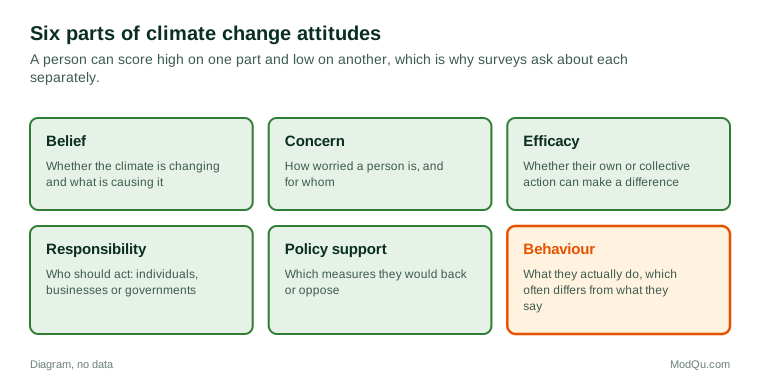
Researchers usually separate attitudes into several parts:
- Belief: whether a person thinks the climate is changing and what is causing it.
- Concern: how worried they are, and whether they see it as a threat to themselves, their family, their country or people far away.
- Efficacy: whether they think their own actions, or collective action, can make a difference.
- Responsibility: who they think should act, such as individuals, businesses, governments or other countries.
- Policy support: which measures they would back, and which they would oppose.
- Behaviour: what they actually do in daily life.
A person can score high on one and low on another. Someone may be very worried but feel that nothing they do matters, or may doubt the science but still insulate their home to save money.
How concern varies
Concern about climate change varies between people and over time. Factors that research has linked to differences in views include political leanings, age, education, where people live, how much their income depends on industries such as oil and gas, and whether they have experienced extreme weather.
Concern also rises and falls with events. A summer of wildfire smoke, a flood or a heat wave can make climate change feel more immediate. An economic downturn or rising prices can push it down the list of worries, because people tend to rank immediate costs above long-term risks.
Example
A farmer in the Prairies describes themselves as not very political about climate change. After two dry summers in a row, they start following seasonal forecasts closely, change their crop rotation and join a local soil health group. Asked in a survey, they say they are "somewhat concerned", but their behaviour has changed more than many people who say they are "very concerned".
Climate anxiety and emotions
Some people describe strong emotions about climate change: worry, grief, anger, guilt or a sense of helplessness. The term climate anxiety is often used, especially for younger people. Researchers debate how best to measure it and how it relates to action. For some people, worry leads to action; for others, it leads to avoiding the topic.
Others feel fatigue: they have heard warnings for many years and tune out new ones. Surveys that ask only "how worried are you?" can miss these differences, which is why many ask several questions about feelings and actions.
What people do in daily life
People who want to reduce their impact on the climate tend to take a mix of actions. Common ones include:
- Home energy: turning down the heat, insulating, switching to a heat pump.
- Transport: driving less, walking, cycling, taking transit, buying a hybrid or electric car, flying less.
- Food: eating less meat, wasting less food, buying local or seasonal food.
- Shopping: buying fewer new things, repairing, buying second-hand, choosing lower-impact products.
- Money: choosing investments or banks based on climate policies.
- Civic action: voting with climate in mind, contacting elected officials, joining groups or protests.
Researchers often note that the actions people take most often, such as recycling and switching off lights, are not always the ones with the biggest effect on emissions, such as heating, driving and flying.
Example
A couple in their thirties in a large city decide to cut their household's climate impact. They already recycle and use reusable bags. After reading about the main sources of household emissions, they sell their second car, start cycling to work in the warmer months and replace one long-haul holiday a year with a trip by train.
Who should be responsible
Views on responsibility are a large part of climate attitudes. Common positions include:
- Individuals should change how they live and shop.
- Businesses, especially large emitters, should cut emissions, report them openly and stop misleading claims.
- Governments should set rules, prices and investments that make low-carbon choices easier.
- Other countries, especially the largest emitters, should act first or do more.
Many people hold several of these views at once. A common survey finding across countries is that people tend to see businesses and governments as having more responsibility than individuals, while also saying individuals should do their part.
Example
In a workplace discussion, one employee argues that personal choices are a distraction while large companies keep polluting. Another argues that companies only change when customers and voters push them. A third says both are right. When the team later fills in a short climate survey, all three tick that businesses should do more.
Policy views and costs
Climate policies range from information and incentives to rules and prices. Examples include rebates for heat pumps and electric vehicles, building codes, fuel efficiency standards, limits on emissions from industry, public transit investment, and carbon pricing. Carbon pricing has been one of the most debated political issues in Canada in recent years.
People's support for a policy often depends on:
- what it costs them personally, and whether costs are visible, such as at the gas pump;
- whether they think it will work;
- whether they think it is fair to people with lower incomes, rural residents or workers in affected industries;
- how much they trust the government proposing it.
Example (hypothetical figures)
A survey asks two versions of a question to two random halves of a sample. Half are asked whether they support a policy that "would cut emissions"; 62% say yes. The other half are asked whether they support the same policy, which "would cut emissions and raise fuel prices by about 5 cents a litre"; 44% say yes. The 18-point difference shows how much the wording about cost can change the answer.
Measuring climate attitudes well
Climate change is a topic where people may give the answer they think is expected, a pattern known as social desirability bias. Good surveys ask about specific, recent actions rather than general intentions, use balanced wording, and separate belief, concern and behaviour into different questions. Repeating the same questions over time shows how views change.
What people disagree about
People disagree about how urgent climate change is, how fast to move away from fossil fuels, how to balance climate goals with jobs and living costs, whether nuclear power and carbon capture should play a role, and whether individual action matters. Questions that businesses and governments want answered include how worried people are, what they have changed in their lives, and whether they think businesses should do more.
Key terms
- Greenhouse gasA gas, such as carbon dioxide or methane, that traps heat in the atmosphere.
- Carbon footprintThe total greenhouse gas emissions caused by a person, product or organization.
- MitigationActions that reduce greenhouse gas emissions or remove them from the atmosphere.
- AdaptationActions that prepare for and reduce harm from a changing climate.
- Carbon pricingPutting a price on greenhouse gas emissions through a tax or a trading system.
- Net zeroA state where emissions released are balanced by emissions removed.
- Climate anxietyDistress or worry about climate change and its effects.
- GreenwashingMaking misleading claims that a product or company is better for the environment than it is.
Full glossary: climate science terms on EditingTests.com.
Climate change attitudes vocabulary test
How well do you know the language of this topic? Try 8 quick questions. Your score is shown straight away and is not saved.
What the climate change attitudes survey asks
This survey is part of ModQu's Energy and Environment survey. The climate change attitudes part takes about five minutes and covers:
- How worried you are about climate change, and how it affects you.
- Whether you think your own actions can make a difference.
- What you have changed in your life because of climate change.
- Who you think should do more: individuals, businesses or governments.
- Which climate policies you would support or oppose, and why.
- Where you get information about climate change and how much you trust it.
After that you can choose to continue with other short parts of the Energy and Environment survey, such as home energy use and bills or solar power at home, or stop.
Ready to take part?
Your answers help show what people really think and do. Results are only ever reported as totals; no one can see your individual answers.
Start the surveyQuestions about this survey
Who can take part?
Adults.
Do I have to give my name?
No. You may be asked for your age group, region and similar details so results can be broken down, but not your name. ModQu never asks for passwords, card numbers or account numbers.
How are the results used?
Answers are combined into totals and percentages and published in ModQu reports. Individual answers are never shown.
Is the vocabulary test part of the survey?
No. It is optional and separate, and your score is not stored.