
Share your experience of your child's health
Tell us how often your child saw a doctor last year, what worries you most and whether vaccinations are up to date. Your answers are combined with other people's and reported only as totals.
Start the children's health surveyAbout 5 minutes. No account needed. You can stop at any time.
What children's health covers
Children's health covers physical health, growth and development, mental and emotional wellbeing, and the services that support them. The medical specialty for children is paediatrics (spelled pediatrics in North America). Children's health includes:
- Routine care: check-ups, growth and development reviews, vision and hearing tests and dental care.
- Vaccinations given on a national schedule.
- Common illnesses: colds, coughs, ear infections, stomach bugs, rashes and fevers.
- Long-term conditions such as asthma, eczema, allergies, diabetes and epilepsy.
- Development and learning: speech, movement and conditions such as autism or ADHD.
- Mental health: anxiety, low mood, behaviour and sleep problems.
- Injuries and accidents, from falls and burns to sports injuries.
Common childhood illnesses
Young children catch many infections, especially when they start nursery, daycare or school and meet new germs. Common examples include colds and other respiratory infections, ear infections, sore throats, conjunctivitis, chickenpox, hand, foot and mouth disease, and stomach bugs causing vomiting and diarrhoea. Most are mild and pass without treatment, but parents often need time off work to care for a sick child, and some illnesses need medical attention.
Health services give guidance on when to seek help, such as signs of dehydration, breathing difficulty, a high fever in a young baby or a rash that does not fade when pressed. This page describes; it does not give medical advice, and parents are advised to contact a health professional or emergency services when they are worried.
Example
A three-year-old starts daycare in autumn and catches four colds and one stomach bug before spring. Each illness means one or two days at home. The parents share the days off between them and ask a grandparent to help for one week.
How families use health services
How children receive care depends greatly on the country. Children may be seen by:
- family doctors or general practitioners;
- paediatricians, who in some countries provide routine care and in others are specialists seen by referral;
- nurses, health visitors and community health workers, who often lead check-ups and vaccinations;
- pharmacists for minor illnesses;
- school nurses and school health programs;
- urgent care and hospital emergency departments.
Costs also differ widely: in some countries children's care is free at the point of use, in others it is covered by insurance, and in others families pay directly. Waiting times, distance to clinics and opening hours all affect how often families seek care.
Example (hypothetical figures)
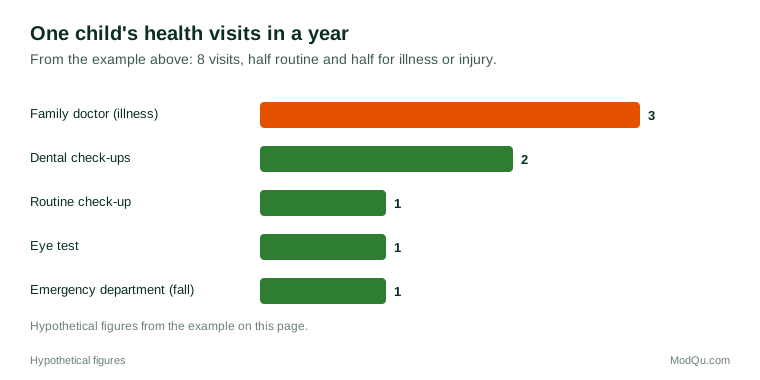
A parent counts their seven-year-old's health visits in a year: 1 routine check-up, 2 dental check-ups, 1 eye test, 3 visits to the family doctor for illness and 1 trip to an emergency department after a fall. That is 8 visits in total, of which 4 were routine (1 + 2 + 1) and 4 were for illness or injury.
Vaccinations
Most countries have a national childhood immunisation schedule, recommending vaccines at set ages from birth through the teenage years. Vaccines commonly given in childhood protect against diseases such as measles, mumps, rubella, polio, diphtheria, tetanus and whooping cough. The World Health Organization and UNICEF support immunisation programs worldwide.
Parents keep track through vaccination records, cards or digital records. Some fall behind because of missed appointments, moving house or country, illness, or difficulty getting time off work. Others have questions or concerns about vaccines, which they usually discuss with health professionals. Questions that health services and researchers want answered include whether children are up to date, and what makes it easier or harder for families to attend.
What parents worry about
When parents are asked what worries them most about their child's health, common answers include:
- Infections and illness, especially in babies.
- Diet and weight: picky eating, sugar, and being under or overweight.
- Sleep: getting enough, and bedtime problems.
- Screen time and its effect on sleep, activity and mood.
- Mental health: anxiety, stress, bullying and low mood, especially in older children.
- Physical activity: whether children move enough.
- Allergies and long-term conditions.
- Accidents and safety.
Worries change as children grow: parents of babies focus on feeding, sleep and illness, while parents of teenagers more often mention mental health, social media and risky behaviour.
Everyday health at home
Much of children's health is managed at home. Parents keep a basic medicine kit, take temperatures, manage minor cuts and bruises and watch for signs that an illness is getting worse. Many rely on telephone advice lines or pharmacists before visiting a doctor. Dental health depends heavily on daily tooth brushing and diet, and eye problems are often first noticed by parents or teachers. Sleep, diet and physical activity are everyday habits that parents influence, and many describe them as a constant source of negotiation with their children.
Long-term conditions and additional needs
Some children live with conditions that need ongoing care, such as asthma, type 1 diabetes, epilepsy, severe allergies or disabilities. Families often coordinate medicines, specialist appointments, school plans and equipment. Parents of children with additional needs report extra pressures on time, work and money, and differing levels of support depending on where they live.
Example
A ten-year-old with asthma uses an inhaler and has a written asthma plan. The parents share the plan with the school, keep a spare inhaler in the school office and book a yearly review with the asthma nurse. They also note which seasons make symptoms worse.
Trends and debates
- Children's mental health receives more attention than in the past, and many parents report long waits for services.
- Lifestyle: diet, physical activity and screen time are frequent topics of public health campaigns.
- Vaccine confidence varies between countries and communities.
- Access: shortages of paediatricians and children's services are reported in some regions.
- Digital health: online appointments and health apps are used more, and some parents find them convenient while others prefer in-person care.
Key terms
- PaediatricsThe branch of medicine that deals with children's health; spelled pediatrics in North America.
- Immunisation scheduleThe list of vaccines recommended at set ages.
- Check-upA routine visit to review a child's health, growth and development.
- Developmental milestoneA skill most children reach by a certain age, such as walking or first words.
- DehydrationLoss of more fluid than the body takes in, a risk with vomiting and diarrhoea.
- Asthma planA written plan describing a child's asthma medicines and what to do if symptoms worsen.
- ReferralA request from one health professional for a patient to see another.
- Health visitorA nurse or health worker who supports families with young children in some countries.
Full glossary: pediatrics terms on EditingTests.com.
Children's health vocabulary test
How well do you know the language of this topic? Try 8 quick questions. Your score is shown straight away and is not saved.
What the children's health survey asks
This survey is part of ModQu's Parenting and Children survey. The children's health part takes about five minutes and covers:
- How many times your child saw a doctor or other health professional last year, and why.
- Which health issues worry you most about your child.
- Whether your child's vaccinations are up to date, and what helps or hinders keeping them up to date.
- How easy it is to get an appointment for your child when they are ill.
- Whether your child has a long-term condition, and the support you receive.
- Where you look for information about children's health.
After that you can choose to continue with other short parts of the Parenting and Children survey, such as baby products and nappies or baby food and formula, or stop.
Ready to take part?
Your answers help show what people really think and do. Results are only ever reported as totals; no one can see your individual answers.
Start the surveyQuestions about this survey
Who can take part?
Parents of children under 16.
Do I have to give my name?
No. You may be asked for your age group, region and similar details so results can be broken down, but not your name. ModQu never asks for passwords, card numbers or account numbers.
How are the results used?
Answers are combined into totals and percentages and published in ModQu reports. Individual answers are never shown.
Is the vocabulary test part of the survey?
No. It is optional and separate, and your score is not stored.