
Share how you feed your baby
Tell us whether your baby has formula, whether you make baby food or buy it, and what matters most when you choose. Your answers are combined with other people's and reported only as totals.
Start the baby food and formula surveyAbout 5 minutes. No account needed. You can stop at any time.
Feeding in the first months
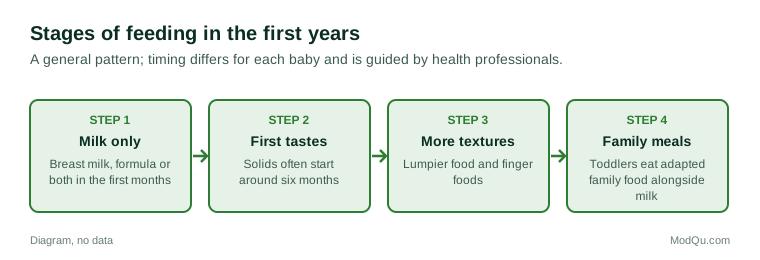
In the first months, babies live on milk: breast milk, infant formula, or a mix of both. The World Health Organization recommends exclusive breastfeeding for the first six months where possible, with breastfeeding continuing alongside other foods after that. National health services give their own guidance, which is broadly similar in many countries but differs in some details.
In practice, families feed babies in many ways:
- Exclusive breastfeeding, sometimes with expressed milk given from a bottle.
- Mixed feeding, combining breast milk and formula.
- Formula feeding, using infant formula from birth or after a period of breastfeeding.
- Donor milk, used in some hospitals, especially for premature babies.
The choice is shaped by health, work, family support, the baby's needs, culture and personal circumstances. Many parents describe strong feelings and pressure around this choice. This page describes the options; decisions about a particular baby's feeding are a matter for families and their health professionals.
Infant formula
Infant formula is a manufactured food designed to feed babies when breast milk is not used or not enough. In many countries it is tightly regulated, with rules on ingredients and labelling, and international guidance on how breast-milk substitutes may be marketed. Main types include:
- First infant formula, usually based on cow's milk, for babies from birth.
- Follow-on formula, marketed for older babies in some countries.
- Specialist formulas for particular medical needs, usually used on the advice of a health professional.
- Formats: powder to be mixed with water, and ready-to-feed liquid, which is more convenient but costs more.
Formula must be prepared following the instructions on the pack and national guidance on hygiene and water. Formula is a significant household cost, and shortages and price rises in some countries have caused real difficulty for families.
Example (hypothetical figures)
A family uses powdered formula at a cost of 14 per tin. One tin lasts about five days, so they buy about six tins a month (84). For a two-week holiday they buy ready-to-feed cartons for convenience at 1.50 each, using five a day: 7.50 a day, compared with about 2.80 a day for powder (14 ÷ 5).
Starting solid foods
Introducing solid food is often called weaning or complementary feeding. Many health bodies advise starting around six months, when babies show signs of readiness such as sitting up with support and showing interest in food. Approaches include:
- Spoon-feeding purées that become thicker and lumpier over time.
- Baby-led weaning, where babies feed themselves soft finger foods from the start.
- A mix of both, which is common.
Families also follow cultural traditions: first foods vary widely around the world, from rice porridge and lentils to mashed vegetables, fruit, fish and meat. Health bodies give advice on foods to avoid for young babies, introducing common allergens and avoiding choking hazards; parents usually get this from health workers and official guidance.
Home-made or shop-bought baby food
Once solids start, families choose between making food and buying it:
- Home-made: cooked and mashed or blended family food, often batch-cooked and frozen in small portions. Parents value knowing exactly what is in it, lower cost and getting babies used to family flavours.
- Shop-bought: jars, pouches, cereals and snacks. Parents value convenience, especially when travelling or working, and long shelf life.
Many families use both. Questions that businesses want answered include how often families use shop-bought food, which types (jars, pouches, cereals, snacks), and what they look for on the label.
Example
A parent who works full time batch-cooks vegetable and lentil purées on Sundays and freezes them in ice-cube trays. On busy weekdays and when visiting relatives, they use shop-bought pouches. They check labels for added sugar and salt before buying.
What parents look for when choosing baby food
Parents mention:
- Ingredients: short ingredient lists, no added sugar or salt, organic options.
- Nutrition: iron, vegetables and variety.
- Texture suitable for the baby's age.
- Price and portion size.
- Packaging: jars, pouches and the environmental impact of single-use packaging.
- Dietary needs: allergies, vegetarian or vegan diets, and halal or kosher requirements.
- Trust in the brand, often influenced by recalls or news stories.
Sources of advice
Parents get feeding advice from midwives, nurses, doctors, health visitors and community health workers, from family members (especially grandparents), from friends, books, websites, apps and social media. Advice from different sources can conflict, for example between grandparents' experience and current health guidance. Many parents say they find the volume of advice overwhelming.
Example
A first-time parent hears different advice about starting solids from a grandparent, a parenting app and a friend. They book an appointment at a community health clinic, where a nurse explains the current national guidance and signs of readiness, and they decide to start a few weeks later.
Costs and support
Feeding costs vary greatly. Breastfeeding has costs too, such as pumps, bottles and time, while formula is a continuing expense. Baby food adds to the weekly shopping. Some countries offer support such as vouchers for milk, fruit and vegetables for families on low incomes, or free vitamin drops for young children; eligibility rules differ.
Feeding toddlers
After the first year, most children eat family meals with some adjustments, alongside milk. Parents of toddlers often describe new challenges: fussy eating, refusing foods they used to like, eating very little one day and a lot the next, and wanting to feed themselves. Health services in many countries publish guidance on portion sizes, drinks and snacks for young children. Families also start buying toddler snacks, growing-up milks and children's meals, and some health professionals say many of these products are not needed.
Debates
- Breastfeeding pressure. Some parents feel judged whichever way they feed.
- Formula marketing. International rules restrict how breast-milk substitutes may be promoted; enforcement and compliance vary.
- Pouches and snacks. Some health professionals have raised concerns about sugar content and sucking food from pouches; makers and parents point to convenience.
- Organic and premium products. Parents disagree about whether these are worth the extra cost.
Key terms
- Exclusive breastfeedingGiving a baby only breast milk, with no other food or drink except medicines or vitamins.
- Infant formulaA manufactured food designed to feed babies, usually made from cow's milk.
- Mixed feedingFeeding a baby both breast milk and formula.
- WeaningIntroducing solid foods to a baby's diet, also called complementary feeding.
- Baby-led weaningAn approach where babies feed themselves soft finger foods from the start of solids.
- PuréeFood blended or mashed to a smooth texture.
- Expressed milkBreast milk removed by hand or pump to be fed later.
- AllergenA substance, such as egg or peanut, that can cause an allergic reaction.
Full glossary: nutrition science terms on EditingTests.com.
Baby food and formula vocabulary test
How well do you know the language of this topic? Try 8 quick questions. Your score is shown straight away and is not saved.
What the baby food and formula survey asks
This survey is part of ModQu's Parenting and Children survey. The baby food and formula part takes about five minutes and covers:
- How your baby is fed: breast milk, formula or both, and how that changed over time.
- Whether you make baby food at home, buy it, or both.
- What matters most when you choose formula or baby food.
- How much you spend on formula and baby food a month.
- At what age your baby started solids, and which approach you used.
- Where you get feeding advice, and which source you trust most.
After that you can choose to continue with other short parts of the Parenting and Children survey, such as baby products and nappies or children's health, or stop.
Ready to take part?
Your answers help show what people really think and do. Results are only ever reported as totals; no one can see your individual answers.
Start the surveyQuestions about this survey
Who can take part?
Parents of children under three.
Do I have to give my name?
No. You may be asked for your age group, region and similar details so results can be broken down, but not your name. ModQu never asks for passwords, card numbers or account numbers.
How are the results used?
Answers are combined into totals and percentages and published in ModQu reports. Individual answers are never shown.
Is the vocabulary test part of the survey?
No. It is optional and separate, and your score is not stored.