
Share how children affect your budget
Tell us how much your child costs a month, whether you save for their future and which costs are hardest to meet. Your answers are combined with other people's and reported only as totals.
Start the family budgets surveyAbout 5 minutes. No account needed. You can stop at any time.
What children cost
The cost of raising a child varies greatly by country, income, number of children and family choices. The main categories are:
- Housing: a larger home or extra room, and higher energy bills.
- Food: groceries, school lunches and snacks.
- Childcare: nurseries, daycare, childminders, nannies, after-school care and holiday care.
- Clothing and shoes, replaced often as children grow.
- Education: fees where schools charge, uniforms, supplies, devices, tutoring and trips.
- Health: medical, dental and eye care where these are not free, and medicines.
- Transport: a bigger car, car seats, fares and school transport.
- Activities and leisure: clubs, holidays, birthdays and toys.
- Technology: phones, data and devices.
- Pocket money and gifts.
Many countries publish official or academic estimates of the cost of raising a child. These depend heavily on what is included, and figures for one country cannot be applied to another.
How costs change with age
Costs tend to shift over childhood:
- Babies and toddlers: nappies, formula, equipment and, often the largest cost, childcare if parents work.
- Primary school age: childcare costs may fall, while food, clothes, activities and school costs rise.
- Teenagers: food, clothing, phones, transport, social activities and education costs are often highest.
- Young adults: many parents continue to support children through further education, housing or the start of working life.
Example
A family finds their monthly spending on their child falls when the child starts free full-time school at age five and no longer needs full-day childcare. By age thirteen, spending has risen again because of food, a phone contract, school trips and sports fees.
Income changes as well as costs
Children affect income too. A parent may reduce hours, take a career break or leave work to care for children, especially when childcare is expensive or unavailable. Parental leave pay varies widely between countries, from generous paid leave to little or none. Some parents return to work and find that childcare costs take up much of a second income.
Example (hypothetical figures)
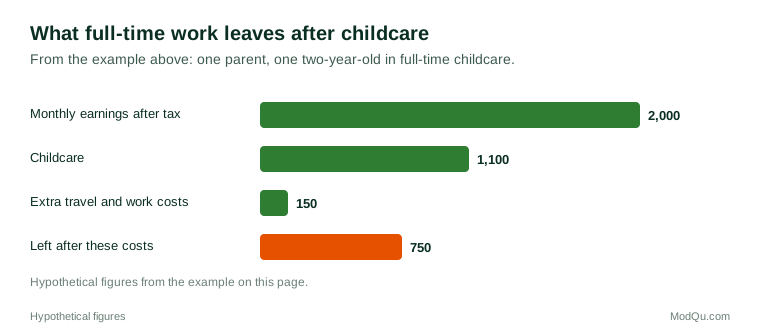
A parent earns 2,000 a month after tax for full-time work. Full-time childcare for their two-year-old costs 1,100 a month, and extra travel and work costs add 150. Working full time leaves them 750 a month better off (2,000 − 1,100 − 150). They decide to work four days a week, which cuts both earnings and childcare costs, and they keep their career progressing.
Saving for a child's future
Many parents save for their children, though not all can. Common goals include:
- further or higher education;
- a first home deposit or help with rent;
- a wedding or other major life event;
- an emergency fund for the child;
- a gift when the child reaches adulthood.
Ways to save include ordinary savings accounts, children's savings accounts, education savings plans with tax advantages in some countries, government-backed children's accounts in others, investments, and contributions from grandparents and other relatives. The options, rules and tax treatment differ widely between countries. This page describes; it does not give investment advice.
Money worries
When parents are asked which child-related costs are hardest to meet, common answers include childcare, housing, food, school costs and one-off expenses such as school trips or a broken phone. Families on low incomes, single-parent families and larger families are more likely to report difficulty. Rising prices for food and energy affect families with children strongly because these costs cannot easily be cut.
Families respond in different ways: cutting back on their own spending before children's, using savings, borrowing, getting help from relatives, or seeking support from government programs and charities.
Example
A single parent with two children keeps a simple monthly budget on paper. Rent, utilities and food are paid first. A small amount goes into an envelope each month for school trips and birthdays, so those costs no longer come as a surprise.
Extra costs at particular times of year
Family budgets face peaks during the year. Common ones include the start of the school year, festivals when gifts and new clothes are expected, birthdays, school holidays when childcare costs rise and children are at home more, and winter when energy bills may rise. Families often find these peaks harder to manage than regular monthly costs. Some save a little each month towards them, some use credit, and some cut back in other areas. Questions that businesses and policymakers want answered include which times of year put most pressure on family budgets and how families cope.
Support for families
Many governments provide financial support for families with children, such as:
- child benefits or family allowances paid per child;
- tax credits or tax allowances for children;
- subsidised or free childcare hours;
- free school meals and school clothing grants;
- parental leave pay;
- support for children with disabilities.
The amounts, rules and whether they are universal or income-tested differ greatly. Many families are unsure what they are entitled to, and some do not claim support they could receive.
Talking about money in the family
Families differ in how openly they talk about money with children. Some explain why the family cannot afford something, show children bills or involve them in planning a holiday budget. Others prefer to keep money worries away from children. Parents also differ on how much financial support to give adult children, for example help with university costs, rent or a first home. These choices are shaped by culture, family history and what parents can afford.
Budgeting habits
Families use many methods to manage money: monthly budgets, budgeting apps, spreadsheets, envelope systems, separate accounts for bills and spending, and regular family conversations about money. Some involve children in budgeting to teach them about money. Questions that banks, policymakers and family services want answered include how families budget, which costs they find hardest and what support they use.
Key terms
- Household budgetA plan for a household's income and spending.
- ChildcareCare for children by someone other than their parents, such as a nursery or childminder.
- Parental leaveTime off work to care for a new child, sometimes paid.
- Child benefitA regular government payment to families for each child, in some countries.
- Income-testedAvailable only to households below a set income.
- Education savings planA savings account or plan for a child's education, sometimes with tax advantages.
- Emergency fundMoney kept aside for unexpected costs.
- Envelope budgetingSetting aside set amounts of money for each type of spending.
Full glossary: financial planning terms on EditingTests.com.
Family budgets vocabulary test
How well do you know the language of this topic? Try 8 quick questions. Your score is shown straight away and is not saved.
What the family budgets survey asks
This survey is part of ModQu's Parenting and Children survey. The family budgets part takes about five minutes and covers:
- How much you estimate your child costs you a month, and the largest costs.
- Which child-related cost is hardest to meet.
- Whether you save for your child's future, and how.
- How having children changed your work and income.
- Which government or other support you receive, if any.
- How you budget, and whether you involve your children.
After that you can choose to continue with other short parts of the Parenting and Children survey, such as baby products and nappies or baby food and formula, or stop.
Ready to take part?
Your answers help show what people really think and do. Results are only ever reported as totals; no one can see your individual answers.
Start the surveyQuestions about this survey
Who can take part?
Parents.
Do I have to give my name?
No. You may be asked for your age group, region and similar details so results can be broken down, but not your name. ModQu never asks for passwords, card numbers or account numbers.
How are the results used?
Answers are combined into totals and percentages and published in ModQu reports. Individual answers are never shown.
Is the vocabulary test part of the survey?
No. It is optional and separate, and your score is not stored.
How much does it cost to raise a child?
It depends on the country, income, family choices and what is counted. Official estimates exist in many countries but cannot be applied elsewhere.
Where can families find out what support they can claim?
Government websites, local advice services, schools and charities can usually explain which benefits and programs apply.