
Share how you buy baby products
Tell us what you spend on nappies, which baby products you bought new and where you shop. Your answers are combined with other people's and reported only as totals.
Start the baby products and nappies surveyAbout 5 minutes. No account needed. You can stop at any time.
What baby products cover
Baby products are the goods parents and carers buy for children from birth to about three years old. The main groups are:
- Nappies (called diapers in North America) and changing supplies: wipes, creams, changing mats and nappy bins.
- Travel gear: car seats, prams, pushchairs (strollers), baby carriers and slings.
- Sleep: cots, cribs, bassinets, mattresses, sleeping bags and baby monitors.
- Feeding: bottles, sterilisers, breast pumps, high chairs, bibs and cups.
- Bathing and health: baby baths, thermometers, nail clippers and toiletries.
- Clothing: bodysuits, sleepsuits, hats and outdoor wear.
- Play and development: play mats, bouncers, toys and books.
- Safety: stair gates, socket covers and cupboard locks for when the baby starts moving.
Which items are seen as essential differs a great deal between cultures and households. Some families buy almost everything on the list; others manage with far less, using slings instead of prams or sharing a bed or room in ways that are traditional in their culture.
Nappies: disposable, reusable and costs
Nappies are one of the largest and most constant baby costs. A newborn may need many changes a day, falling as the child grows, and most children use nappies until they are two or three years old, sometimes longer.
The main types are:
- Disposable nappies, the most common in many countries, sold in sizes by the baby's weight.
- Reusable cloth nappies, washed and used again, either as all-in-one designs or as a cover with absorbent inserts.
- Hybrid systems with a reusable cover and disposable inserts.
- Training pants for children learning to use the toilet.
Parents choose based on cost, convenience, skin comfort, leaks and environmental concerns. Reusable nappies cost more at the start but can be used for more than one child; disposables cost less at first but must be bought continually. Some local councils and health services offer reusable nappy trials or discounts.
Example (hypothetical figures)
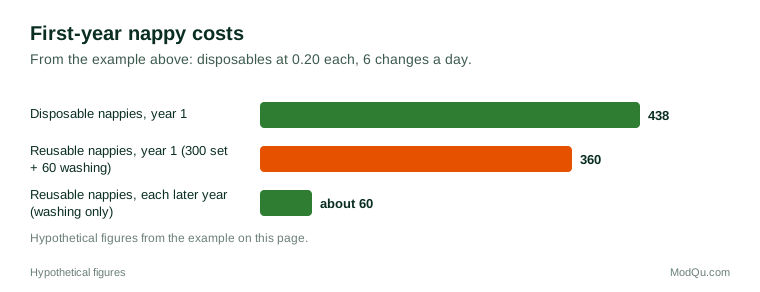
A parent estimates nappy costs for the first year. Disposable nappies at an average of 0.20 each, at 6 changes a day, cost 1.20 a day, or 438 for 365 days. A set of reusable nappies costs 300, plus about 60 a year for extra washing. The reusable option costs 360 in the first year (78 less), and only about 60 a year after that if used for a second child.
Big-ticket items: car seats, prams and cots
Car seats, prams and cots are usually the most expensive baby purchases, and the ones parents research most.
- Car seats are required by law for young children in vehicles in many countries. They are tested against national or regional standards, and seats are grouped by the child's height or weight. Rear-facing seats are recommended for babies in many countries.
- Prams and pushchairs range from simple folding strollers to travel systems where a car seat clips onto the frame. Parents weigh weight, folding size, terrain, storage and price.
- Cots and cribs must meet safety rules on bar spacing, mattress fit and materials in many countries. Public health bodies give advice on safe sleep for babies, including sleeping on the back in a clear cot.
Example
Parents who live in a third-floor flat with no lift choose a lightweight pushchair that folds with one hand, even though a heavier travel system was offered as a gift. They also buy a baby carrier for days when they need both hands on the stairs.
New or second-hand
Many baby items are used for only a few months, so second-hand buying, borrowing and passing items on are common. Parents often use second-hand for clothes, toys, baby baths, high chairs and prams.
Some items are commonly advised to be bought new or checked very carefully:
- Car seats, because a seat that has been in a crash may be damaged in ways that cannot be seen, and its history may be unknown.
- Cot mattresses, which health bodies in some countries advise buying new for each baby.
- Items with recalls, since older models may have been withdrawn for safety reasons.
Parents can check national product recall lists before using second-hand items.
Example
A family receives a pram, cot and high chair from relatives and buys a new car seat and a new cot mattress. They check the high chair's model number on their country's recall list and find a recall for the harness, so they order the free replacement part from the maker.
Where parents buy baby products
Baby products are sold through:
- supermarkets and pharmacies, especially for nappies, wipes and toiletries;
- specialist baby shops, which may offer car seat fitting and advice;
- department stores and large retailers with baby sections;
- online shops and marketplaces, often with subscriptions for nappies;
- second-hand shops, markets, online resale and local parent groups.
Many parents put together a baby registry or gift list so that relatives and friends can buy items they need. In some cultures gifts for a new baby are given at a baby shower before the birth; in others gifts are given only after the baby is born.
Costs and how parents manage them
The cost of baby products varies widely with choices and income. Parents keep costs down by buying second-hand, borrowing, using hand-me-downs, waiting for sales, buying own-brand or store-brand products, and limiting what they buy before the baby arrives. Some countries provide support such as baby boxes containing clothes and essentials, or grants and benefits for new parents, and eligibility differs widely.
Trends and debates
- How much is needed. Some parents feel pressure to buy many items; others take a minimal approach.
- Environmental impact of disposable nappies and plastic baby products.
- Smart baby products, such as connected monitors and sleep trackers, which some parents find reassuring and others find unnecessary or worrying.
- Safety information, since parents receive advice from many sources and it is not always consistent.
Key terms
- NappyAn absorbent garment worn by babies and toddlers; called a diaper in North America.
- Cloth nappyA reusable nappy made of fabric that is washed and used again.
- Travel systemA pram or pushchair frame that a car seat can clip onto.
- Rear-facing car seatA car seat in which the baby faces the back of the vehicle.
- BassinetA small bed for a newborn baby.
- Baby registryA list of items parents would like as gifts for a new baby.
- Product recallA request from a maker or authority to return or repair a product because of a safety problem.
- Safe sleep guidancePublic health advice on how babies should sleep to reduce risks.
Full glossary: consumer goods terms on EditingTests.com.
Baby products and nappies vocabulary test
How well do you know the language of this topic? Try 8 quick questions. Your score is shown straight away and is not saved.
What the baby products and nappies survey asks
This survey is part of ModQu's Parenting and Children survey. The baby products and nappies part takes about five minutes and covers:
- How much you spend on nappies and wipes a month, and which type you use.
- Which baby products you bought new, second-hand, borrowed or received as gifts.
- Where you buy baby products: supermarkets, specialist shops, online or second-hand.
- What mattered most when choosing a car seat, pram or cot.
- Which items you found most and least useful.
- How you checked the safety of second-hand items.
After that you can choose to continue with other short parts of the Parenting and Children survey, such as baby food and formula or children's health, or stop.
Ready to take part?
Your answers help show what people really think and do. Results are only ever reported as totals; no one can see your individual answers.
Start the surveyQuestions about this survey
Who can take part?
Parents of children under three.
Do I have to give my name?
No. You may be asked for your age group, region and similar details so results can be broken down, but not your name. ModQu never asks for passwords, card numbers or account numbers.
How are the results used?
Answers are combined into totals and percentages and published in ModQu reports. Individual answers are never shown.
Is the vocabulary test part of the survey?
No. It is optional and separate, and your score is not stored.