
Share your child's activities
Tell us which activities your child does after school, what they cost and how many hours they take. Your answers are combined with other people's and reported only as totals.
Start the children's activities and clubs surveyAbout 5 minutes. No account needed. You can stop at any time.
What children's activities cover
Children's activities are organised pastimes outside normal school lessons. They may take place at school after hours, at community centres, sports clubs, places of worship, private studios, libraries or online. Common kinds include:
- Sport: football, swimming, basketball, gymnastics, martial arts, athletics, cricket, tennis and many others.
- Music: instrument lessons, choirs, bands and orchestras.
- Dance and drama: ballet, hip-hop, cultural dance, theatre groups.
- Arts and crafts: drawing, painting, pottery and design.
- Academic and tutoring: extra maths or language lessons, test preparation, homework clubs.
- Science and technology: coding, robotics, chess and maths clubs.
- Youth organisations: scouting and guiding, cadets and youth groups.
- Religious and cultural classes: faith education, heritage language schools and cultural clubs.
- Outdoor activities: hiking clubs, camps and nature groups.
In some countries schools run many activities themselves; in others families rely on private providers and community groups.
Why parents choose activities
Parents give a range of reasons for enrolling children in activities:
- Enjoyment and the child's own interests.
- Physical health and fitness.
- Skills and talent, from swimming safety to music.
- Friendships and social confidence.
- Childcare: activities that cover the hours between school and the end of the working day.
- Academic progress and future opportunities, including school or university applications.
- Culture, faith and language, passing on heritage to the next generation.
- Keeping children busy and away from screens.
Example
A parent enrols their eight-year-old in swimming lessons because they want the child to be safe in water, and in a weekend heritage-language school so the child can talk with grandparents. The child also asks to join a friend's football team, so they try it for one term.
How families choose
The choice depends on more than interest. Families consider:
- Cost, including fees, uniforms, equipment, travel and competitions.
- Time and timing: whether sessions fit around work, other children's schedules and homework.
- Distance and transport: who will drive or accompany the child, and whether public transport works.
- Quality and safety: qualified coaches, safeguarding checks and good facilities.
- The child's preferences, which often change.
- Siblings, since activities that several children can attend at the same time are easier to manage.
Costs
Costs vary from free community programs to expensive private lessons and competitive sport. Typical costs include termly or monthly fees, registration and membership fees, equipment and uniforms, exam and competition entry fees, trips and camps, and the cost of transport.
Example (hypothetical figures)
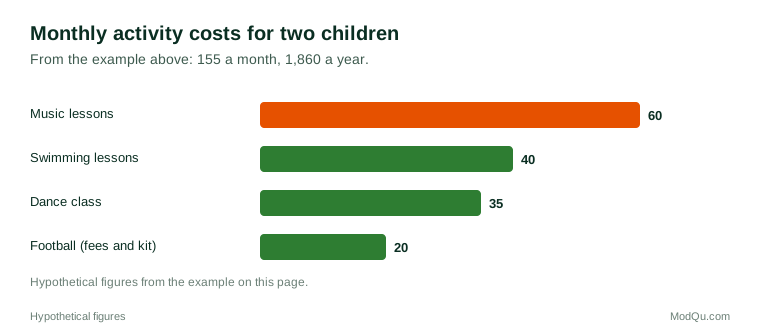
A family with two children pays monthly for: swimming lessons at 40, a dance class at 35, football at 20 (fees plus a share of the kit cost spread over the year) and music lessons at 60. That is 155 a month, or 1,860 a year (155 × 12) if all activities run every month. Music lessons are the largest single item at 60, about 39% of the monthly total.
Some governments, schools and charities help with costs through free school clubs, subsidised places, sports vouchers or tax relief on children's activities. Availability differs widely, and families on lower incomes often report that cost is the main reason children miss out.
Time and family schedules
Activities take time not only for children but for parents, who often drive, wait and attend competitions or performances. Children doing several activities may have something on most days of the week. Families report juggling schedules, especially with more than one child, and some use car-pooling with other parents to share the driving.
Example
Three families whose children attend the same Saturday sports club take turns driving. Each parent drives one week in three, saving two trips out of every three and giving them more free weekend mornings.
Holiday clubs and camps
School holidays raise a separate question for working parents. Holiday clubs, day camps, sports camps and residential camps fill some of the weeks when school is closed. They range from free community schemes to expensive specialist camps. Many parents combine camps with time off work, help from grandparents and shared care with other families. Costs for holiday care can be high, especially in long summer breaks, and places in popular schemes are often booked months ahead.
How much is too much?
Parents, teachers and researchers disagree about how many activities children should do:
- Some argue that structured activities build skills, confidence and discipline and keep children safe and active.
- Others warn of over-scheduling, saying children also need unstructured free play, rest and time with family, and that pressure can lead to stress or burnout.
- In competitive sport, there is debate about children specialising in one sport very young, compared with trying many.
- Some parents feel social pressure to sign children up for many activities to keep up with others.
Researchers often note that what suits one child may not suit another, and that the child's enjoyment matters.
Access and inequality
Access to activities is not equal. Children from lower-income families, rural areas or families without a car often have fewer options. Children with disabilities may find that clubs cannot meet their needs, though inclusive and adapted programs exist in many places. Girls and boys may be steered towards different activities. Questions that schools, councils and providers want answered include which children take part, what stops others, and which activities families would choose if cost were not a barrier.
Online and new activities
Online lessons in music, languages, coding and art grew in many countries and remain popular because they save travel time. New activities such as e-sports clubs, robotics and climbing have joined traditional options. Parents differ on whether online activities offer the same social and physical benefits as in-person ones.
Key terms
- Extracurricular activityAn organised activity outside normal school lessons.
- SafeguardingMeasures to protect children from harm, such as background checks on adults who work with them.
- TermA period of the school year, often used as the billing period for activities.
- Subsidised placeA place on an activity where part of the cost is paid by a school, council or charity.
- Over-schedulingFilling a child's time with so many activities that little free time remains.
- Unstructured playFree play that children direct themselves, without adult-set rules or goals.
- Car-poolingSharing car journeys between families to reduce driving.
- Heritage language schoolClasses that teach children the language of their family's culture.
Full glossary: childcare services terms on EditingTests.com.
Children's activities and clubs vocabulary test
How well do you know the language of this topic? Try 8 quick questions. Your score is shown straight away and is not saved.
What the children's activities and clubs survey asks
This survey is part of ModQu's Parenting and Children survey. The children's activities and clubs part takes about five minutes and covers:
- Which activities your child does after school and at weekends.
- How much the activities cost a month, including equipment and travel.
- How many hours a week they take, for your child and for you.
- Why you chose them, and who chose: you or your child.
- What stops your child doing more or different activities.
- Whether you think your child does too much, too little or about the right amount.
After that you can choose to continue with other short parts of the Parenting and Children survey, such as baby products and nappies or baby food and formula, or stop.
Ready to take part?
Your answers help show what people really think and do. Results are only ever reported as totals; no one can see your individual answers.
Start the surveyQuestions about this survey
Who can take part?
Parents of children aged 4 to 16.
Do I have to give my name?
No. You may be asked for your age group, region and similar details so results can be broken down, but not your name. ModQu never asks for passwords, card numbers or account numbers.
How are the results used?
Answers are combined into totals and percentages and published in ModQu reports. Individual answers are never shown.
Is the vocabulary test part of the survey?
No. It is optional and separate, and your score is not stored.
How many activities do children usually do?
It varies widely. Some children do none, others do several a week. Cost, time, transport and the child's interests all affect the number.
Are free activities available?
Many schools, libraries, councils, community centres and charities run free or low-cost clubs. What is available differs by area.