
Share your experience of budget travel
Tell us whether you travelled on a tight budget last trip, where you stayed and how you kept costs down. Your answers are combined with other people's and reported only as totals.
Start the budget and backpacker travel surveyAbout 5 minutes. No account needed. You can stop at any time.
What this topic covers
Budget travel means travelling for leisure while keeping costs as low as possible. Backpacker travel is one well-known form of it: usually longer trips, often through several places or countries, with luggage carried in a backpack, staying in hostels and other low-cost places and moving on when ready.
This topic covers:
- who travels on a budget and why;
- where budget travellers stay;
- how they get to and around their destinations;
- the ways they save on food, activities and other costs;
- how they plan, book and pay;
- the trade-offs in comfort, time and safety.
Budget travel is not only for young people. Students, workers taking a career break, couples, families and retirees all travel this way, for short weekends or trips of many months.
Who travels on a budget and why
People choose budget travel for different reasons:
- Limited money: it is the only way they can afford to travel.
- Longer trips: spending less each day lets them travel for longer.
- Experience: they want to meet other travellers and local people, and see places beyond the main tourist sights.
- Independence: they prefer to plan their own route instead of a package tour.
- Values: some prefer simple travel and dislike spending on luxury.
Well-known backpacker routes exist on every continent, often through places where daily costs are relatively low, and many travellers use them as a starting point.
Where budget travellers stay
Accommodation is often the largest daily cost, so budget travellers look at a wide range of options:
- Hostels, with shared dormitory rooms and shared kitchens and bathrooms. Many also offer private rooms, and some have women-only dormitories.
- Guesthouses and family-run lodgings, often simple and inexpensive.
- Budget hotels, with small private rooms and few extras.
- Short-term rentals of rooms or apartments, which can be good value for groups.
- Camping and campervans.
- Staying with friends or family.
- Hospitality exchange, where hosts offer free stays to travellers through online communities.
- Work exchange, where travellers work a few hours a day, for example at a hostel or farm, in return for a bed and meals. Rules on whether this counts as work differ between countries, and some require a work visa.
Example
Two friends on a three-week trip mix their accommodation. They stay in hostel dormitories in big cities to save money and meet people, book cheap private rooms in guesthouses in smaller towns to get some sleep, and take one overnight bus instead of paying for a night's accommodation.
Getting there and getting around
Transport choices make a big difference to cost:
- Low-cost airlines, which offer cheap fares but charge extra for checked bags, seat choice and other services.
- Buses and coaches, often the cheapest way between cities.
- Trains, including overnight trains that save a night's accommodation.
- Rail passes that cover many journeys in a region for one price.
- Shared rides organized through apps or noticeboards.
- Local public transport, walking and cycling in cities.
Booking early, travelling at off-peak times, being flexible with dates and carrying only hand luggage are common ways to keep transport costs down.
Common ways to save
Budget travellers use many methods to save money:
- Travelling in the off-season, when prices are lower.
- Choosing cheaper destinations, where food, transport and accommodation cost less.
- Cooking in hostel kitchens or eating at markets and street stalls.
- Free activities: walking tours that run on tips, parks, beaches, hiking and free museum days.
- City passes and student cards for discounts on attractions and transport.
- Avoiding currency and card fees by choosing cards with no foreign transaction fees.
- Packing light to avoid baggage charges.
- Setting a daily budget and tracking spending.
Example (hypothetical figures)
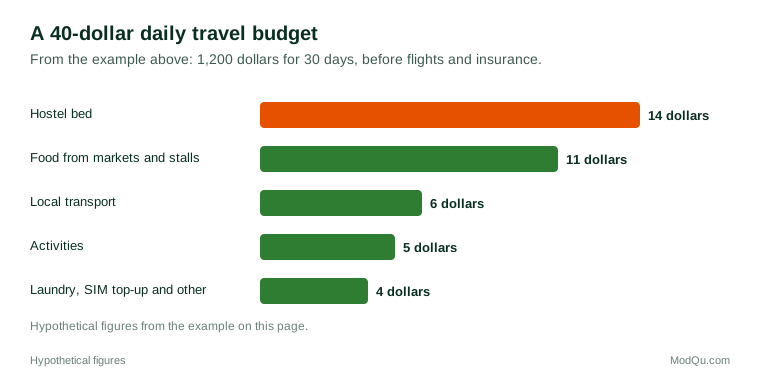
A traveller sets a daily budget of 40 dollars for a month-long trip. A typical day costs 14 dollars for a hostel bed, 11 dollars for food from markets and street stalls, 6 dollars for local transport, 5 dollars for activities and 4 dollars for other costs such as laundry and a SIM card top-up. That totals exactly 40 dollars, or 1,200 dollars for 30 days, before flights and insurance.
Figure 1 shows the daily budget from the example.
Planning, booking and paying
Some budget travellers plan every night in advance; others book only the first few nights and decide the rest on the way. Common tools and habits include:
- comparing prices on booking sites and then sometimes booking directly;
- reading reviews from other travellers, especially about cleanliness, safety and location;
- joining online groups and forums for advice on routes and costs;
- using offline maps and translation apps;
- carrying more than one bank card and some cash in case one fails;
- buying a local SIM card or an eSIM for mobile data.
Many budget travellers also decide whether to buy travel insurance. Some skip it to save money, which can leave them facing large bills if they become ill or are injured abroad.
Trade-offs and common problems
Saving money usually means giving something up. Common trade-offs and problems include:
- Comfort and sleep: noisy dormitories, long bus journeys and early flights.
- Time: cheaper routes are often slower.
- Hidden costs: baggage fees, tourist taxes, card fees and airport transfers.
- Safety and security: theft of belongings in shared rooms, scams that target travellers and travelling at night.
- Health: food and water safety, and the cost of medical care without insurance.
- Fatigue: long trips with constant planning can be tiring.
Example
A retired teacher travels for two months on a fixed pension. They book private rooms in guesthouses rather than dormitories because they value sleep, but save money by travelling slowly, staying a week in each place, cooking some meals and using local buses. They say slow travel made the trip cheaper and less tiring.
Trends and debates
Trends in budget travel include the growth of hostels with private rooms and better facilities, "digital nomads" who work online while travelling, and more interest in slow travel. Debates include the effect of large numbers of budget travellers on popular places, the fairness of work-exchange arrangements, and whether very cheap travel puts pressure on local wages and housing.
Questions that businesses want answered here include how much people spend per day, where they stay, how they choose transport, and which savings they use most.
Key terms
- BackpackerA traveller on a low budget, usually on a longer trip, carrying a backpack.
- HostelLow-cost accommodation with shared dormitories and shared facilities.
- DormitoryA shared room with several beds, rented by the bed.
- Low-cost airlineAn airline with cheap base fares that charges extra for bags and services.
- Off-seasonThe time of year when fewer people travel and prices are lower.
- Work exchangeWorking a few hours a day in return for accommodation and sometimes meals.
- Foreign transaction feeA charge for using a card in another currency.
- Slow travelStaying longer in fewer places to save money and see more of each place.
Full glossary: travel tourism terms on EditingTests.com.
Budget and backpacker travel vocabulary test
How well do you know the language of this topic? Try 8 quick questions. Your score is shown straight away and is not saved.
What the budget and backpacker travel survey asks
This survey is part of ModQu's Travel and Hospitality survey. The budget and backpacker travel part takes about five minutes and covers:
- Whether you travelled on a tight budget on your last leisure trip, and for how long.
- Where you stayed, and whether you have stayed in a hostel.
- How you travelled to and around your destination.
- Which methods you used to keep costs down.
- How much you spent per day, roughly, and on what.
- What you gave up to save money, and whether it was worth it.
After that you can choose to continue with other short parts of the Travel and Hospitality survey, such as holiday and leisure travel or air travel, or stop.
Ready to take part?
Your answers help show what people really think and do. Results are only ever reported as totals; no one can see your individual answers.
Start the surveyQuestions about this survey
Who can take part?
Adults who travelled for leisure in the last two years.
Do I have to give my name?
No. You may be asked for your age group, region and similar details so results can be broken down, but not your name. ModQu never asks for passwords, card numbers or account numbers.
How are the results used?
Answers are combined into totals and percentages and published in ModQu reports. Individual answers are never shown.
Is the vocabulary test part of the survey?
No. It is optional and separate, and your score is not stored.