
Share how loyal you are to brands
Tell us whether you buy the same brands every time, what made you switch recently and which brand you would never give up. Your answers are combined with other people's and reported only as totals.
Start the brand loyalty surveyAbout 5 minutes. No account needed. You can stop at any time.
What brand loyalty means
Brand loyalty is a tendency to keep buying the same brand over time rather than switching to others. It can be seen in two ways:
- Behavioural loyalty: what people actually do, such as buying the same brand repeatedly.
- Attitudinal loyalty: how people feel, such as liking a brand, trusting it and recommending it.
The two do not always match. Someone may buy the same brand of rice every week only because it is the one the local shop stocks, without feeling any attachment. Someone else may love a car brand but not have bought a car for ten years.
Loyalty also differs by category. Many people stay with one brand of phone, toothpaste, beer or coffee for years, but buy whatever is on offer for paper towels, batteries or tinned tomatoes.
Why people stay with a brand
Common reasons people give for buying the same brand include:
- Habit: it is easier not to think about the choice.
- Satisfaction: the product works and they see no reason to change.
- Trust and reduced risk: they know what they will get.
- Taste and preference, especially for food and drink.
- Switching costs: changing would take time, money or effort, as with phone systems, banks or software.
- Rewards: loyalty points, member prices or discounts.
- Identity: the brand says something about who they are, or links them to family, a sports team or a country.
- Availability: it is the brand their usual shop stocks.
Example
A man has bought the same brand of instant coffee for twenty years. He says he has "tried others" but always comes back. Asked when he last tried another, he cannot remember. His daughter points out that his mother always bought the same brand, and that its jar is the first he sees on the shelf.
Why people switch
People switch brands for many reasons:
- Price: a rise in price or a strong offer from a competitor.
- Out of stock: the usual brand is not available.
- Variety seeking: wanting to try something new, which is common for snacks, drinks and beauty products.
- A bad experience: a faulty product, poor service or a change in recipe.
- Life changes: moving, a new partner, a new baby or a health concern.
- Recommendations from friends, family or online reviews.
- Values: learning something about a company that people dislike, or finding a brand that better matches their values.
Example (hypothetical figures)
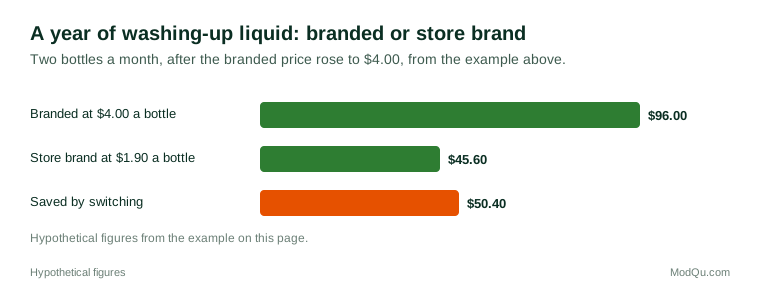
A household buys a branded washing-up liquid at $3.50 a bottle, about two bottles a month. The supermarket's own brand costs $1.90. After a price rise to $4.00, they switch. Over a year they spend $45.60 on the store brand instead of $96 on the branded product, saving $50.40. They say they would switch back only if the branded product went on offer.
Loyalty schemes and programs
Many companies run loyalty schemes to reward repeat buyers. Common types include:
- Points schemes, where purchases earn points that can be spent on rewards.
- Stamp or punch cards, such as "buy nine coffees, get the tenth free".
- Member prices, where scheme members get lower prices in shops.
- Tiered programs, where frequent customers reach levels with extra benefits, common with airlines and hotels.
- Paid memberships, where customers pay a fee for benefits such as free delivery.
Loyalty schemes also collect data on what people buy, which companies use to target offers. Some people value the rewards; others worry about privacy or feel that member prices punish people who do not sign up.
How loyal are people really?
Research on buying behaviour across many categories and countries has found that most buyers of a brand are not exclusively loyal to it. They buy a few brands in the category and switch between them, buying some more often than others. Larger brands tend to have more buyers and slightly more loyal ones, a pattern sometimes called "double jeopardy" for small brands, which have fewer buyers who also buy them less often.
This means that "100% loyal" customers are usually a small share of a brand's buyers. Much of a brand's sales come from occasional buyers who also buy competitors.
Example
A snack brand's loyalty card data shows that of its customers in a year, only a small group bought nothing but its crisps. Most bought it some of the time and two or three other brands at other times. The company shifts its focus from rewarding the most loyal buyers to reaching occasional buyers more often.
How loyalty is measured
Ways to measure loyalty include:
- Repeat purchase rate: the share of buyers who buy again within a period.
- Share of category requirements: the share of a person's purchases in a category that go to one brand.
- Retention and churn: how many customers stay or leave over a year, used for subscriptions and services.
- Survey questions on preference, likelihood to buy again and likelihood to recommend, such as the Net Promoter Score.
- Willingness to pay more or to wait for the brand rather than switch.
Survey answers about loyalty are useful but can differ from what people do. People often say they are loyal to brands they in fact switch between.
Loyalty in services and subscriptions
In services such as banking, insurance, phone plans, energy and streaming, "loyalty" is often a mix of satisfaction and inertia. Some companies charge existing customers more than new ones, a practice called the "loyalty penalty", which regulators in some countries have acted against, for example in home and car insurance. Customers who check prices and switch often pay less.
What people disagree about
People disagree about whether brand loyalty is a sensible way to save time and reduce risk or an expensive habit, whether loyalty schemes give real value or mainly collect data, whether companies should reward existing customers rather than offer the best deals to new ones, and whether marketers should focus on loyal customers or on reaching new ones.
Questions that brand owners, retailers, agencies and loyalty program operators want answered include which brands people buy every time, which they switch between, what made them switch recently, which loyalty schemes they use and which brands they would never give up.
Key terms
- Brand loyaltyA tendency to keep buying the same brand over time.
- Behavioural loyaltyLoyalty seen in repeated buying.
- Attitudinal loyaltyLoyalty seen in liking, trust and willingness to recommend.
- Switching costThe time, money or effort needed to change brands or providers.
- Variety seekingSwitching brands to try something new.
- Loyalty schemeA program that rewards repeat buying, often with points or member prices.
- ChurnThe share of customers who stop buying or cancel over a period.
- Loyalty penaltyCharging existing customers more than new customers for the same product.
Full glossary: loyalty platforms terms on EditingTests.com.
Brand loyalty vocabulary test
How well do you know the language of this topic? Try 8 quick questions. Your score is shown straight away and is not saved.
What the brand loyalty survey asks
This survey is part of ModQu's Brands and Advertising survey. The brand loyalty part takes about five minutes and covers:
- Whether you buy the same brands every time for everyday products, and in which categories.
- What made you switch brands most recently.
- Which loyalty schemes you use, and whether they change what you buy.
- Which brand you would never give up, and why.
- Whether you think companies treat loyal customers fairly.
After that you can choose to continue with other short parts of the Brands and Advertising survey, such as brand awareness or trust in brands, or stop.
Ready to take part?
Your answers help show what people really think and do. Results are only ever reported as totals; no one can see your individual answers.
Start the surveyQuestions about this survey
Who can take part?
Adults.
Do I have to give my name?
No. You may be asked for your age group, region and similar details so results can be broken down, but not your name. ModQu never asks for passwords, card numbers or account numbers.
How are the results used?
Answers are combined into totals and percentages and published in ModQu reports. Individual answers are never shown.
Is the vocabulary test part of the survey?
No. It is optional and separate, and your score is not stored.