
Share your indoor leisure outings
Tell us whether you have been to a bowling alley, arcade or escape room this year, who you went with and what you spent. Your answers are combined with other people's and reported only as totals.
Start the bowling, arcades and indoor fun surveyAbout 5 minutes. No account needed. You can stop at any time.
What indoor leisure venues cover
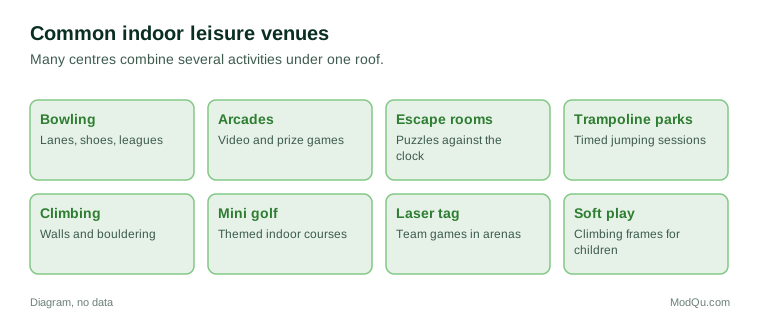
Indoor leisure venues are places people visit for fun, games and activities under one roof. Common types include:
- Bowling alleys, with ten-pin bowling in many countries and other forms, such as candlepin or duckpin bowling, in some regions.
- Arcades, with video games, driving and dance games, claw machines and prize games.
- Escape rooms, where groups solve puzzles to "escape" a themed room within a time limit.
- Trampoline parks.
- Indoor climbing and bouldering walls.
- Mini golf, often with themed or glow-in-the-dark courses.
- Laser tag and paintball arenas.
- Go-kart tracks, indoors in some places.
- Children's soft play centres.
- Virtual reality centres.
- Ice and roller rinks.
- Axe throwing, darts and shuffleboard venues, often combined with food and drink.
- Family entertainment centres, which combine several activities.
Who visits and why
Indoor venues attract a wide range of people:
- Families with children, especially at weekends and during school holidays.
- Teenagers and young adults, as a social outing.
- Friends and couples, for an evening out.
- Workplaces, for team-building and parties.
- Birthday and celebration groups.
- Leagues and regular players, for bowling, darts and similar games.
People choose these venues because they are weatherproof, suitable for mixed ages, and give a group something to do together rather than just eating or drinking.
Example
A parent is planning their child's tenth birthday party in winter. They book two bowling lanes and a party room at a local centre, which includes shoe hire, a meal for each child and a set of arcade tokens.
Bowling
Bowling has a long history in many countries and remains one of the most common indoor activities. A typical visit involves:
- Booking or turning up and paying per game or per hour, per lane or per person.
- Hiring special shoes, unless players bring their own.
- Choosing a ball by weight.
- Using bumpers, which block the gutters, for children or beginners.
- Electronic scoring, which keeps track automatically.
Many alleys have bars, restaurants and arcades. Bowling leagues meet regularly, and the sport is played competitively in many countries.
Arcades
Arcades have changed over the decades. Classic video game arcades were very popular in the 1980s in many countries. Today arcades often feature:
- Redemption games, where players win tickets to exchange for prizes.
- Claw and crane machines.
- Rhythm and dance games, especially popular in parts of Asia.
- Racing and shooting simulators.
- Retro gaming bars, with older games for adults.
- Card or app-based payment instead of coins.
In some countries, prize machines are regulated because of their similarity to gambling, and rules can set age limits and the value of prizes.
Example (hypothetical figures)
A family loads 30 in their local currency onto an arcade card. Each game costs 1.50, so the card covers 20 games. They win 600 tickets, which can be exchanged for a prize marked at 500 tickets. The shop price of a similar toy is about 6.
Escape rooms
Escape rooms became popular worldwide during the 2010s. A small group, often two to six people, is locked into a themed room and has a set time, often 60 minutes, to find clues and solve puzzles. A staff member watches and can give hints. Themes range from detective stories to science fiction. Escape rooms are popular for team-building and with friends who enjoy puzzles. Fire and safety rules in many places require that players can leave the room at any time.
Active venues
Trampoline parks, climbing walls and similar venues combine leisure with physical activity. They often require:
- Booking time slots.
- Safety briefings.
- Waivers or consent forms, sometimes signed by a parent for children.
- Special socks or equipment.
- Age or height limits.
Injury risks are higher than at bowling or arcades, and some countries have introduced safety standards for trampoline parks after reports of injuries.
Example
A group of teenagers book an hour at a trampoline park. Before jumping they watch a short safety video and are given grip socks. One of them sprains an ankle after trying a flip; staff provide first aid and fill in an incident report.
Costs and booking
Spending on indoor venues depends on the activity, group size and extras. Common costs include:
- Entry or session fees.
- Equipment or shoe hire.
- Food and drink, often a large part of spending.
- Party packages.
- Arcade credits.
- Memberships or passes for regular visitors.
- Booking fees.
Many venues offer off-peak prices, family deals and group discounts. Booking online in advance has become normal for many activities, especially escape rooms and trampoline parks.
Food, drink and parties
Food and drink are a large part of the business of many indoor venues. Bowling alleys and family entertainment centres often have restaurants, bars or snack counters, and party packages usually include a meal. Some venues for adults focus as much on drinks and food as on the games. Families sometimes find that extras such as snacks, arcade credits and prize games double the cost of the main activity.
Trends and debates
Current trends include:
- "Competitive socializing" venues, which combine games such as darts, mini golf or shuffleboard with food and drinks for adults.
- Virtual reality and immersive experiences.
- Retro and nostalgia themes.
- Shopping centres adding leisure venues as retail space changes.
- Accessibility, such as quieter sessions for people with sensory needs.
- Prices, with debate about the cost of a family outing.
What people and businesses want to know
Questions businesses want answered include how often people visit indoor leisure venues, which ones, who they go with, what they spend on activities, food and extras, how they book, and what would make them visit more often.
Key terms
- Ten-pin bowlingA form of bowling with ten pins arranged in a triangle.
- BumpersBarriers that block the gutters on a bowling lane.
- Redemption gameAn arcade game that rewards players with tickets for prizes.
- Escape roomA themed room where a group solves puzzles within a time limit.
- BoulderingClimbing short walls without ropes, over padded floors.
- WaiverA form people sign to show they accept certain risks.
- Off-peakTimes of lower demand, often with lower prices.
- Family entertainment centreA venue combining several leisure activities.
Full glossary: amusement ride engineering terms on EditingTests.com.
Bowling, arcades and indoor fun vocabulary test
How well do you know the language of this topic? Try 8 quick questions. Your score is shown straight away and is not saved.
What the bowling, arcades and indoor fun survey asks
This survey is part of ModQu's Leisure and Lifestyle survey. The bowling, arcades and indoor fun part takes about five minutes and covers:
- Whether you have been to a bowling alley, arcade, escape room or similar venue in the last year, and which ones.
- How often you go, and who you go with.
- How much you spent on your last visit, including food, drink and extras.
- How you booked and paid.
- What you enjoy most, and what puts you off going more often.
- Which new types of indoor venue you would like to try.
After that you can choose to continue with other short parts of the Leisure and Lifestyle survey, such as gambling and lotteries or cannabis, or stop.
Ready to take part?
Your answers help show what people really think and do. Results are only ever reported as totals; no one can see your individual answers.
Start the surveyQuestions about this survey
Who can take part?
Adults.
Do I have to give my name?
No. You may be asked for your age group, region and similar details so results can be broken down, but not your name. ModQu never asks for passwords, card numbers or account numbers.
How are the results used?
Answers are combined into totals and percentages and published in ModQu reports. Individual answers are never shown.
Is the vocabulary test part of the survey?
No. It is optional and separate, and your score is not stored.
Do I need to book in advance?
Many venues accept walk-ins at quiet times, but escape rooms, trampoline parks and busy weekend bowling sessions often need booking, sometimes days ahead.
Are indoor venues suitable for people with disabilities?
Many venues offer step-free access, ramps for bowling balls, quiet sessions and carer discounts. Facilities vary, so people often check with the venue first.
What is a typical age limit?
Rules differ by activity and venue. Soft play is usually for young children, while escape rooms and some arcades set minimum ages or require an adult for younger players.