
Tell us about your personal care routine
Tell us which products you use, where you buy them and what makes you try something new. Your answers are combined with other people's and reported only as totals.
Start the beauty and personal care surveyAbout 5 minutes. No account needed. You can stop at any time.
What beauty and personal care covers
Beauty and personal care is a broad category. It includes:
- skin care: cleansers, moisturizers, sunscreen, serums and treatments;
- hair care: shampoo, conditioner, styling products, hair colour and tools;
- makeup: foundation, mascara, lipstick and other cosmetics;
- fragrance: perfume, cologne and scented body products;
- personal hygiene: soap, body wash, deodorant, oral care and feminine care;
- grooming and shaving: razors, shaving products and beard care;
- nail care and bath and body products.
People of all genders use personal care products. Men's grooming has grown as a category, with more products for skin care and beard care marketed to men.
How people choose products
Common reasons for choosing a product include:
- past experience and habit;
- price and value;
- suitability for skin type, hair type or skin tone;
- recommendations from friends, family and online reviews;
- advice from pharmacists, dermatologists or store staff;
- ingredients, including what is left out;
- scent, texture and packaging;
- brand reputation and values, such as cruelty-free testing.
Many people stay with the same basic products for years, such as a deodorant or toothpaste, while trying new products more often in categories such as skin care and makeup.
Example
A man in his forties had used the same bar soap for twenty years. After his skin became dry in winter, a pharmacist suggested a fragrance-free cleanser and moisturizer. He now buys both at the pharmacy every two months and says he had never thought about skin care before.
Where people buy
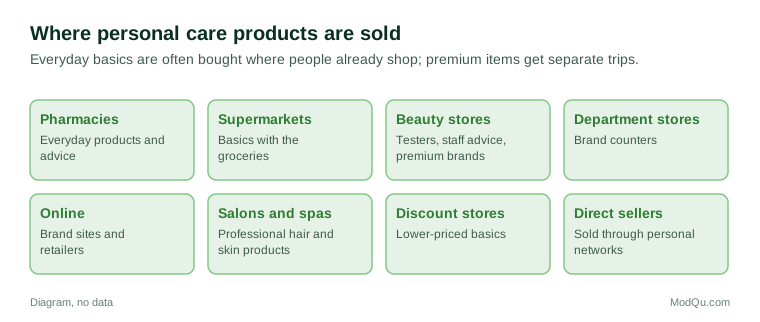
Personal care products are sold through many channels:
- pharmacies and drugstores, among the most common places to buy everyday products;
- supermarkets and mass merchandisers, for basics;
- beauty specialty stores, with testers, staff advice and premium brands;
- department stores, with brand counters;
- brand websites and online retailers;
- salons and spas, for professional hair and skin products;
- dollar stores and discount stores;
- direct sellers, who sell through personal networks.
Shoppers often buy everyday products where they already shop for groceries or prescriptions, and make separate trips or online orders for premium skin care, makeup and fragrance.
Ingredients and safety
Many shoppers check ingredients, particularly people with sensitive skin, allergies or concerns about certain chemicals. Common interests include fragrance-free, paraben-free and sulfate-free products, "clean" or "natural" beauty, and products for sensitive skin.
In Canada, cosmetics are regulated by Health Canada under the Food and Drugs Act and the Cosmetic Regulations. Ingredients must be listed on the label, and certain substances are prohibited or restricted. Some products that make health claims, such as sunscreens, anti-dandruff shampoos and fluoride toothpastes, are regulated as drugs or natural health products and carry a product number.
Terms such as "clean", "natural" and "non-toxic" have no single legal definition in cosmetics marketing, which can make comparison difficult.
The influence of social media
Social media has changed how people discover beauty products. Tutorials, reviews, "get ready with me" videos and creator recommendations reach large audiences, and some products sell out after going viral. Younger shoppers in particular say they learn about products this way.
Paid partnerships are common, and rules require them to be disclosed. Many shoppers say they trust creators who show real results and mention downsides, and distrust posts that look like advertising.
Example
A university student sees a moisturizer recommended in several short videos. She checks the reviews, finds the price is reasonable and buys it. It irritates her skin, and she learns from a pharmacist that it contains a fragrance ingredient that bothers some people. She now reads the ingredient list before buying a product she has seen online.
Spending and value
Spending on personal care varies widely. Some people spend very little and buy mainly basics; others spend a large amount on premium products, treatments and services. Shoppers trade up in some categories and down in others.
Example (hypothetical figures)
A shopper spends about $60 a month on personal care: $25 on basics such as shampoo, deodorant and toothpaste, $20 on skin care and $15 on makeup. Over a year that is $720. When she switches her basics to store brands, she saves about $8 a month, or $96 a year, and keeps her skin care unchanged.
Sustainability and packaging
Personal care products create a lot of packaging, much of it plastic and hard to recycle. Some brands now offer refills, concentrated products, solid shampoo bars and recyclable packaging. Shoppers say they like these options but often choose on price and performance first. Questions about animal testing, palm oil and the working conditions of ingredient suppliers also matter to some buyers.
Services: salons, barbers and spas
Personal care also includes services: haircuts, colouring, manicures, facials, waxing and massage. Many people stay with the same hairstylist or barber for years. Price, skill, convenience and a good relationship are the main reasons people choose and stay.
Men's grooming
The market for men's grooming has grown beyond razors and shaving cream to include skin care, beard care, hair styling and fragrance. Some men buy products designed for men; others use products marketed to everyone. Barbershops have also seen renewed interest.
Inclusive beauty
Shoppers with darker skin tones and textured hair have long reported that mainstream ranges did not meet their needs. More brands now offer wider shade ranges and products for different hair types, and shoppers say representation in advertising matters to them.
What brands and retailers want to know
Brands, retailers and salons want to understand where people buy personal care products, how much they spend, how they choose brands, how much ingredients matter, how social media affects purchases and how loyal shoppers are.
Key terms
- CosmeticA product used to cleanse, improve or change the appearance of the skin, hair or teeth.
- Ingredient listThe list of a product's ingredients printed on the label, required for cosmetics in Canada.
- Fragrance-freeA product with no added fragrance.
- Cruelty-freeA claim that a product was developed without animal testing.
- DermatologistA medical doctor who specializes in skin, hair and nails.
- Paid partnershipA social media post that a brand has paid for or supported.
- RefillA product sold to refill an existing container, reducing packaging.
- SPFSun protection factor, a measure of how well a sunscreen protects against UVB rays.
Full glossary: personal care products terms on EditingTests.com.
Beauty and personal care vocabulary test
How well do you know the language of this topic? Try 8 quick questions. Your score is shown straight away and is not saved.
What the beauty and personal care survey asks
This survey is part of ModQu's Shopping and Retail survey. The beauty and personal care part takes about five minutes and covers:
- Which personal care products you buy most often, and for whom.
- Where you buy most of your personal care products.
- Whether you check ingredients before you buy, and what you look for.
- Whether you have bought a product because of a social media post.
- How much you spend in a typical month, and where you would cut back.
- Which brands you stay loyal to, and why.
After that you can choose to continue with other short parts of the Shopping and Retail survey, such as online shopping or groceries and food shopping, or stop.
Ready to take part?
Your answers help show what people really think and do. Results are only ever reported as totals; no one can see your individual answers.
Start the surveyQuestions about this survey
Who can take part?
Adults who buy beauty or grooming products.
Do I have to give my name?
No. You may be asked for your age group, region and similar details so results can be broken down, but not your name. ModQu never asks for passwords, card numbers or account numbers.
How are the results used?
Answers are combined into totals and percentages and published in ModQu reports. Individual answers are never shown.
Is the vocabulary test part of the survey?
No. It is optional and separate, and your score is not stored.